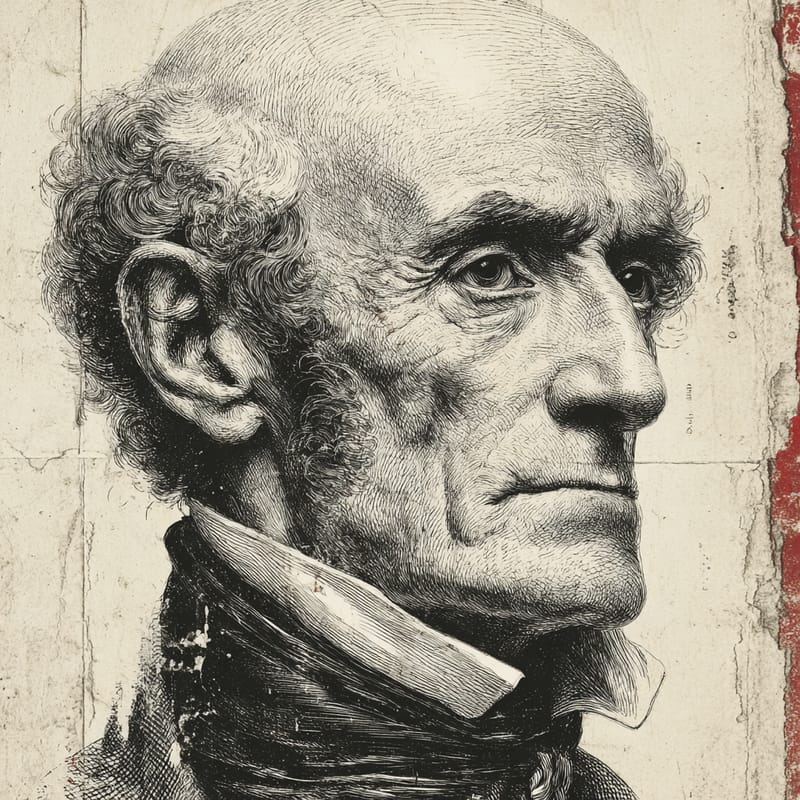
John Stuart Mill
On liberty
The harm principle and the freedom of the individual.
Reformist Classical LiberalOne of 729 ideologies · enter the Classical Liberal hall →- Role
- Philosopher & MP
- Era
- 1806–1873
- Region
- United Kingdom
- Social band
- Reformist
- Placement
- +45 · −55 · +60
§ Where John Stuart Mill stands
3 axesMill's Principles of Political Economy (1848) defended competition and free trade and became the leading economics textbook of its age, yet it held that the distribution of wealth is a matter of human choice rather than natural law. Later editions warmed to worker cooperatives, and in 1870 he helped found the Land Tenure Reform Association to tax the unearned increase in land values, a market liberal with egalitarian sympathies.
On Liberty (1859) held that power may rightly be exercised over anyone against their will only to prevent harm to others, and it warned against the tyranny of the majority as well as of governments. In Considerations on Representative Government (1861) he backed proportional representation, yet he also proposed extra votes for the educated and accepted paternal rule over colonies, which limits his libertarianism.
Mill was strikingly progressive for his age. He moved an amendment to the 1867 Reform Bill replacing 'man' with 'person' to enfranchise women, published The Subjection of Women in 1869, backed the Union against the slaveholding Confederacy and chaired the Jamaica Committee that sought to prosecute Governor Edward Eyre after the 1865 Morant Bay repression. On Liberty attacked the despotism of custom itself.
How close are you to John Stuart Mill?
Three statements, one per axis. Answer them and we’ll drop you on the compass next to them.
§ The story
HistoricalJohn Stuart Mill (1806–1873) was an English philosopher, economist and Liberal politician, born in London and educated at home by his father, James Mill, in an experiment that had him learning Greek at three. Raised as a disciple of Jeremy Bentham's utilitarianism, he suffered a mental crisis in 1826 that led him to broaden it. He worked for the East India Company from 1823 to 1858 while writing A System of Logic (1843) and Principles of Political Economy (1848), and sat as MP for Westminster from 1865 to 1868.
Mill's On Liberty (1859), dedicated to his late wife Harriet Taylor Mill, whom he credited as co-author, set out the harm principle and remains the classic defence of free speech and individual freedom. In 1867 he moved the first women's suffrage amendment in the Commons, and The Subjection of Women (1869) argued for full legal equality of the sexes. His record also includes a lifelong defence of British rule in India and his claim in On Liberty that despotism is a legitimate way of governing barbarians if it aims at their improvement.
Notable for
- 01'On Liberty' (1859)
- 02'The Subjection of Women'
- 03The harm principle
Key works & moments
- 1848Publishes Principles of Political Economy, the leading economics textbook for decades.
- 1859Publishes On Liberty, setting out the harm principle.
- 1861Publishes Considerations on Representative Government and, in Fraser's Magazine, Utilitarianism.
- 1865Elected Liberal MP for Westminster, serving until 1868.
- 1867Moves the first Commons amendment for women's suffrage; it is defeated by 196 votes to 73.
- 1869Publishes The Subjection of Women.
In their own words
“That the only purpose for which power can be rightfully exercised over any member of a civilised community, against his will, is to prevent harm to others.”
“If all mankind minus one, were of one opinion, and only one person were of the contrary opinion, mankind would be no more justified in silencing that one person, than he, if he had the power, would be justified in silencing mankind.”
§ Minds closest to John Stuart Mill
All minds →




§ Also in the Classical Liberal hall
Enter the hall →§ Common questions
4 answersWhat was John Stuart Mill's political ideology?
John Stuart Mill was a liberal and utilitarian reformer: on the 99ideologies three-axis compass, a Reformist Classical Liberal. Economically he leaned clearly to the market (+45), defending competition and free trade while backing cooperatives, limits on inheritance and the taxation of rising land values. On governance he was strongly libertarian (−55), holding that power over individuals is justified only to prevent harm to others. Socially he was progressive (+60), championing women's suffrage, free expression and the abolition of slavery.
Was John Stuart Mill left-wing or right-wing?
A left-liberal by the standards of his time. Mill sat as a Liberal MP, pressed for votes for women and working men, opposed slavery and imperial brutality in Jamaica and grew sympathetic to cooperative socialism. But he remained committed to competition, private property and free trade, and his deepest fear was conformity imposed by the state or by public opinion. Classical liberals and modern progressives both claim him, which reflects his position between the two.
What is John Stuart Mill's harm principle?
The harm principle, set out in On Liberty (1859), holds that the only legitimate reason for society or the state to restrict a person's freedom against their will is to prevent harm to others. A person's own good, physical or moral, is not enough, so conduct that concerns only oneself should be left free even if others find it foolish or immoral. Mill applied it to speech, ways of life and religion, though he exempted children and, controversially, societies he considered backward. It remains the most cited test in debates about personal liberty.
Which minds are closest to John Stuart Mill?
On the 99ideologies three-axis compass, the minds closest to John Stuart Mill are John Perry Barlow (92% alike), Edward Snowden (91% alike) and Glenn Greenwald (91% alike). The furthest is Gregor Strasser (7% alike).