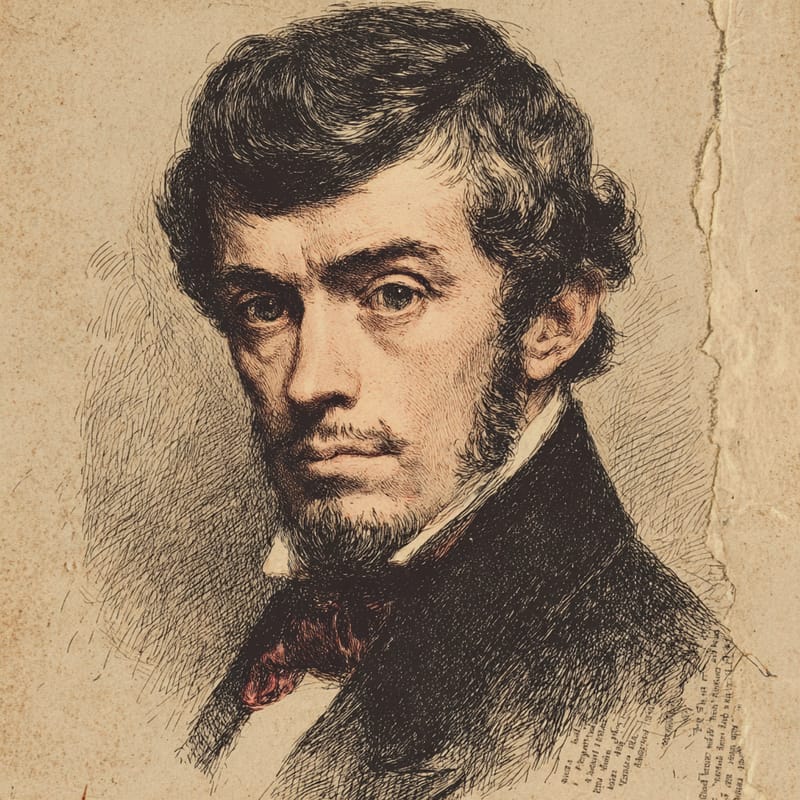
Alexis de Tocqueville
Liberty against soft despotism
Civil association as the school of freedom.
Classical LiberalOne of 729 ideologies · enter the Classical Liberal hall →- Role
- Political thinker
- Era
- 1805–1859
- Region
- France
- Social band
- Centre (no modifier)
- Placement
- +48 · −45 · −10
§ Where Alexis de Tocqueville stands
3 axesTocqueville defended private property and commerce as supports of independence, and in his 1835 Memoir on Pauperism he warned that England's legal right to public relief bred dependence. In September 1848 he spoke against writing a right to work into the new constitution, arguing that socialism sought equality in servitude, though he favoured voluntary charity as a remedy for distress.
Tocqueville prized decentralisation, local self-government, free associations, juries and a free press as barriers against both the tyranny of the majority and the centralising state, as he argued in Democracy in America (1835–40). He opposed Louis-Napoléon's coup of 1851 and was briefly arrested for it. Yet he backed forceful state action in the conquest of Algeria, which tempers his liberalism.
An aristocrat by birth, Tocqueville believed religion and settled mores were indispensable to free societies, arguing in Democracy in America that Americans' faith restrained the passions democracy unleashes. Yet he was no reactionary: his 1839 parliamentary report backed the abolition of slavery in the French colonies, achieved in 1848, and he championed prison reform, which leaves him just on the traditional side.
How close are you to Alexis de Tocqueville?
Three statements, one per axis. Answer them and we’ll drop you on the compass next to them.
§ The story
HistoricalAlexis de Tocqueville (1805–1859) was a French political thinker, historian and politician, born in Paris into an old Norman aristocratic family that had lost members to the guillotine. Trained as a magistrate, he travelled through the United States in 1831–32 with Gustave de Beaumont to study its prisons, and turned the journey into Democracy in America (1835 and 1840). He sat in the Chamber of Deputies from 1839 and served briefly as foreign minister in 1849 under the Second Republic.
Democracy in America argued that equality of conditions was the irresistible trend of the modern world and asked how liberty could survive it, praising American associations, local self-government and juries while warning of the tyranny of the majority and a mild, tutelary despotism. In January 1848 he told the Chamber that France was sleeping on a volcano, weeks before revolution. He opposed Louis-Napoléon's 1851 coup, retired to write The Old Regime and the Revolution (1856), and has drawn later criticism for championing the brutal conquest of Algeria.
Notable for
- 01'Democracy in America'
- 02Theory of the tyranny of the majority
- 03Analysis of civic association
Key works & moments
- 1831–32Tours the United States with Gustave de Beaumont to study American prisons.
- 1835Publishes the first volume of Democracy in America; the second follows in 1840.
- 1839Elected to the Chamber of Deputies; reports in favour of abolishing slavery in French colonies.
- 1848Warns in January that France is sleeping on a volcano; helps draft the Second Republic's constitution.
- 1849Serves as foreign minister under President Louis-Napoléon Bonaparte.
- 1856Publishes The Old Regime and the Revolution.
In their own words
“Americans of all ages, all conditions, and all dispositions, constantly form associations.”
“Above this race of men stands an immense and tutelary power, which takes upon itself alone to secure their gratifications, and to watch over their fate.”
§ Minds closest to Alexis de Tocqueville
All minds →

§ Also in the Classical Liberal hall
Enter the hall →§ Common questions
4 answersWhat was Alexis de Tocqueville's political ideology?
Alexis de Tocqueville was an aristocratic liberal who accepted democracy and sought to keep it free: on the 99ideologies three-axis compass, a Classical Liberal. Economically he sat on the market side (+48), defending property and opposing socialism and a legal right to work. On governance he was anti-centralist (−45), prizing local self-government, associations and checks on majority rule. Socially he leaned slightly traditional (−10), seeing religion and settled mores as foundations of a free society.
Was Alexis de Tocqueville left-wing or right-wing?
Neither, and both now claim him. In his own day he was a liberal who accepted democracy as inevitable, supported the abolition of slavery and prison reform, and opposed both reactionaries and Louis-Napoléon's dictatorship. Yet he resisted socialism in 1848, feared the centralising state and valued religion and tradition. Conservatives cite his warnings about soft despotism, while liberals and communitarians cite his praise of civic association, which reflects his place between the camps.
What did Tocqueville mean by the tyranny of the majority?
He meant that democracy can oppress minorities as surely as kings can. In Democracy in America (1835) Tocqueville argued that in the United States the majority controlled legislatures, juries and public opinion, so a dissenter had nowhere to appeal; worse, its pressure worked on the mind, discouraging independent thought without any law being passed. He saw local self-government, associations, the press, independent courts and lawyers as the main counterweights. John Stuart Mill later took up the idea in On Liberty.
Which minds are closest to Alexis de Tocqueville?
On the 99ideologies three-axis compass, the minds closest to Alexis de Tocqueville are William Gladstone (98% alike), John Locke (97% alike) and Ludwig von Mises (94% alike). The furthest is Pol Pot (13% alike).