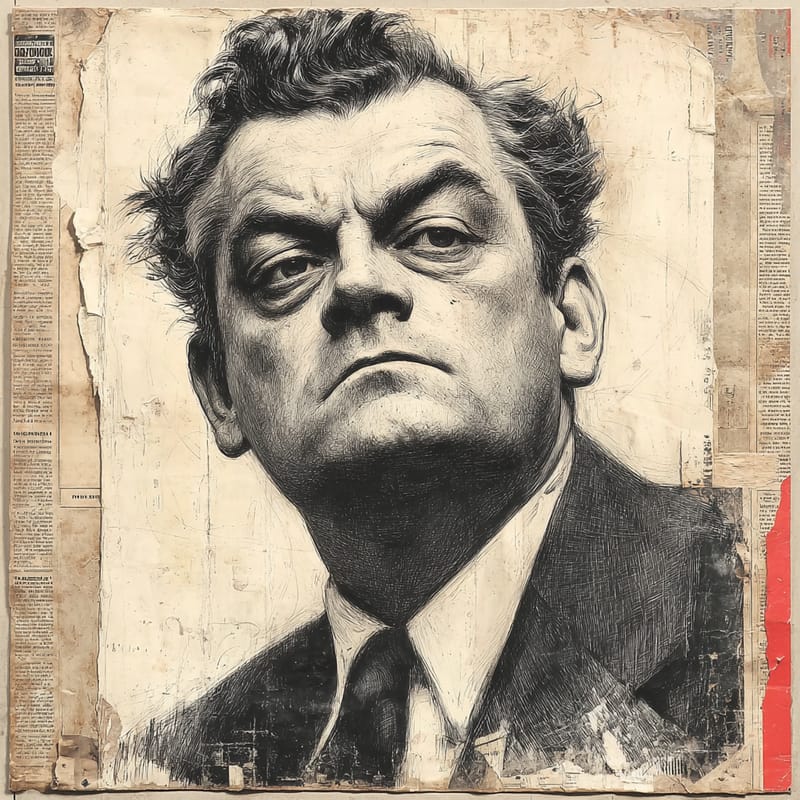
Gregor Strasser
The 'socialism' in National Socialism
Anti-capitalist totalitarian nationalism.
Restorationist StrasseriteOne of 729 ideologies · enter the Strasserite hall →- Role
- Nazi organiser
- Era
- 1892–1934
- Region
- Germany
- Social band
- Restorationist
- Placement
- −52 · +92 · −92
§ Where Gregor Strasser stands
3 axesStrasser championed the party's anti-capitalist current. His northern faction drafted a programme in 1925–26 that went further than Hitler on nationalisation, and in his Reichstag speech of 10 May 1932 he called for state-financed job creation to answer the people's anti-capitalist longing, though like other Nazis he rejected Marxist class struggle and defended small property.
Strasser was an architect of the totalitarian party rather than a dissenter from it. As Reich organisation leader from 1928 he built a centralised hierarchy of regional Gaue and specialised offices that the party later used to coordinate the state, and he took part in the armed Beer Hall Putsch of 1923; his break with Hitler was over tactics, not dictatorship.
Strasser shared the Nazi movement's racial nationalism and antisemitism. He joined a party whose 1920 programme excluded Jews from citizenship, and his socialism was explicitly national, aimed at a racially defined community of Germans rather than at workers of all nations, which places him at the traditional extreme of the compass.
How close are you to Gregor Strasser?
Three statements, one per axis. Answer them and we’ll drop you on the compass next to them.
§ The story
HistoricalGregor Strasser (1892–1934) was the Nazi Party's chief organiser and the leading figure of its anti-capitalist wing. A pharmacist from Bavaria and a decorated officer in the First World War, he joined the party in the early 1920s, led stormtroopers from Landshut in the 1923 Beer Hall Putsch and entered the Reichstag in 1924. While Hitler was in prison and afterwards, he built the party in northern Germany, with the young Joseph Goebbels as his assistant, and as Reich organisation leader from 1928 he created its national machine.
Strasser gave voice to the party's anti-capitalist rhetoric, notably in a May 1932 Reichstag speech on the German people's anti-capitalist longing, and he favoured compromise to win power. When Chancellor Kurt von Schleicher offered him the vice-chancellorship in December 1932, Hitler refused to let him accept, and Strasser resigned all his party offices on 8 December and withdrew from politics. He did not escape Hitler's suspicion: on 30 June 1934, during the Night of the Long Knives, he was seized in Berlin and shot in a cell at Gestapo headquarters.
Notable for
- 01Led the Nazi 'left' wing
- 02Built the party organisation
- 03Killed in the Night of the Long Knives
Key works & moments
- 1923Leads stormtroopers from Landshut into Munich during the failed Beer Hall Putsch.
- 1924Elected to the Reichstag and keeps the movement going while Hitler is imprisoned.
- 1926Hitler overrules his northern faction's draft programme at the Bamberg conference.
- 1928Becomes Reich organisation leader, building the party's national machine.
- 1932Resigns all party offices in December after Hitler vetoes a deal with Chancellor Schleicher.
- 1934Murdered in Gestapo custody in Berlin during the Night of the Long Knives.
§ Minds closest to Gregor Strasser
All minds →

§ Also in the Strasserite hall
Enter the hall →The closest minds above are this hall’s whole roster.
§ Common questions
4 answersWhat was Gregor Strasser's political ideology?
Gregor Strasser was a national socialist from the party's anti-capitalist wing: on the 99ideologies three-axis compass, a Restorationist Strasserite. Economically he sat left of centre (−52), pressing for nationalisation and state-financed job creation. On governance he was near the authoritarian extreme (+92), as the builder of the Nazi Party's centralised machine, and socially he was at the traditional extreme (−92), committed to racial nationalism and the antisemitism of the party's programme.
Was Gregor Strasser left-wing or right-wing?
Far right, though from the Nazi Party's self-styled left. Strasser's anti-capitalist rhetoric and calls for nationalisation place him left of centre economically, and they alarmed the industrialists Hitler courted. But he was a racial nationalist and antisemite who helped build a movement dedicated to destroying parliamentary democracy and the organised labour movement, and his quarrel with Hitler in 1932 was about tactics. His ideology belongs to the far right's anti-capitalist fringe, not to socialism.
Why did Gregor Strasser break with Hitler?
Over strategy at a moment of crisis. After the Nazis lost votes in the November 1932 election and the party's finances came under strain, Strasser favoured entering a coalition, and Chancellor Kurt von Schleicher offered him the vice-chancellorship in an apparent attempt to split the party. Hitler insisted on all or nothing and treated the talks as betrayal, so on 8 December 1932 Strasser resigned his offices. He led no revolt, but Hitler had him killed in 1934.
Which minds are closest to Gregor Strasser?
On the 99ideologies three-axis compass, the minds closest to Gregor Strasser are The Brown Radical (archetype) (99% alike), Ernst Röhm (98% alike) and Otto Strasser (98% alike). The furthest is Lysander Spooner (0% alike).