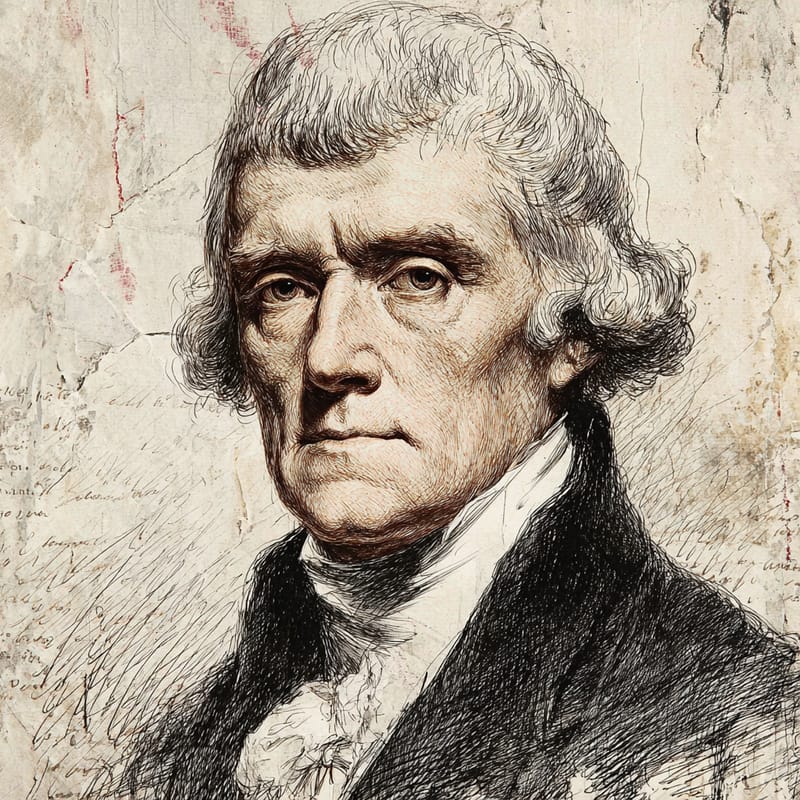
Thomas Jefferson
That government is best which governs least
Agrarian liberty and limited federal power.
Classical LiberalOne of 729 ideologies · enter the Classical Liberal hall →- Role
- President & founder
- Era
- 1743–1826
- Region
- United States
- Social band
- Centre (no modifier)
- Placement
- +45 · −48 · +5
§ Where Thomas Jefferson stands
3 axesJefferson wanted a republic of independent landowning farmers, low taxes and little public debt; as president he secured the repeal of internal taxes, including the whiskey excise, in 1802 and cut the national debt. He opposed Hamilton's national bank as unconstitutional in 1791 and distrusted finance, while his Embargo Act of 1807 shut down foreign trade, so his market liberalism was agrarian rather than laissez-faire.
Jefferson read the Constitution narrowly and feared central power. He secretly drafted the Kentucky Resolutions of 1798, which declared the Alien and Sedition Acts void, and he shrank the army and the federal payroll as president. Yet he stretched executive power himself, buying Louisiana in 1803 despite doubting its constitutionality and enforcing the 1807 embargo harshly, which pulls him back from the libertarian pole.
Jefferson was an Enlightenment rationalist whose Virginia Statute for Religious Freedom, drafted in 1777 and enacted in 1786, separated church and state, and who compiled his own edition of the Gospels stripped of miracles. Against that stands slavery: he held hundreds of people in bondage, and in Notes on the State of Virginia (1785) speculated that Black people were inherently inferior, so he sits near the social centre.
How close are you to Thomas Jefferson?
Three statements, one per axis. Answer them and we’ll drop you on the compass next to them.
§ The story
HistoricalThomas Jefferson (1743–1826) was the third president of the United States, from 1801 to 1809, and the principal author of the Declaration of Independence. Born into the Virginia planter class and trained as a lawyer, he rose through the colonial House of Burgesses, wrote A Summary View of the Rights of British America (1774) and drafted the Declaration in 1776. He then served as governor of Virginia, minister to France, the first secretary of state under Washington and vice-president under John Adams.
Jefferson co-founded the Democratic-Republican opposition to Alexander Hamilton's Federalists and, as president, doubled the country's size with the Louisiana Purchase of 1803 and sent Lewis and Clark west. He wrote Virginia's statute for religious freedom and founded the University of Virginia. The central contradiction of his life is slavery: the author of 'all men are created equal' enslaved more than 600 people over his lifetime, and most historians accept that he fathered children with Sally Hemings, an enslaved woman at Monticello.
Notable for
- 01Drafted the Declaration of Independence
- 02Louisiana Purchase
- 03Founded the University of Virginia
Key works & moments
- 1776Drafts the Declaration of Independence, adopted by the Continental Congress in July.
- 1786Virginia enacts his Statute for Religious Freedom, drafted in 1777.
- 1798Secretly writes the Kentucky Resolutions against the Alien and Sedition Acts.
- 1803Completes the Louisiana Purchase from France, doubling the nation's territory.
- 1807Signs the ban on importing enslaved people from 1808, and the Embargo Act.
- 1819Founds the University of Virginia, which opens to students in 1825.
In their own words
“We hold these truths to be self-evident, that all men are created equal, that they are endowed by their Creator with certain unalienable Rights, that among these are Life, Liberty and the pursuit of Happiness.”
“I contemplate with sovereign reverence that act of the whole American people which declared that their legislature should make no law respecting an establishment of religion, or prohibiting the free exercise thereof, thus building a wall of separation between Church & State.”
§ Minds closest to Thomas Jefferson
All minds →
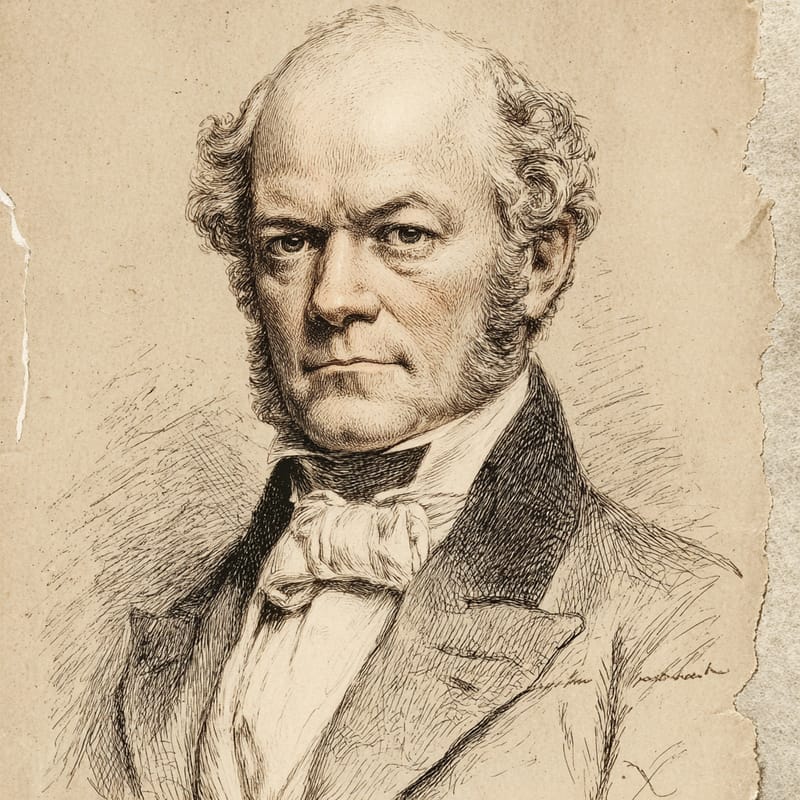
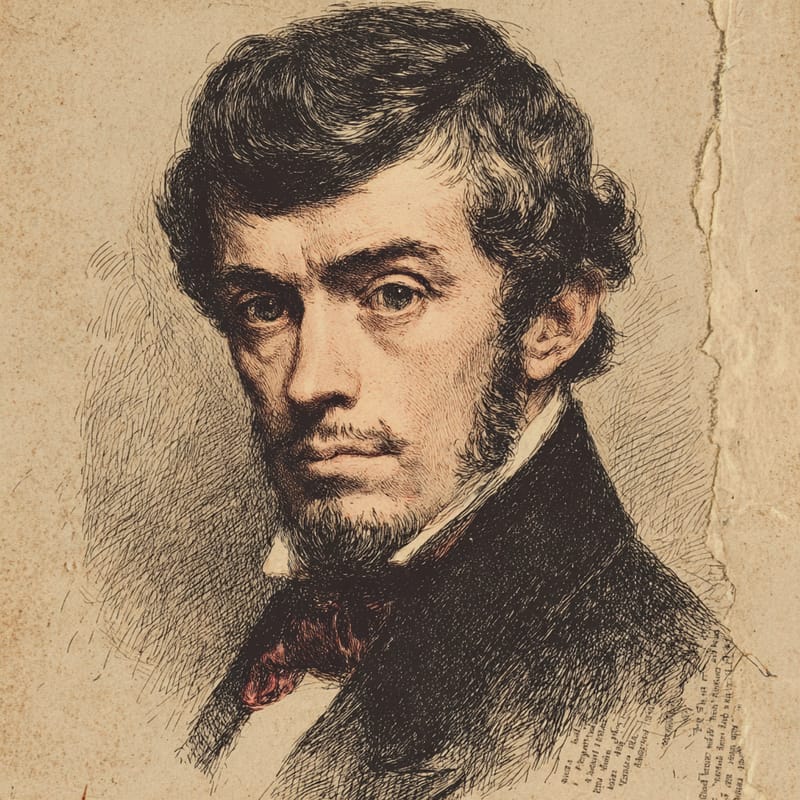
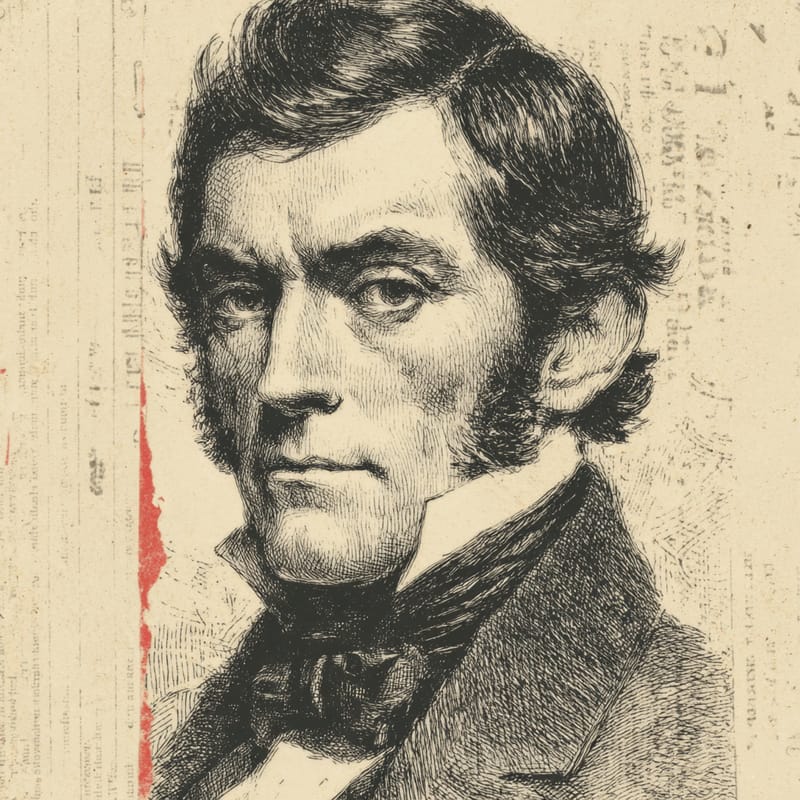

§ Also in the Classical Liberal hall
Enter the hall →§ Common questions
4 answersWhat was Thomas Jefferson's political ideology?
Thomas Jefferson was an agrarian republican and Enlightenment liberal: on the 99ideologies three-axis compass, a Classical Liberal. Economically he sat clearly on the market side (+45), favouring low taxes, minimal debt and independent farmers over concentrated finance. On governance he leaned strongly toward limited government (−48), defending states' rights and strict construction of the Constitution. Socially he sat near the centre (+5): a champion of religious freedom who also held hundreds of people in slavery.
Was Thomas Jefferson left-wing or right-wing?
Both sides claim him, because his ideas cut across today's divide. In his own time he led the more popular, egalitarian party against Hamilton's Federalists, championed religious freedom and spoke the language of natural rights, which progressives honour. Yet his distrust of federal power, debt and taxes, and his defence of states' rights, are now staples of the American right. On the site's axes he is a limited-government, market-leaning liberal near the social centre.
Did Thomas Jefferson say 'That government is best which governs least'?
No; there is no evidence that he did. A version of the line was the motto of the United States Magazine and Democratic Review, founded in 1837, and Henry David Thoreau quoted it at the start of Civil Disobedience in 1849. The Thomas Jefferson Foundation at Monticello lists it among quotations wrongly attributed to him. The sentiment does echo his preference for limited government, which is why the misattribution has stuck.
Which minds are closest to Thomas Jefferson?
On the 99ideologies three-axis compass, the minds closest to Thomas Jefferson are Wilhelm von Humboldt (97% alike), Adam Smith (97% alike) and John Locke (96% alike). The furthest is Pol Pot (15% alike).