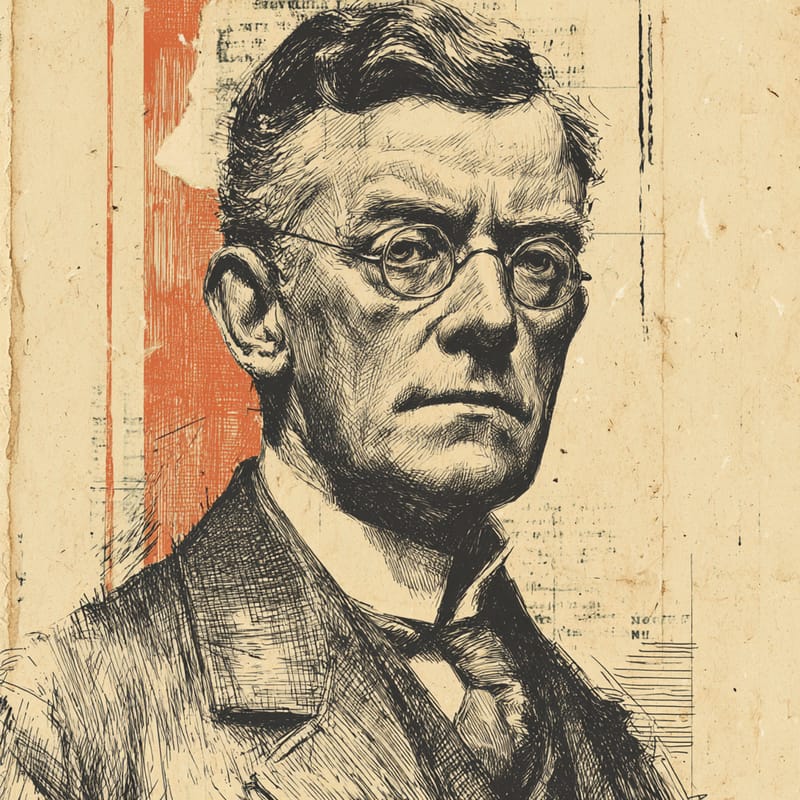
Roger Baldwin
Founded the ACLU
Civil liberties as the first principle.
Reformist Civil LibertarianOne of 729 ideologies · enter the Civil Libertarian hall →- Role
- ACLU founder
- Era
- 1884–1981
- Region
- United States
- Social band
- Reformist
- Placement
- +42 · −30 · +60
§ Where Roger Baldwin stands
3 axesBaldwin's placement reflects the ACLU's deliberate neutrality on economics and his own later acceptance of a liberal market order. As a young radical he backed labour militancy and wrote sympathetically of Soviet Russia in Liberty Under the Soviets (1928), but the 1939 Nazi–Soviet pact disillusioned him, and from 1940 he steered the ACLU away from communists while defending the rights of all sides in economic conflicts.
Civil liberty against state power was Baldwin's lifelong cause. He went to prison in 1918 rather than submit to the wartime draft, founded the ACLU in 1920 to defend free speech, assembly and due process, and built its policy of defending unpopular speakers whatever their politics, from labour radicals and communists to the Ku Klux Klan.
Baldwin's progressivism began in social work: in St Louis he served as chief probation officer of the juvenile court and co-wrote Juvenile Courts and Probation (1914). A pacifist and admirer of Emma Goldman, he led an ACLU that backed the Scopes defence of evolution teaching in 1925 and took up the rights of racial minorities, immigrants and religious dissenters such as Jehovah's Witnesses.
How close are you to Roger Baldwin?
Three statements, one per axis. Answer them and we’ll drop you on the compass next to them.
§ The story
HistoricalRoger Nash Baldwin (1884–1981) was an American civil liberties campaigner and the principal founder of the American Civil Liberties Union, which he directed from 1920 to 1950. Born into a prosperous Massachusetts family and educated at Harvard, he became a social worker and juvenile-court official in St Louis, where hearing the anarchist Emma Goldman radicalised him. In 1917 he led the civil liberties bureau of the American Union Against Militarism, and in 1918 he was jailed for refusing to submit to the wartime draft.
Under Baldwin the ACLU became the leading defender of free speech, assembly and due process in the United States, taking up the causes of labour organisers, communists, Jehovah's Witnesses and Ku Klux Klan members alike and backing the 1925 Scopes trial. His early sympathy for the Soviet Union, set out in Liberty Under the Soviets (1928), later embarrassed him; after the Nazi–Soviet pact he supported the ACLU's 1940 resolution barring supporters of totalitarian regimes from its leadership. He advised on civil liberties in occupied Japan and received the Presidential Medal of Freedom in 1981.
Notable for
- 01Founded the ACLU
- 02Defended free speech and dissent
- 03Civil-liberties institution-building
Key works & moments
- 1918Jailed for refusing to comply with the Selective Service Act as a conscientious objector.
- 1920Founds the American Civil Liberties Union and becomes its director.
- 1925The ACLU's offer to defend a Tennessee teacher leads to the Scopes 'Monkey Trial'.
- 1928Publishes Liberty Under the Soviets after visiting the Soviet Union.
- 1940Backs the ACLU resolution barring supporters of totalitarian regimes from its leadership.
- 1981Receives the Presidential Medal of Freedom from Jimmy Carter, months before his death.
§ Minds closest to Roger Baldwin
All minds →

§ Also in the Civil Libertarian hall
Enter the hall →§ Common questions
4 answersWhat was Roger Baldwin's political ideology?
Roger Baldwin was a civil libertarian whose early radicalism mellowed into liberal anti-communism: on the 99ideologies three-axis compass, a Reformist Civil Libertarian. Economically he sat on the market side of centre (+42), reflecting the ACLU's neutrality on economics and his later acceptance of a liberal market order, though he was drawn to socialism and the Soviet experiment in the 1920s and 1930s. On governance he was libertarian (−30), defending speech and due process against the state, and socially he was progressive (+60).
Was Roger Baldwin left-wing or right-wing?
Left-wing for most of his life, though his core commitment was to civil liberties rather than to any party. As a young man he admired the anarchist Emma Goldman, defended radical labour and wrote sympathetically about Soviet Russia. The 1939 Nazi–Soviet pact turned him against communism, and in later decades he worked within the liberal mainstream, advising on civil liberties in occupied Japan. Throughout, his ACLU defended the speech of the far right as well as the far left.
Did Roger Baldwin found the ACLU?
Yes. Baldwin was the ACLU's principal founder and its director for three decades. The organisation grew out of the National Civil Liberties Bureau, which he ran from 1917 to defend conscientious objectors and critics of the First World War, and it was reorganised as the American Civil Liberties Union in January 1920 with backers including Jane Addams, Helen Keller, Crystal Eastman and Norman Thomas. Baldwin directed it until 1950, building its policy of defending free speech regardless of the speaker's politics.
Which minds are closest to Roger Baldwin?
On the 99ideologies three-axis compass, the minds closest to Roger Baldwin are John Perry Barlow (98% alike), Atticus Finch (98% alike) and Ida B. Wells (98% alike). The furthest is Gregor Strasser (13% alike).