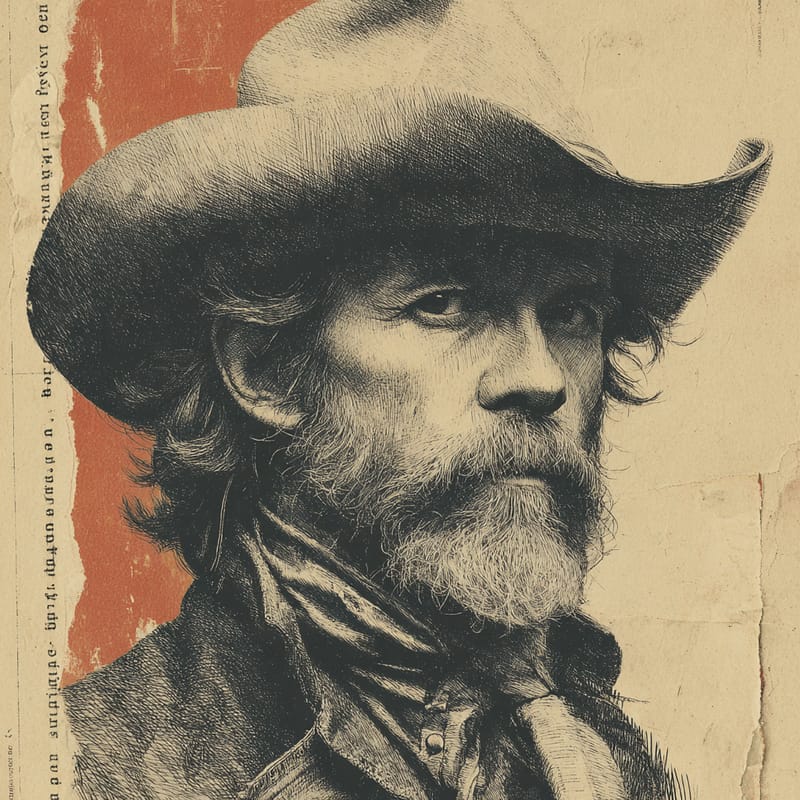
John Perry Barlow
Declaring cyberspace free
Digital liberty's poet.
Reformist Civil LibertarianOne of 729 ideologies · enter the Civil Libertarian hall →- Role
- Internet activist
- Era
- 1947–2018
- Region
- United States
- Social band
- Reformist
- Placement
- +44 · −34 · +60
§ Where John Perry Barlow stands
3 axesBarlow was broadly pro-market, a rancher and former Republican who distrusted state economic management, but his best-known economic essay challenged property rules rather than defended them. The Economy of Ideas (Wired, 1994) argued that digital copying made traditional copyright unworkable and that value online would come from relationships, performance and service, an outlook shaped by the Grateful Dead's tolerance of fans taping their concerts.
Barlow's Declaration of the Independence of Cyberspace (1996) told governments they had no sovereignty online and that the internet would develop its own social contract. Through the Electronic Frontier Foundation, founded in 1990, he backed legal challenges to online censorship and surveillance, including the successful attack on the Communications Decency Act's indecency provisions in Reno v. ACLU (1997).
Barlow came out of the 1960s counterculture and the Grateful Dead's world of open, improvised community, and he applied its anti-authoritarian values to the internet. His 1996 Declaration promised a world that all could enter without privilege or prejudice of race, economic power, military force or station of birth, and he defended anonymity and free expression for marginal voices online.
How close are you to John Perry Barlow?
Three statements, one per axis. Answer them and we’ll drop you on the compass next to them.
§ The story
HistoricalJohn Perry Barlow (1947–2018) was an American poet, essayist and digital-rights activist. Raised on a cattle ranch in Wyoming and educated at Wesleyan University, he wrote lyrics for the Grateful Dead from the early 1970s, mostly with guitarist Bob Weir, while running the family ranch until the late 1980s. A Republican in his ranching years, he worked on Dick Cheney's first congressional campaign in 1978. He discovered the early online world through the WELL, a pioneering virtual community, and became one of its most vivid chroniclers.
In 1990, after federal agents raided hackers and the games publisher Steve Jackson Games, Barlow co-founded the Electronic Frontier Foundation with Mitch Kapor and John Gilmore to defend civil liberties online. His 1996 Declaration of the Independence of Cyberspace, written at Davos in response to the US Communications Decency Act, became a founding text of internet libertarianism, though critics later called its faith in a self-governing network naive. In 2012 he co-founded the Freedom of the Press Foundation to support public-interest journalism.
Notable for
- 01Co-founded the EFF
- 02'Declaration of Independence of Cyberspace'
- 03Digital-rights advocacy
Key works & moments
- 1972His lyrics, including 'Cassidy' and 'Mexicali Blues', appear on Bob Weir's album Ace.
- 1978Works on Dick Cheney's first, successful campaign for Wyoming's seat in Congress.
- 1990Co-founds the Electronic Frontier Foundation with Mitch Kapor and John Gilmore.
- 1994Publishes The Economy of Ideas in Wired, arguing copyright cannot survive digital copying.
- 1996Issues A Declaration of the Independence of Cyberspace from the World Economic Forum in Davos.
- 2012Co-founds the Freedom of the Press Foundation.
In their own words
“Governments of the Industrial World, you weary giants of flesh and steel, I come from Cyberspace, the new home of Mind. On behalf of the future, I ask you of the past to leave us alone.”
§ Minds closest to John Perry Barlow
All minds →

§ Also in the Civil Libertarian hall
Enter the hall →§ Common questions
4 answersWhat was John Perry Barlow's political ideology?
John Perry Barlow was a cyber-libertarian, a former Wyoming Republican who became the poet of internet freedom: on the 99ideologies three-axis compass, a Reformist Civil Libertarian. Economically he sat on the market side of centre (+44), distrustful of state management though sceptical of intellectual-property law. On governance he was clearly libertarian (−34), declaring that governments had no sovereignty in cyberspace, and socially he was progressive (+60), a counterculture veteran who defended free expression and anonymity online.
Was John Perry Barlow left-wing or right-wing?
Neither cleanly; he was a libertarian. Barlow was a Republican rancher who worked on Dick Cheney's 1978 campaign, yet he came out of the 1960s counterculture, wrote songs for the Grateful Dead and allied with progressives on privacy, free speech and press freedom. His politics combined right-libertarian suspicion of government with left-libertarian hostility to state and corporate control of information, which is why people on both sides have claimed him and criticised him.
What is the Declaration of the Independence of Cyberspace?
It is a short manifesto Barlow published online on 8 February 1996, written in Davos during the World Economic Forum on the day the US Telecommunications Act, including the Communications Decency Act, became law. Addressed to the governments of the industrial world, it declared that they had no sovereignty where internet users gathered and that cyberspace would form its own social contract. It became a founding text of internet libertarianism, though critics later faulted its belief that the network could escape state and corporate power.
Which minds are closest to John Perry Barlow?
On the 99ideologies three-axis compass, the minds closest to John Perry Barlow are Roger Baldwin (98% alike), Glenn Greenwald (97% alike) and Clarence Darrow (96% alike). The furthest is Gregor Strasser (12% alike).