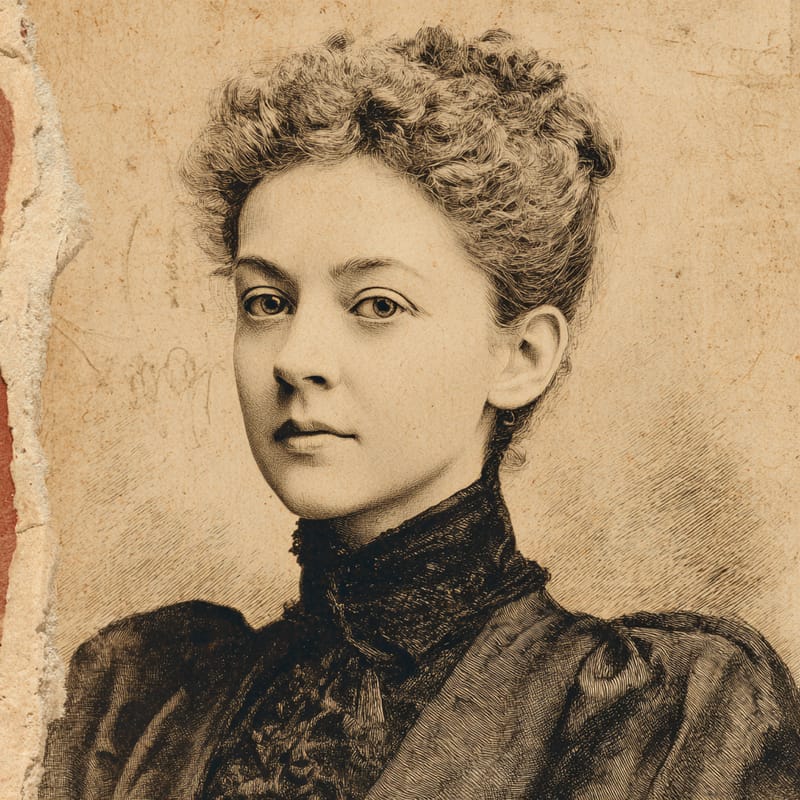
Lizzie Magie
The Landlord's Game
Taught land economics through play.
Reformist GeorgismOne of 729 ideologies · enter the Georgism hall →- Role
- Inventor & Georgist
- Era
- 1866–1948
- Region
- United States
- Social band
- Reformist
- Placement
- +20 · −50 · +55
§ Where Lizzie Magie stands
3 axesMagie's economics were Henry George's: trade and enterprise were healthy, but the private capture of land rent was the root of poverty. She gave The Landlord's Game, patented in 1904, two sets of rules, one rewarding the player who monopolised land and bankrupted rivals and one in which everyone gained when wealth was created, so that players could feel the case for the single tax.
Her politics favoured persuasion over power. Writing in the Single Tax Review in 1902, she described her game as a practical demonstration of land-grabbing and hoped that children who played it would grow up to end the injustice. Like George, she wanted a state that collected land rent and otherwise left labour and trade free, rather than one that managed the economy.
Magie was a feminist by example and by stunt. A working woman who held patents in her own name at a time when few women did, she placed a mock newspaper advertisement in 1906 offering herself for sale to the highest bidder, a protest at the economic dependence that marriage and low wages imposed on women.
How close are you to Lizzie Magie?
Three statements, one per axis. Answer them and we’ll drop you on the compass next to them.
§ The story
HistoricalElizabeth 'Lizzie' Magie (1866–1948), later Lizzie Magie Phillips, was an American game designer and writer, born in Macomb, Illinois, who earned her living for years as a stenographer, much of the time in Washington, D.C. A follower of Henry George, she designed The Landlord's Game to show how private ownership of land enriches landlords and impoverishes tenants, and received a US patent for it in January 1904. She patented a revised version in 1924.
The Landlord's Game spread informally among college students and Quaker communities, picking up Atlantic City street names, and in 1935 Parker Brothers bought a version from Charles Darrow as Monopoly while acquiring Magie's patent for $500. For decades Darrow was credited as the sole inventor. Her role resurfaced in the 1970s, when the economist Ralph Anspach, sued by Parker Brothers over his Anti-Monopoly game, documented the game's origins. She is now widely recognised as Monopoly's originator, the author of a game built to teach the opposite of its eventual lesson.
Notable for
- 01Invented 'The Landlord's Game'
- 02Georgist educator
- 03Monopoly's true originator
Key works & moments
- 1902Describes her game in the Single Tax Review as a demonstration of land-grabbing.
- 1904Receives a US patent for The Landlord's Game, designed to teach Henry George's land theory.
- 1906Places a mock advertisement offering herself for sale, protesting women's economic dependence.
- 1924Patents a revised version of The Landlord's Game.
- 1935Parker Brothers launches Monopoly, crediting Charles Darrow, and buys her patent for $500.
- 1970sRalph Anspach's Anti-Monopoly litigation brings her role as Monopoly's originator back to light.
In their own words
“It is a practical demonstration of the present system of land-grabbing with all its usual outcomes and consequences.”
§ Minds closest to Lizzie Magie
All minds →


§ Also in the Georgism hall
Enter the hall →§ Common questions
4 answersWhat was Lizzie Magie's political ideology?
Lizzie Magie was a Georgist reformer and feminist: on the 99ideologies three-axis compass, an adherent of Reformist Georgism. Economically she leaned moderately to the market side (+20), accepting trade and enterprise but blaming private land monopoly for poverty and backing Henry George's single tax on land values. On governance she was anti-authoritarian (−50), seeking change through education rather than state control. Socially she was progressive (+55), challenging women's economic dependence on men.
Was Lizzie Magie left-wing or right-wing?
Left-leaning in her era's terms, though her economics resist the label. Georgism was a radical reform movement in the 1890s and 1900s, allied with progressives, populists and some socialists against landlords and monopolies, and Magie shared its egalitarian anger. But George's remedy was a tax on land values that left markets, trade and enterprise free, which is why her economic placement sits on the market side. Her feminism placed her among the progressive reformers of her day.
Did Lizzie Magie invent Monopoly?
Yes, in all but name. Magie patented The Landlord's Game in 1904, with a square track of properties, rents, railroads and a jail, the features that define Monopoly. The game spread through home-made versions until Charles Darrow sold one to Parker Brothers in 1935 as his own invention. Parker Brothers bought Magie's patent for $500, but Darrow was credited for decades. Her authorship was established in the 1970s through the economist Ralph Anspach's legal fight over his Anti-Monopoly game.
Which minds are closest to Lizzie Magie?
On the 99ideologies three-axis compass, the minds closest to Lizzie Magie are Leo Tolstoy (97% alike), Silvio Gesell (96% alike) and The City of Arden (illustrative) (96% alike). The furthest is Gregor Strasser (13% alike).