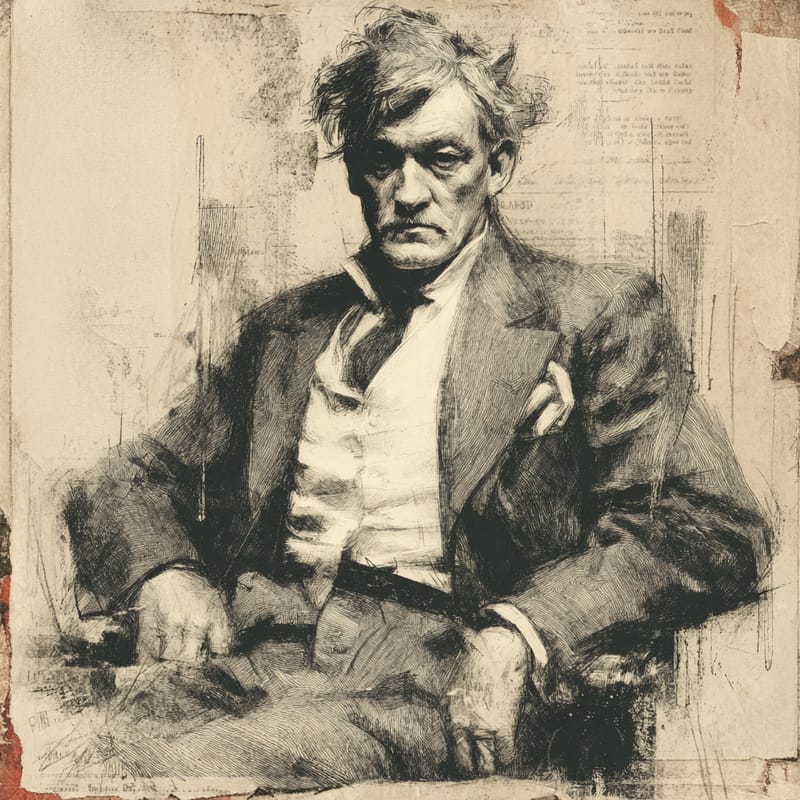
Clarence Darrow
Attorney for the damned
Liberty of conscience in the courtroom.
Reformist Civil LibertarianOne of 729 ideologies · enter the Civil Libertarian hall →- Role
- Defense attorney
- Era
- 1857–1938
- Region
- United States
- Social band
- Reformist
- Placement
- +38 · −30 · +55
§ Where Clarence Darrow stands
3 axesDarrow sympathised with labour and spent much of his career defending unions, beginning with the Pullman strike of 1894, but he never joined the Socialist Party and drew instead on Henry George's single-tax ideas and a Jeffersonian dislike of monopoly. As chair of the National Recovery Review Board in 1934 he attacked the New Deal's NRA industrial codes for shielding big business from competition.
Darrow's career was a defence of the individual against the punishing power of the state. He campaigned against capital punishment in court, in public debates and in his book Crime: Its Cause and Treatment (1922), which argued that crime grew from heredity and environment rather than free will, and he defended the free speech of anarchists, socialists and other unpopular dissenters.
An agnostic and freethinker, Darrow defended the teaching of evolution at the 1925 Scopes trial, where he cross-examined William Jennings Bryan on the literal truth of the Bible. He opposed Prohibition and fought racial prejudice in court, most famously in the Sweet trials of 1925–26 in Detroit, though his 1932 defence in Hawaii's Massie case of white defendants who had killed a Native Hawaiian man has drawn lasting criticism.
How close are you to Clarence Darrow?
Three statements, one per axis. Answer them and we’ll drop you on the compass next to them.
§ The story
HistoricalClarence Seward Darrow (1857–1938) was an American lawyer whose courtroom oratory made him the country's most famous defence attorney. Raised in Kinsman, Ohio, by a freethinking father, he was admitted to the bar in 1878 and moved to Chicago in 1887, where he became counsel to the Chicago and North Western Railway. He left that post to defend the union leader Eugene Debs after the 1894 Pullman strike and went on to represent unions, radicals and murder defendants, serving one term in the Illinois legislature from 1903.
Darrow's best-known cases became public arguments about society itself. He won the acquittal of the union leader Big Bill Haywood in 1907, saved the young murderers Nathan Leopold and Richard Loeb from execution in 1924, defended the teacher John Scopes against Tennessee's ban on teaching evolution in 1925 and won acquittal in 1926 for Henry Sweet, a Black man who had helped defend his brother's Detroit home from a white mob. He was himself tried for bribing jurors after the 1911 McNamara bombing case and was acquitted at the first trial; the second ended in a hung jury.
Notable for
- 01The Scopes 'Monkey Trial'
- 02Opposed capital punishment
- 03Civil-liberties defence
Key works & moments
- 1894Leaves his railway post to defend Eugene Debs after the Pullman strike.
- 1907Wins the acquittal of union leader Big Bill Haywood in an Idaho murder trial.
- 1912Tried for jury bribery after the McNamara case; acquitted at the first trial.
- 1924His plea saves Nathan Leopold and Richard Loeb from the death penalty in Chicago.
- 1925Defends John Scopes and cross-examines William Jennings Bryan on the Bible.
- 1926Wins Henry Sweet's acquittal in Detroit, a landmark case on racial violence and self-defence.
§ Minds closest to Clarence Darrow
All minds →
§ Also in the Civil Libertarian hall
Enter the hall →§ Common questions
4 answersWhat was Clarence Darrow's political ideology?
Clarence Darrow was a radical liberal, a freethinker who defended labour, dissenters and the accused against the state: on the 99ideologies three-axis compass, a Reformist Civil Libertarian. Economically he sat on the market side of centre (+38), sympathetic to unions and hostile to monopoly but drawn to Henry George's single tax rather than to party socialism. On governance he leaned libertarian (−30), opposing capital punishment and the moralising state, and socially he was progressive (+55), an agnostic champion of science, racial justice and personal freedom.
Was Clarence Darrow left-wing or right-wing?
Left-wing for his era. Darrow defended unions and radicals, attacked capital punishment and Prohibition, fought racial prejudice in court and mocked religious fundamentalism, all causes of the progressive and radical left of the early twentieth century. Yet he never joined the Socialist Party, admired Henry George's single tax and attacked the New Deal's NRA for helping monopolies, so his politics were those of an individualist, anti-monopoly radical rather than a party ideologue.
What happened at the Scopes Monkey Trial?
In July 1925 the Tennessee teacher John Scopes was tried in Dayton for violating the Butler Act, which banned teaching that humans had descended from a lower order of animals. Darrow volunteered for the defence of a case the ACLU had organised as a test, while William Jennings Bryan assisted the prosecution. Darrow's cross-examination of Bryan on the Bible became the trial's famous moment, but Scopes was convicted and fined $100; the verdict was overturned on a technicality in 1927, and the law stood until 1967.
Which minds are closest to Clarence Darrow?
On the 99ideologies three-axis compass, the minds closest to Clarence Darrow are Glenn Greenwald (98% alike), Atticus Finch (98% alike) and Roger Baldwin (97% alike). The furthest is Gregor Strasser (16% alike).