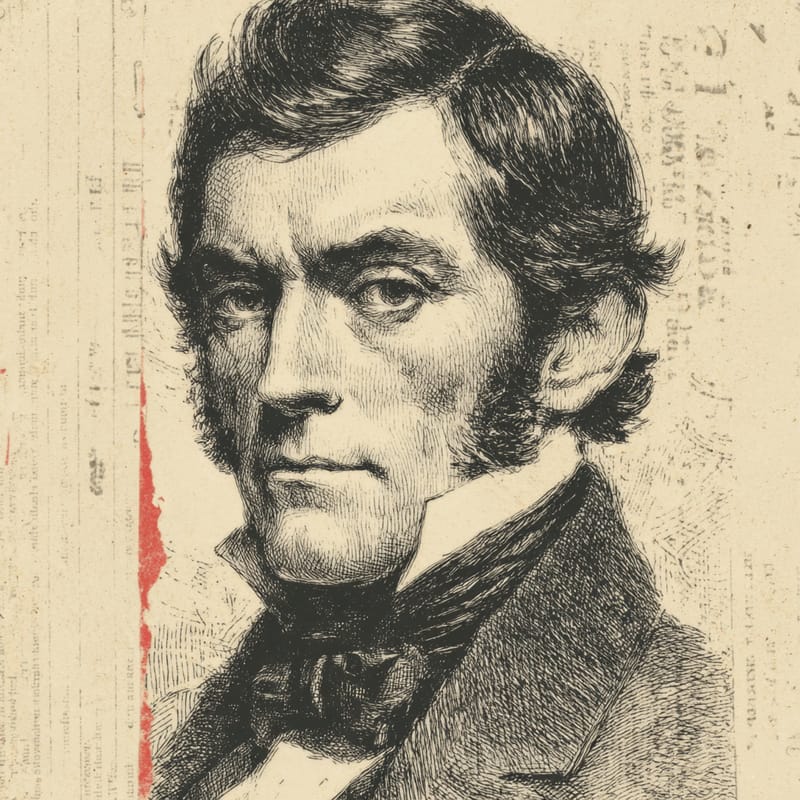
Frédéric Bastiat
The seen and the unseen
Wit against protectionism and plunder.
Classical LiberalOne of 729 ideologies · enter the Classical Liberal hall →- Role
- Economist & writer
- Era
- 1801–1850
- Region
- France
- Social band
- Centre (no modifier)
- Placement
- +60 · −50 · 0
§ Where Frédéric Bastiat stands
3 axesBastiat was a thoroughgoing free trader. His Economic Sophisms (1845–48) mocked protectionism, most memorably in the candlemakers' plea for a law to shut out the sun, and the 1850 essay That Which Is Seen and That Which Is Not Seen used a broken window to expose the hidden costs of state spending. He defended interest and property against Proudhon's plans for free credit in 1849–50.
In The Law (1850) Bastiat argued that law exists only to protect persons, liberty and property, and that when it takes from some to give to others it becomes legal plunder. He described the state as the great fiction through which everyone tries to live at the expense of everyone else, and, consistently, he urged the Assembly in 1849 to let workers combine and strike.
Bastiat's liberalism was economic and legal rather than cultural. A Catholic who saw the harmony of free exchange as part of a providential order, he took little part in debates over social customs, though The Law condemned slavery and protectionism alike as legal plunder. His focus on economic liberty leaves him at the centre of the social axis.
How close are you to Frédéric Bastiat?
Three statements, one per axis. Answer them and we’ll drop you on the compass next to them.
§ The story
HistoricalClaude-Frédéric Bastiat (1801–1850) was a French economist, pamphleteer and legislator, born in Bayonne and orphaned young. He spent most of his life at Mugron in the Landes, managing a family estate, serving as a local justice of the peace and reading political economy. An 1844 article comparing French and English tariffs launched his writing career, and he went on to found a free-trade association in 1846 and to sit in France's National Assembly after the revolution of 1848.
In just six years Bastiat produced the Economic Sophisms, including the satirical Candlemakers' Petition against competition from the sun, the essay The Law (1850) and That Which Is Seen and That Which Is Not Seen (1850), whose broken-window parable remains a staple of economics teaching. He debated Proudhon and the socialists of 1848 and championed Richard Cobden's free-trade campaign in France. He died of tuberculosis in Rome in December 1850, aged 49, leaving his Economic Harmonies unfinished.
Notable for
- 01'The Law' (1850)
- 02'That Which Is Seen and That Which Is Not Seen'
- 03Candlemakers' petition satire
Key works & moments
- 1844An article on French and English tariffs in the Journal des Économistes launches his career.
- 1845Publishes Cobden and the League and the first Economic Sophisms, including the Candlemakers' Petition.
- 1846Founds a free-trade association in Bordeaux, soon extended to Paris.
- 1848Elected to the Constituent Assembly for the Landes after the February Revolution.
- 1849–50Debates Proudhon in print over interest and free credit.
- 1850Publishes The Law and That Which Is Seen and That Which Is Not Seen; dies in Rome.
In their own words
“The state is the great fictitious entity by which everyone seeks to live at the expense of everyone else.”
“Life, liberty, and property do not exist because men have made laws. On the contrary, it was the fact that life, liberty, and property existed beforehand that caused men to make laws in the first place.”
§ Minds closest to Frédéric Bastiat
All minds →

§ Also in the Classical Liberal hall
Enter the hall →§ Common questions
4 answersWhat was Frédéric Bastiat's political ideology?
Frédéric Bastiat was a French classical liberal and free-trade campaigner: on the 99ideologies three-axis compass, a Classical Liberal. Economically he sat firmly on the market side (+60), attacking tariffs, subsidies and socialist schemes as forms of plunder. On governance he wanted a state limited to protecting persons, liberty and property (−50). Socially he sat at the centre (0), a liberal whose energies went into economic freedom rather than questions of custom or religion.
Was Frédéric Bastiat left-wing or right-wing?
His ideas are now championed mainly on the right, though he saw himself as a reformer of the people against privilege. In his day free trade was a cause aimed at protected landowners and industrialists, and he defended workers' right to combine. But his fierce opposition to socialism, redistribution and state spending made him a hero to later libertarians and free-market conservatives, especially in the United States, where The Law has been widely reprinted since the mid-twentieth century.
What is Bastiat's broken window fallacy?
It is the error of counting the visible benefits of destruction or spending while ignoring their hidden costs. In That Which Is Seen and That Which Is Not Seen (1850), Bastiat imagines a boy who breaks a shopkeeper's window; onlookers console themselves that the glazier now has work. What is not seen is that the shopkeeper would otherwise have spent the money on something else, such as shoes or a book. Bastiat applied the lesson to public works, subsidies and tariffs, and economists still use it to explain opportunity cost.
Which minds are closest to Frédéric Bastiat?
On the 99ideologies three-axis compass, the minds closest to Frédéric Bastiat are Richard Cobden (97% alike), Robert Nozick (96% alike) and Adam Smith (94% alike). The furthest is Pol Pot (9% alike).