
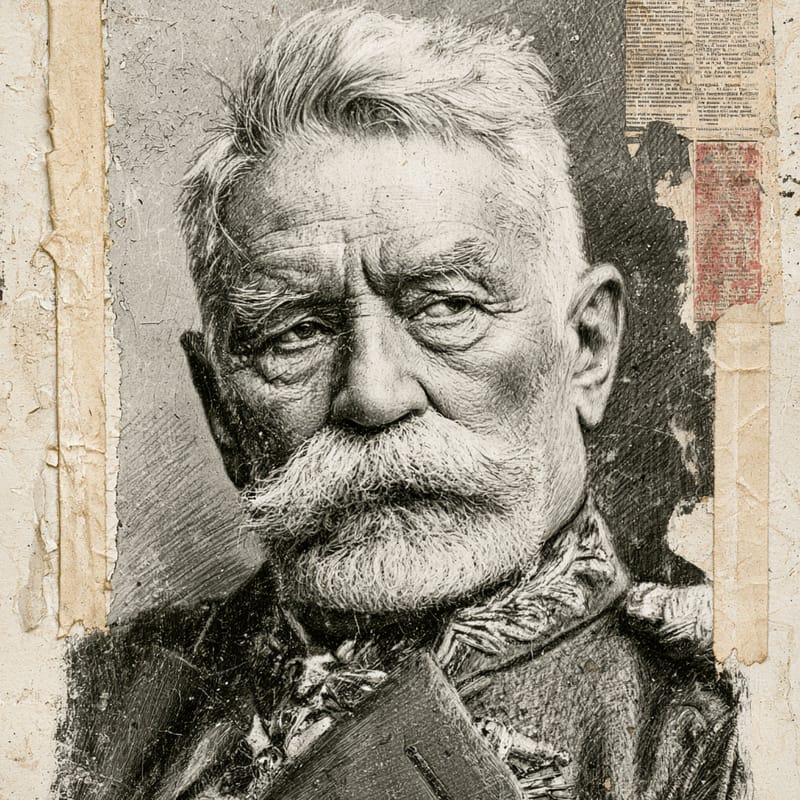
Ramsay MacDonald
Labour's first PM
A pioneer whose coalition turn split his party.
Social DemocratOne of 729 ideologies · enter the Social Democrat hall →- Role
- Prime Minister
- Era
- 1866–1937
- Region
- United Kingdom
- Social band
- Centre (no modifier)
- Placement
- −42 · −20 · −8
§ Where Ramsay MacDonald stands
3 axesMacDonald's books Socialism and Society (1905) and Socialism and Government (1909) presented socialism as the gradual, organic growth of collective provision rather than a seizure of property. In office his governments subsidised council housing through the Wheatley Housing Act of 1924 and slum clearance through the Housing Act 1930, but he clung to balanced budgets and the gold standard, and in 1931 backed cuts to unemployment benefit.
MacDonald was a committed parliamentarian who believed Labour must prove it could govern within the constitution, accepting office as a minority in 1924 and 1929 rather than waiting for a majority. In 1914 he helped found the Union of Democratic Control, which demanded parliamentary oversight of foreign policy, and his 1931 National Government was formed constitutionally, though his party saw it as betrayal.
Culturally MacDonald was a conventional, respectable figure, more concerned to show that Labour was fit to govern than to challenge custom: in 1924 he accepted court dress for his ministers at the palace, and in the 1930s he moved easily in aristocratic society. His opposition to the First World War, which cost him the leadership in 1914, sprang from internationalist conviction rather than social radicalism.
How close are you to Ramsay MacDonald?
Three statements, one per axis. Answer them and we’ll drop you on the compass next to them.
§ The story
HistoricalJames Ramsay MacDonald (1866–1937) was Britain's first Labour prime minister, in 1924 and again from 1929 to 1931, and then led a Conservative-dominated National Government until 1935. Born illegitimate in Lossiemouth in north-east Scotland, he worked as a pupil-teacher and clerk in London, joined the Independent Labour Party in 1894 and in 1900 became secretary of the new Labour Representation Committee, negotiating the 1903 electoral pact with the Liberals that helped Labour win 29 seats in 1906.
He led the parliamentary party from 1911 until his opposition to the First World War forced him out in 1914, and he lost his Leicester seat in 1918. Returning in 1922 as leader, he twice took Labour into minority government. The first fell within a year, its defeat in the 1924 election coloured by the forged Zinoviev letter; the second was overwhelmed by the Depression and split in August 1931 over cuts to unemployment benefit. MacDonald then formed a National Government with Conservatives and Liberals and was expelled from Labour, which long regarded him as a traitor.
Notable for
- 01First Labour PM (1924)
- 02Built Labour into a party of government
- 03The 1931 National Government
Key works & moments
- 1900Becomes secretary of the new Labour Representation Committee.
- 1905Publishes Socialism and Society, an evolutionary case for socialism.
- 1914Resigns as Labour's parliamentary leader over his opposition to the First World War.
- 1924Forms Britain's first Labour government, a minority administration that falls that autumn.
- 1931Forms the National Government amid financial crisis and is expelled from the Labour Party.
- 1935Hands the premiership to Stanley Baldwin and loses his Seaham seat that November.
§ Minds closest to Ramsay MacDonald
All minds →




§ Also in the Social Democrat hall
Enter the hall →§ Common questions
4 answersWhat was Ramsay MacDonald's political ideology?
Ramsay MacDonald was an evolutionary socialist who believed collective provision would grow gradually out of capitalism: on the 99ideologies three-axis compass, a Social Democrat. Economically he sits left of centre (−42), committed to socialism in theory but to balanced budgets in practice. On governance he was a committed parliamentarian (−20) who built Labour into a party of government, and socially he leaned slightly traditional (−8), conventional and respectable in outlook.
Was Ramsay MacDonald left-wing or right-wing?
Left-wing for most of his career, though he ended it governing with the right. MacDonald co-founded the Labour Party, wrote books arguing for socialism and opposed the First World War, which made him a hero of the left in 1914–18. In 1931, however, he formed a National Government dominated by the Conservatives to impose spending cuts, and his old party expelled him. He is best seen as a moderate social democrat whose priorities were respectability and sound finance.
Why did Ramsay MacDonald form the National Government?
Because his Labour cabinet split during the financial crisis of August 1931. A run on sterling and the May Committee's call for heavy spending cuts led bankers to demand economies, including a 10 per cent cut in unemployment benefit, which much of the cabinet refused. MacDonald went to the King intending to resign but agreed to head a coalition with Conservatives and Liberals. Labour expelled him, and the National Government won a landslide in October 1931 that reduced Labour to about fifty seats.
Which minds are closest to Ramsay MacDonald?
On the 99ideologies three-axis compass, the minds closest to Ramsay MacDonald are Helmut Schmidt (99% alike), Golda Meir (93% alike) and Per Albin Hansson (93% alike). The furthest is Adam Sutler (23% alike).