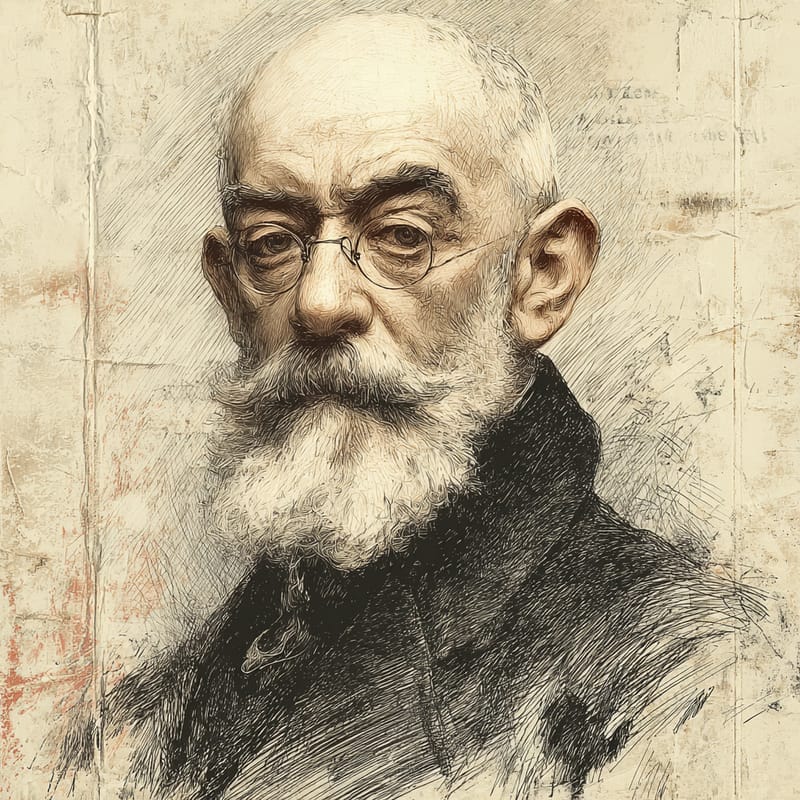
Eduard Bernstein
Revisionism's founder
Argued socialism would arrive by reform, not revolution.
Heterodox Social DemocratOne of 729 ideologies · enter the Social Democrat hall →- Role
- Theorist & politician
- Era
- 1850–1932
- Region
- Germany
- Social band
- Heterodox
- Placement
- −50 · −20 · +18
§ Where Eduard Bernstein stands
3 axesBernstein remained a socialist who wanted the economy progressively socialised, but by stages: through trade unions, consumer cooperatives, municipal enterprise and labour legislation won in parliament. In Die Voraussetzungen des Sozialismus (1899) he rejected Marx's forecast that capitalism would collapse and the middle classes vanish, so he saw no need for wholesale expropriation, which places him left of centre rather than at the collectivist pole.
For Bernstein democracy was both the means and the goal of socialism. In 1899 he dismissed the dictatorship of the proletariat as political atavism, urged the SPD to admit that it was already a democratic reform party and entered the Reichstag as a deputy in 1902. After 1917 he condemned Bolshevik rule as a betrayal of socialism's democratic purpose.
Bernstein was a reforming moderniser rather than a cultural radical. He backed universal suffrage, including votes for women, and civil liberties, and from 1915 he opposed the First World War by voting against war credits. His progressivism had limits typical of his era: in the late 1890s he defended a reformed colonialism, arguing that more developed societies could claim rights over less developed lands.
How close are you to Eduard Bernstein?
Three statements, one per axis. Answer them and we’ll drop you on the compass next to them.
§ The story
HistoricalEduard Bernstein (1850–1932) was a German social democrat and the founder of revisionism, the first major attempt to rethink Marxism from within. Born in Berlin to a Jewish family, the son of a railway engine driver, he worked as a bank clerk and joined the Eisenach Social Democratic Workers' Party in 1872. Under Bismarck's anti-socialist laws he edited the party's banned newspaper, Der Sozialdemokrat, from exile in Zürich and then London, where he became a close collaborator of Friedrich Engels and absorbed the gradualism of the Fabians.
In articles from 1896 and his book Die Voraussetzungen des Sozialismus (1899), published in English as Evolutionary Socialism, Bernstein argued that capitalism was not heading for collapse, that the middle classes were not disappearing and that socialism would come through democratic reform rather than revolution. Karl Kautsky and Rosa Luxemburg led the orthodox attack, and party congresses condemned revisionism, yet the SPD's practice moved steadily his way. A Reichstag deputy from 1902, he broke with the party's war policy in 1915, joined the Independent Social Democrats in 1917 and returned to the SPD after the war.
Notable for
- 01'Evolutionary Socialism' (1899)
- 02Founded social-democratic revisionism
- 03Reichstag deputy
Key works & moments
- 1872Joins the Eisenach Social Democratic Workers' Party.
- 1881Becomes editor of Der Sozialdemokrat, the party's banned paper, printed in Zürich.
- 1888Expelled from Switzerland, moves to London and works closely with Friedrich Engels.
- 1899Publishes Die Voraussetzungen des Sozialismus, translated as Evolutionary Socialism in 1909.
- 1902Enters the Reichstag as an SPD deputy after returning from exile in 1901.
- 1915Votes against war credits, breaking with the SPD's support for the First World War.
In their own words
“The final goal, whatever it may be, is nothing to me; the movement is everything.”
§ Minds closest to Eduard Bernstein
All minds →

§ Also in the Social Democrat hall
Enter the hall →§ Common questions
4 answersWhat was Eduard Bernstein's political ideology?
Eduard Bernstein was a revisionist Marxist who became the theorist of democratic, evolutionary socialism: on the 99ideologies three-axis compass, a Heterodox Social Democrat. Economically he sits left of centre (−50), favouring gradual socialisation through unions, cooperatives and legislation rather than expropriation. On governance he was a convinced democrat (−20) who saw democracy as both the road to socialism and its form, and socially he was a moderate reformer (+18), progressive on suffrage and peace but conventional for his era.
Was Eduard Bernstein left-wing or right-wing?
Left-wing. Bernstein was a lifelong socialist who wanted to replace capitalism's inequalities with a socialised, democratic economy. In the debates of his own party, however, he stood on the right, because he rejected revolution and the Marxist prediction of capitalist collapse in favour of parliamentary reform. That reformism, condemned by orthodox Marxists in his lifetime, later became the mainstream of European social democracy, which is why he is often called its intellectual founder.
Was Eduard Bernstein a Marxist?
He began as one and became its most influential revisionist. In the 1880s Bernstein was a leading orthodox Marxist and a close associate of Friedrich Engels, who made him one of his literary executors. From 1896, however, he argued that key Marxist predictions, such as the collapse of capitalism and the disappearance of the middle classes, were not being borne out. Orthodox Marxists led by Karl Kautsky and Rosa Luxemburg condemned him, and the SPD's Dresden congress formally rejected revisionism in 1903.
Which minds are closest to Eduard Bernstein?
On the 99ideologies three-axis compass, the minds closest to Eduard Bernstein are Clement Attlee (98% alike), Hjalmar Branting (97% alike) and Frances Perkins (97% alike). The furthest is Adam Sutler (16% alike).