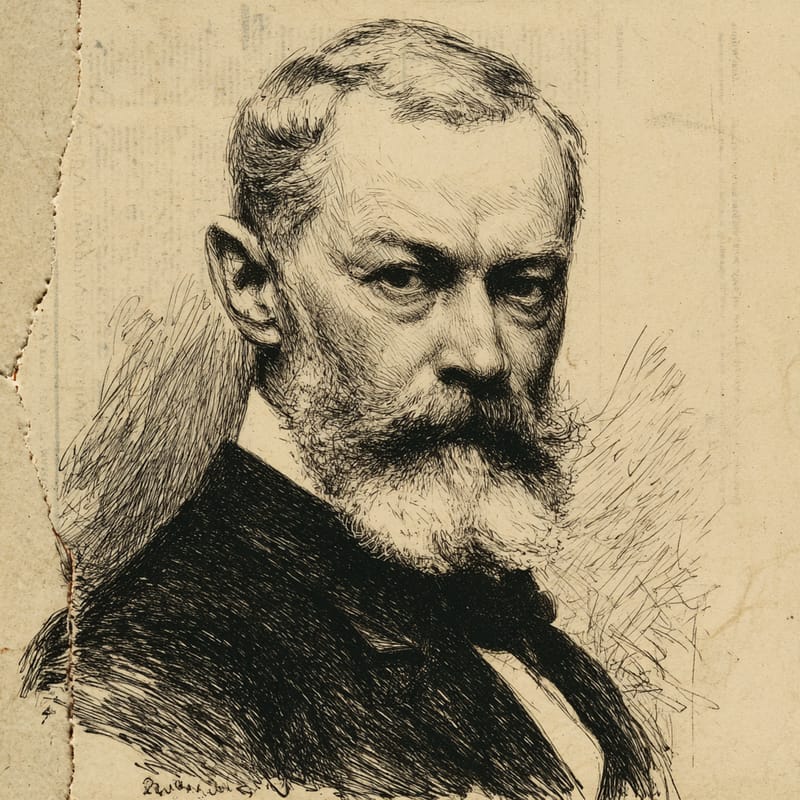
Hjalmar Branting
Sweden's first SD premier
Won the vote, then governed with it.
Social DemocratOne of 729 ideologies · enter the Social Democrat hall →- Role
- Prime Minister
- Era
- 1860–1925
- Region
- Sweden
- Social band
- Centre (no modifier)
- Placement
- −48 · −20 · +12
§ Where Hjalmar Branting stands
3 axesBranting's party was formally Marxist and called for socialised production, and in 1920 his first government appointed a socialisation commission to study bringing industry into public ownership. It produced reports rather than nationalisations, and in practice Branting pursued labour protection and social reform, including the eight-hour working day his party helped carry through the Riksdag in 1919, which places him left of centre but short of collectivism.
A committed parliamentarian, Branting insisted that socialism must come through the ballot box. He worked with the Liberals for decades to win democratic suffrage and joined Nils Edén's coalition in 1917, which carried the constitutional reforms of 1918–21. That year he also refused the revolutionary road demanded by the party's left wing, accepting its departure to form a rival party.
Branting was a reform-minded internationalist of his generation rather than a cultural radical. In 1905 he led Social Democratic opposition to war when Norway dissolved its union with Sweden, he supported votes for women, and as Sweden's delegate to the League of Nations from 1920 he championed arbitration and disarmament, work recognised by the 1921 Nobel Peace Prize.
How close are you to Hjalmar Branting?
Three statements, one per axis. Answer them and we’ll drop you on the compass next to them.
§ The story
HistoricalKarl Hjalmar Branting (1860–1925) was the founding leader of Swedish social democracy and the country's first Social Democratic prime minister. Born into a prosperous Stockholm family, he studied mathematics and astronomy at Uppsala before turning to radical journalism in the 1880s, editing the newspaper Social-Demokraten. He helped found the Social Democratic Workers' Party in 1889, became its first member of the Riksdag in 1896 and led the party formally from 1907.
Branting steered his party from Marxist agitation to parliamentary reform, allying with the Liberals in the campaign that brought universal and equal suffrage, first used for both sexes in the 1921 election. He served as finance minister in Nils Edén's Liberal-led coalition in 1917–18 and headed three minority governments, in 1920, 1921–23 and 1924–25. His rejection of the Bolshevik model after 1917 confirmed the split with the party's revolutionary left. Abroad he championed the League of Nations and shared the 1921 Nobel Peace Prize with Norway's Christian Lange. Illness forced him from office weeks before his death in February 1925.
Notable for
- 01Universal suffrage in Sweden
- 02First Social Democratic PM
- 03Nobel Peace Prize, 1921
Key works & moments
- 1889Helps found the Swedish Social Democratic Workers' Party.
- 1896Becomes the first Social Democrat elected to the Riksdag.
- 1905Opposes war as Norway dissolves its union with Sweden.
- 1917Joins Nils Edén's Liberal-led coalition government as finance minister.
- 1920Forms Sweden's first Social Democratic government.
- 1921Shares the Nobel Peace Prize; women vote in a Swedish general election for the first time.
§ Minds closest to Hjalmar Branting
All minds →

§ Also in the Social Democrat hall
Enter the hall →§ Common questions
4 answersWhat was Hjalmar Branting's political ideology?
Hjalmar Branting was a reformist social democrat who moved his party from Marxist theory to parliamentary practice: on the 99ideologies three-axis compass, a Social Democrat. Economically he sits left of centre (−48), favouring labour protection and gradual socialisation over revolution. On governance he was a firm democrat (−20) whose life's work was universal suffrage, and socially he sits close to the centre (+12), a peace-minded internationalist rather than a cultural radical.
Was Hjalmar Branting left-wing or right-wing?
Left-wing. Branting founded and led Sweden's Social Democratic Workers' Party, which was formally committed to socialising the means of production, and he spent decades fighting for workers' rights and the vote. He was, however, a reformer: he governed in alliance with Liberals, refused the revolutionary path in 1917 and opposed Bolshevism, so he stands at the moderate, parliamentary end of the socialist tradition that became modern Nordic social democracy.
Why did Hjalmar Branting win the Nobel Peace Prize?
For his work for international peace, especially in the League of Nations. Branting shared the 1921 prize with the Norwegian internationalist Christian Lange. He had opposed war with Norway when the two countries separated in 1905, supported Swedish neutrality in the First World War and, as Sweden's delegate to the League of Nations from its first assembly in 1920, argued for international arbitration and disarmament. His socialism was internationalist, and he saw the League as the instrument of a lasting peace.
Which minds are closest to Hjalmar Branting?
On the 99ideologies three-axis compass, the minds closest to Hjalmar Branting are Eduard Bernstein (97% alike), Frances Perkins (97% alike) and Clement Attlee (97% alike). The furthest is Adam Sutler (17% alike).