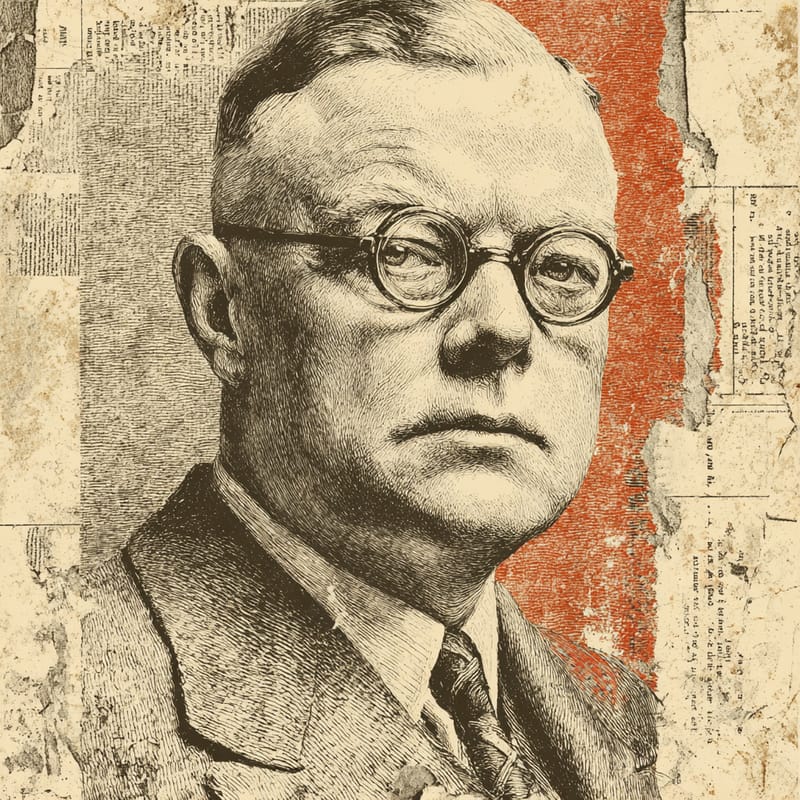
Per Albin Hansson
The people's home
Coined folkhemmet — society as a home for all.
Social DemocratOne of 729 ideologies · enter the Social Democrat hall →- Role
- Prime Minister
- Era
- 1885–1946
- Region
- Sweden
- Social band
- Centre (no modifier)
- Placement
- −54 · −20 · +6
§ Where Per Albin Hansson stands
3 axesHansson's governments answered the Depression with deficit-financed public works under the 1933 crisis agreement with the Farmers' League, which traded farm price supports for Social Democratic job creation. They added state-subsidised unemployment insurance in 1934 and two weeks of statutory paid holiday in 1938, while leaving industry in private hands and relying on the 1938 Saltsjöbaden Agreement between unions and employers to keep labour peace.
A pragmatic parliamentarian, Hansson governed through compromise, first by agreement with the Farmers' League in 1933, then in formal coalition with it from 1936 and at the head of a four-party national unity government from December 1939 to 1945. Wartime brought limits on liberty: his coalition confiscated newspaper editions judged hostile to Nazi Germany and allowed German troop transit across Swedish territory.
Hansson's folkhem ideal cast society as a family home, an egalitarian but nation-centred vision rooted in conventional family and community life rather than cultural change. His governments expanded support for mothers and families in the late 1930s, but they also passed the Sterilisation Acts of 1934 and 1941, under which some 63,000 people were sterilised by 1975, many under pressure from the authorities.
How close are you to Per Albin Hansson?
Three statements, one per axis. Answer them and we’ll drop you on the compass next to them.
§ The story
HistoricalPer Albin Hansson (1885–1946) led the Swedish Social Democratic Workers' Party from 1925 and was prime minister almost continuously from 1932 until his death in 1946. Born near Malmö to a working-class family, he left school at twelve, rose through the socialist youth movement and the party press, entered the Riksdag in 1918 and served as defence minister in the Social Democratic governments of the 1920s.
In a 1928 Riksdag speech Hansson described society as a folkhem, a people's home without favourites or stepchildren, recasting socialism as national solidarity. His governments answered the Depression with a 1933 crisis agreement with the Farmers' League and laid the foundations of the Swedish welfare state. During the Second World War he led a national unity government that kept Sweden neutral through concessions to Germany, including iron-ore exports and the transit of German troops. The sterilisation laws of 1934 and 1941 were also passed under his governments. He died suddenly in October 1946 and was succeeded by Tage Erlander.
Notable for
- 01Coined 'folkhemmet'
- 02Kept Sweden neutral in WWII
- 03Laid the welfare-state foundations
Key works & moments
- 1918Enters the Riksdag's lower chamber as a Social Democrat.
- 1925Succeeds Hjalmar Branting as leader of the Social Democrats.
- 1928Delivers his folkhem speech in the Riksdag, describing society as a good home.
- 1932Becomes prime minister after Social Democratic gains in the September election.
- 1933Crisis agreement with the Farmers' League funds public works against the Depression.
- 1939Forms a national unity government as war begins; Sweden stays neutral.
In their own words
“The good home does not recognise any privileged or neglected members, no favourites and no stepchildren.”
§ Minds closest to Per Albin Hansson
All minds →

§ Also in the Social Democrat hall
Enter the hall →§ Common questions
4 answersWhat was Per Albin Hansson's political ideology?
Per Albin Hansson was a reformist social democrat who turned Swedish socialism into a politics of national community: on the 99ideologies three-axis compass, a Social Democrat. Economically he sits left of centre (−54), building the foundations of the welfare state while leaving industry in private hands. On governance he was a pragmatic parliamentary democrat (−20) who ruled through coalitions, and socially he sits close to the centre (+6), his folkhem ideal resting on conventional family and national values.
Was Per Albin Hansson left-wing or right-wing?
Left-wing, but in a consensual, national form. Hansson led the Social Democrats for over two decades and laid the foundations of the Swedish welfare state through public works, unemployment insurance and labour reforms. Yet he abandoned the language of class struggle for that of the people's home, borrowing a term earlier used by conservatives, governed with the agrarian Farmers' League and led a national unity government in wartime, which made him a unifying centre-left figure rather than a radical.
What does folkhemmet mean?
Folkhemmet means the people's home. Hansson used the image in a Riksdag speech in January 1928, arguing that society should be like a good home built on equality, consideration and cooperation, where no one is privileged or neglected and the strong do not oppress the weak. The phrase gave Swedish social democracy a national, cross-class language and became shorthand for the universal welfare state built by his governments and, after 1946, by Tage Erlander's.
Which minds are closest to Per Albin Hansson?
On the 99ideologies three-axis compass, the minds closest to Per Albin Hansson are Hjalmar Branting (97% alike), Eduard Bernstein (95% alike) and Frances Perkins (94% alike). The furthest is Adam Sutler (17% alike).