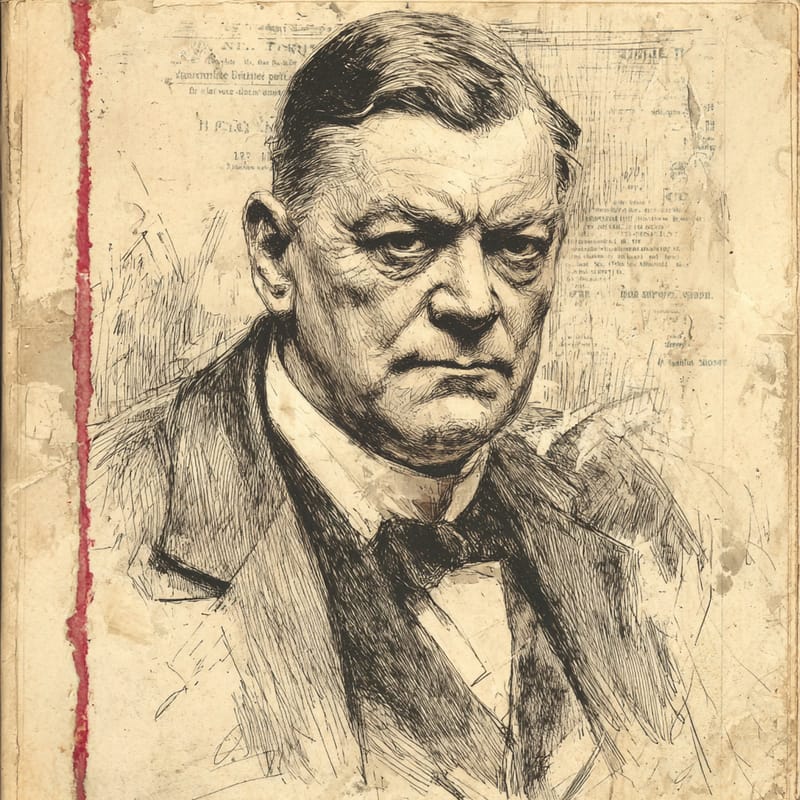
Ernest Bevin
Trade-union patriot
Working-class power with a conservative cultural streak.
Rooted Social DemocratOne of 729 ideologies · enter the Social Democrat hall →- Role
- Foreign Secretary
- Era
- 1881–1951
- Region
- United Kingdom
- Social band
- Rooted
- Placement
- −48 · −24 · −30
§ Where Ernest Bevin stands
3 axesA lifelong trade unionist, Bevin built the Transport and General Workers' Union from its 1922 amalgamation into one of Britain's largest unions and championed collective bargaining, public ownership of transport and a welfare floor. As wartime minister of labour he extended state-backed wage regulation, including the Catering Wages Act 1943, and treated full employment and union partnership as the foundations of post-war policy.
Bevin was a democrat who believed organised labour belonged inside parliamentary government, and his wartime power under Defence Regulation 58A to direct any worker into essential jobs was used sparingly, through consultation with unions and employers. Fiercely anti-communist, he was a principal architect of the Brussels Treaty of 1948 and the North Atlantic Treaty of 1949, binding Britain to the democratic West.
Bevin's outlook was that of a self-made, patriotic working man, suspicious of intellectuals and pacifists: at the 1935 Labour conference his attack on George Lansbury's pacifism helped force Lansbury out as leader. He was determined that Britain remain a great power with its own atomic bomb, which he pressed for in 1946, and his restrictive Palestine policy was condemned by Zionists and many on the left.
How close are you to Ernest Bevin?
Three statements, one per axis. Answer them and we’ll drop you on the compass next to them.
§ The story
HistoricalErnest Bevin (1881–1951) was a trade-union leader who became one of the dominant figures of Britain's wartime and post-war governments. Born in Winsford, Somerset, he was orphaned young, left school at eleven and worked as a farm boy and carter in Bristol before becoming an organiser for the dockers' union in 1910. His advocacy at the 1920 Shaw Inquiry into dock wages won him the nickname the Dockers' KC, and in 1922 he merged more than a dozen unions into the Transport and General Workers' Union, which he led as general secretary until 1940.
As Churchill's minister of labour and national service from 1940 he mobilised the civilian workforce, sending conscripts into the coal mines as Bevin Boys from 1943. As Attlee's foreign secretary from 1945 to 1951, he organised Western Europe's response to the Marshall Plan, backed the Berlin airlift and was a principal architect of NATO, and he pressed for a British atomic bomb. His Palestine policy, which restricted Jewish immigration and turned back refugee ships such as the Exodus in 1947, left a bitter legacy, and that year Britain referred the question to the United Nations. He died in April 1951.
Notable for
- 01Built the Transport & General Workers' Union
- 02Architect of NATO-era British policy
- 03Wartime Minister of Labour
Key works & moments
- 1920Argues the dockers' case at the Shaw Inquiry, earning the nickname the Dockers' KC.
- 1922Founds the Transport and General Workers' Union and becomes its general secretary.
- 1935Attacks George Lansbury's pacifism at the Labour conference; Lansbury resigns as leader.
- 1940Becomes minister of labour and national service in Churchill's wartime coalition.
- 1947Leads Western Europe's response to the Marshall Plan offer of American aid.
- 1949Signs the North Atlantic Treaty for Britain in Washington.
§ Minds closest to Ernest Bevin
All minds →

§ Also in the Social Democrat hall
Enter the hall →§ Common questions
4 answersWhat was Ernest Bevin's political ideology?
Ernest Bevin was a Labour trade unionist and patriotic anti-communist: on the 99ideologies three-axis compass, a Rooted Social Democrat. Economically he sits left of centre (−48), a union leader who backed collective bargaining, public ownership of transport and full employment. On governance he was a parliamentary democrat (−24) who used wartime powers with restraint, and socially he leaned traditional (−30), patriotic, Atlanticist and suspicious of pacifists, intellectuals and the radical left.
Was Ernest Bevin left-wing or right-wing?
Left-wing on economics, right of his party on almost everything else. Bevin built Britain's largest union and served in the Attlee government that nationalised industries and created the welfare state. But he was a fierce anti-communist who fought Communist influence inside the labour movement, a patriot determined to keep Britain a great power with an atomic bomb, and a cold warrior who helped found NATO, positions that made him a hero of Labour's right and a target of its left.
What was Ernest Bevin's role in creating NATO?
He was one of its chief architects. After the breakdown of four-power talks on Germany in late 1947, Bevin proposed a Western Union in a Commons speech in January 1948, which led to the Brussels Treaty with France and the Benelux countries that March. He then pressed the Truman administration for an Atlantic security pact including the United States and Canada, a goal achieved with the North Atlantic Treaty, which he signed in Washington on 4 April 1949.
Which minds are closest to Ernest Bevin?
On the 99ideologies three-axis compass, the minds closest to Ernest Bevin are Golda Meir (96% alike), Helmut Schmidt (91% alike) and Ramsay MacDonald (91% alike). The furthest is Adam Sutler (23% alike).