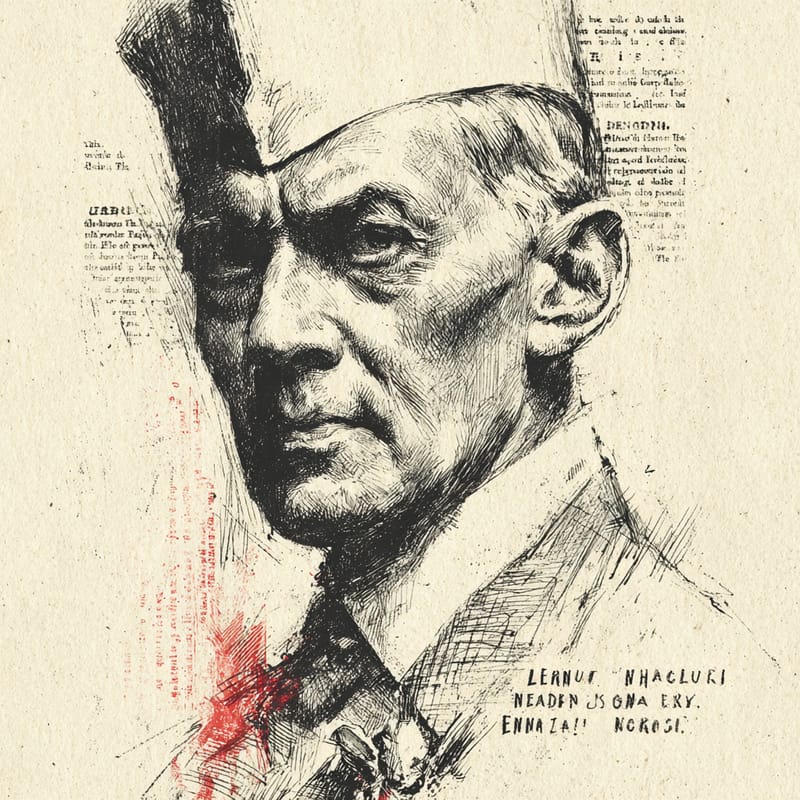
Jawaharlal Nehru
Democratic socialism for India
A planned mixed economy inside a parliamentary democracy.
Heterodox Social DemocratOne of 729 ideologies · enter the Social Democrat hall →- Role
- Prime Minister
- Era
- 1889–1964
- Region
- India
- Social band
- Heterodox
- Placement
- −50 · −18 · +30
§ Where Jawaharlal Nehru stands
3 axesInfluenced by Fabian socialism and by Soviet planning, Nehru built a mixed economy in which the state led industrialisation. The Planning Commission was set up in 1950, the Second Five-Year Plan of 1956 gave priority to heavy industry in the public sector, and the Industrial Policy Resolution of 1956 reserved key sectors for the state. Agriculture and most trade stayed private, and Congress's 1955 Avadi resolution named the goal a socialistic pattern of society.
Nehru was a founding democrat who held India to free elections, parliamentary government and an independent judiciary, beginning with the 1951–52 general election, then the largest ever held. His record had limits: the 1951 First Amendment added new restrictions on free speech, and in 1959 his government dismissed Kerala's elected communist ministry by imposing President's Rule.
A secular modernist, Nehru saw science, industry and reason as the cure for poverty and communal strife, and he insisted that India be a secular state rather than a Hindu one. His government passed the Hindu Code Bills of 1955–56, which legalised divorce, banned bigamy and gave daughters inheritance rights among Hindus, while leaving Muslim personal law untouched, a choice that remains contested.
How close are you to Jawaharlal Nehru?
Three statements, one per axis. Answer them and we’ll drop you on the compass next to them.
§ The story
HistoricalJawaharlal Nehru (1889–1964) was India's first prime minister, serving from independence in August 1947 until his death in May 1964. The son of the wealthy lawyer and nationalist Motilal Nehru, he was educated at Harrow and Trinity College, Cambridge, and trained as a barrister in London before joining Mahatma Gandhi's movement. As president of the Indian National Congress at Lahore in 1929 he presided over its demand for complete independence, and he spent nearly nine years in British prisons, where he wrote The Discovery of India.
As prime minister Nehru built the institutions of the new republic: parliamentary democracy under the 1950 constitution, five-year plans for a state-led mixed economy, linguistic states, and scientific and technical bodies such as the Indian Institutes of Technology. Abroad he championed non-alignment between the Cold War blocs, co-founding the Non-Aligned Movement in 1961. His record is contested: critics fault his central planning for slow growth, his handling of Kashmir and India's defeat by China in the 1962 border war, which shadowed his final years.
Notable for
- 01Architect of independent India's state
- 02Non-Aligned Movement
- 03Secular constitutionalism
Key works & moments
- 1929Presides over the Congress session at Lahore that demands complete independence from Britain.
- 1946Publishes The Discovery of India, written in Ahmednagar Fort prison.
- 1947Becomes India's first prime minister and delivers the Tryst with Destiny speech at midnight.
- 1956The Second Five-Year Plan and Industrial Policy Resolution put heavy industry in state hands.
- 1961Co-founds the Non-Aligned Movement at the Belgrade summit.
- 1962India is defeated by China in a short border war.
In their own words
“At the stroke of the midnight hour, when the world sleeps, India will awake to life and freedom.”
§ Minds closest to Jawaharlal Nehru
All minds →

§ Also in the Social Democrat hall
Enter the hall →§ Common questions
4 answersWhat was Jawaharlal Nehru's political ideology?
Jawaharlal Nehru was a democratic socialist in the Fabian mould: on the 99ideologies three-axis compass, a Heterodox Social Democrat. Economically he sat left of centre (−50), building a planned, state-led mixed economy through five-year plans. On governance he was a founding democrat (−18) who held India to elections and parliamentary rule, though he restricted speech and dismissed an elected state government. Socially he was a secular moderniser (+30), reforming Hindu family law and championing science and pluralism.
Was Jawaharlal Nehru left-wing or right-wing?
Left of centre. Nehru called himself a socialist, admired Soviet planning and committed Congress to a socialistic pattern of society in 1955, and his governments expanded public enterprise and land reform. But he rejected communism and revolution, kept a large private sector and preserved parliamentary democracy, so he is best described as a democratic socialist or social democrat. Abroad, his policy of non-alignment kept India out of both Cold War blocs.
Was Nehru a socialist?
Yes, though a democratic rather than a revolutionary one. Nehru was drawn to Fabian socialism as a student in England and impressed by Soviet planning on a 1927 visit to Moscow, and he called himself a socialist throughout his career. In office he applied it through state ownership of heavy industry, five-year plans and the 1955 Avadi resolution, while preserving private enterprise, private farming and parliamentary democracy, which places him closer to European social democracy than to communism.
Which minds are closest to Jawaharlal Nehru?
On the 99ideologies three-axis compass, the minds closest to Jawaharlal Nehru are Tage Erlander (98% alike), François Mitterrand (97% alike) and Bruno Kreisky (97% alike). The furthest is Adam Sutler (14% alike).