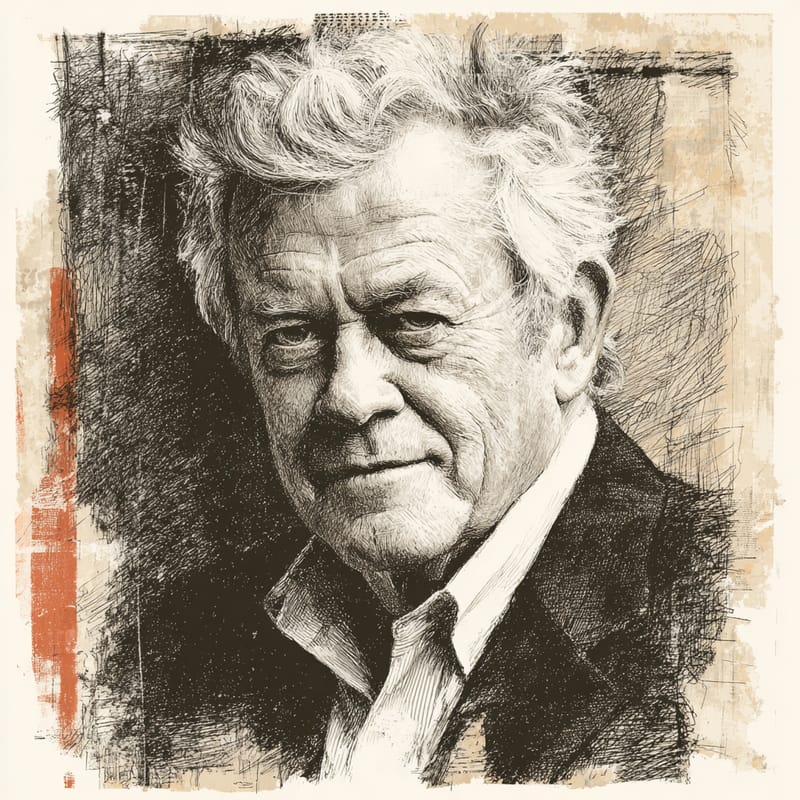
Bob Hawke
Consensus and the Accord
Union leader who governed by bringing everyone to the table.
Social DemocratOne of 729 ideologies · enter the Social Democrat hall →- Role
- Prime Minister
- Era
- 1929–2019
- Region
- Australia
- Social band
- Centre (no modifier)
- Placement
- −38 · −22 · +10
§ Where Bob Hawke stands
3 axesHawke's Prices and Incomes Accord of 1983 bound the unions to wage restraint in return for a social wage of universal Medicare from 1984, family payments and award superannuation, which keeps him left of centre. Yet his government floated the dollar in December 1983, licensed foreign banks from 1985 and cut tariffs, opening a protected economy to global competition, which is where his left-wing economics stopped.
A consensus democrat, Hawke opened his term by convening business, unions and governments at the National Economic Summit in Parliament House in April 1983 and governed through negotiated agreements. When his Australia Card, a proposed national identity card, met fierce civil-liberties opposition, he used its rejection by the Senate to call the 1987 double-dissolution election, but abandoned the scheme later that year.
Culturally Hawke stood near the centre, but his government passed the Sex Discrimination Act 1984 and used federal power to stop the Franklin Dam in Tasmania in 1983, a decision upheld by the High Court. After the Tiananmen Square massacre in 1989 he let Chinese students in Australia remain, and in 1988 he responded to the Barunga Statement by promising Aboriginal Australians a treaty that was never concluded.
How close are you to Bob Hawke?
Three statements, one per axis. Answer them and we’ll drop you on the compass next to them.
§ The story
HistoricalRobert James Lee Hawke (1929–2019) was prime minister of Australia from 1983 to 1991, the longest-serving Labor holder of the office. The son of a Congregationalist minister, born in Bordertown, South Australia, he studied law and economics in Perth and went to Oxford as a Rhodes Scholar before joining the Australian Council of Trade Unions as research officer and wage advocate in 1958. As ACTU president through the 1970s he became the country's best-known union leader, entered Parliament for Wills in 1980 and replaced Bill Hayden as Labor leader in February 1983, a month before winning a general election.
Hawke governed by consensus, opening his term with a National Economic Summit and building policy on the Prices and Incomes Accord with the unions, which traded wage restraint for a social wage that included Medicare in 1984. With Treasurer Paul Keating he floated the dollar, deregulated finance and cut tariffs, opening a long-protected economy. He won four elections, blocked the Franklin Dam, helped secure a ban on mining in Antarctica and launched APEC in 1989. Critics on the left argue that the Accord eroded union power and real wages. Keating deposed him in a caucus ballot in December 1991.
Notable for
- 01The Prices and Incomes Accord
- 02Saved the Franklin River
- 03Medicare's introduction
Key works & moments
- 1969Elected president of the Australian Council of Trade Unions.
- 1983Becomes prime minister in March and floats the Australian dollar in December.
- 1984Medicare begins, giving all Australians tax-funded hospital and medical cover.
- 1987Wins a third election after a double dissolution triggered by the Australia Card bill.
- 1989Launches Asia-Pacific Economic Cooperation, whose first ministerial meeting is held in Canberra.
- 1991Loses the Labor leadership to Paul Keating in a December caucus ballot.
§ Minds closest to Bob Hawke
All minds →

§ Also in the Social Democrat hall
Enter the hall →§ Common questions
4 answersWhat was Bob Hawke's political ideology?
Bob Hawke was a consensus-minded Labor social democrat: on the 99ideologies three-axis compass, a Social Democrat. Economically he sits left of centre (−38), pairing the union Accord and Medicare with market reforms such as floating the dollar and cutting tariffs. On governance he was a consensual parliamentary democrat (−22) who preferred negotiated agreements to confrontation, and socially he sits close to the centre (+10), cautious on culture but with landmark environmental and anti-discrimination measures.
Was Bob Hawke left-wing or right-wing?
Centre-left. Hawke came from the trade-union movement and led the Australian Labor Party, and his governments created Medicare, expanded superannuation and family payments and passed anti-discrimination law. But together with Paul Keating he also deregulated finance, floated the dollar, cut tariffs and began privatisation, reforms that critics on the left saw as a turn towards free-market economics. That mix places him in the moderate social-democratic mainstream of the 1980s.
Did Bob Hawke introduce Medicare?
Yes. Medicare began on 1 February 1984 under the Hawke government, with Neal Blewett as health minister, as a central part of the social wage promised to the unions under the Accord. It restored universal, tax-funded health insurance after the Fraser government had dismantled Gough Whitlam's Medibank, offering free treatment in public hospitals and subsidised visits to doctors. It was funded partly by a levy of 1 per cent of taxable income and has remained a pillar of Australian health policy.
Which minds are closest to Bob Hawke?
On the 99ideologies three-axis compass, the minds closest to Bob Hawke are Frances Perkins (97% alike), Hjalmar Branting (96% alike) and Clement Attlee (95% alike). The furthest is Adam Sutler (20% alike).