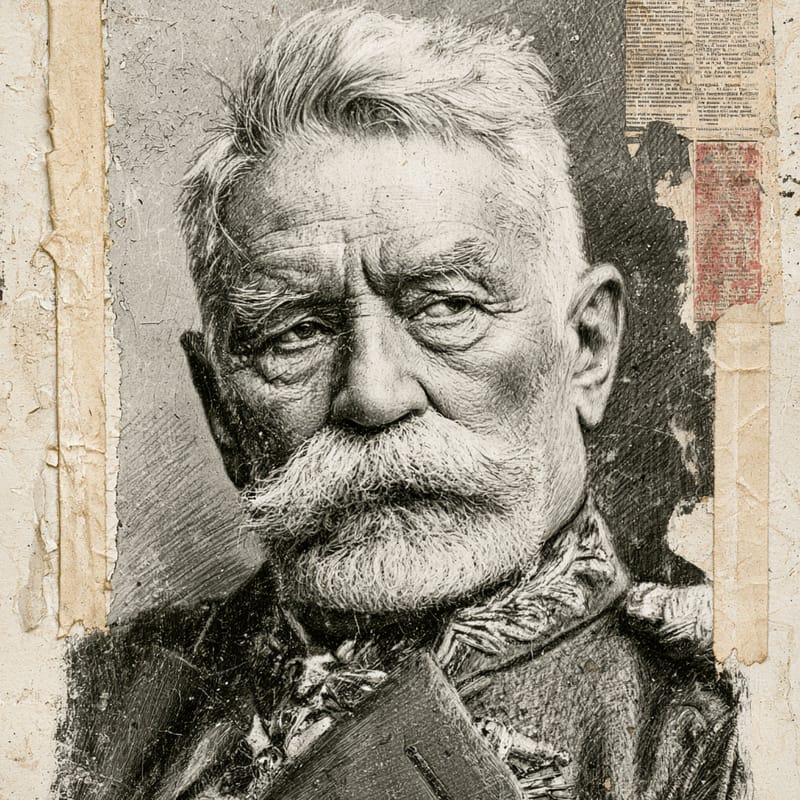
Paul von Hindenburg
Liberal DemocratOne of 729 ideologies · enter the Liberal Democrat hall →- Role
- —
- Era
- —
- Region
- —
- Social band
- Centre (no modifier)
- Placement
- −25 · −25 · 0
§ Where Paul von Hindenburg stands
3 axesHindenburg had no economic programme of his own; his left-of-centre placement reflects the Weimar social state over which he presided as head of state, including the national unemployment insurance law he signed in 1927. His personal sympathies lay with the East Elbian landed estates, which benefited from the Osthilfe agricultural subsidies of the early 1930s, and from 1930 he approved Heinrich Brüning's emergency decrees cutting wages, salaries and benefits.
Hindenburg's placement reflects the pluralist Weimar constitution he swore to uphold in 1925, and until 1930 he governed through cabinets backed or tolerated by the Reichstag. His own conduct then moved the other way: he appointed presidential cabinets ruling by Article 48 emergency decrees, repeatedly dissolved the Reichstag, made Hitler chancellor in January 1933 and signed the Reichstag Fire Decree that February, suspending basic rights.
Hindenburg was a Lutheran Prussian conservative and monarchist who remained loyal to the exiled Kaiser and the values of the old officer caste. Before a parliamentary committee of inquiry in November 1919 he lent his authority to the stab-in-the-back myth, blaming defeat on subversion at home, and in 1933 he asked Hitler to exempt Jewish front-line veterans from the civil-service purge.
How close are you to Paul von Hindenburg?
Three statements, one per axis. Answer them and we’ll drop you on the compass next to them.
§ The story
HistoricalPaul von Hindenburg (1847–1934) was a Prussian field marshal and the second president of the Weimar Republic, serving from 1925 until his death. Born in Posen into an old Junker military family, he fought at Königgrätz in 1866 and in the Franco-Prussian War, retired in 1911 and was recalled in August 1914, when victory over the Russians at Tannenberg made him a national hero. From 1916 he and Erich Ludendorff directed the German war effort from the Supreme Army Command and dominated German politics until defeat in 1918.
Elected president in 1925 as the candidate of the nationalist right after Friedrich Ebert's death, the monarchist swore to uphold the republican constitution and at first governed through parliamentary cabinets. From 1930 he appointed presidential cabinets under Heinrich Brüning, Franz von Papen and Kurt von Schleicher that ruled by emergency decree under Article 48. Re-elected in 1932 with Social Democratic and Centre Party support against Adolf Hitler, he nonetheless appointed Hitler chancellor on 30 January 1933 and weeks later signed the Reichstag Fire Decree suspending civil liberties. His death in August 1934 let Hitler merge the presidency and the chancellorship.
Key works & moments
- 1914Defeats the Russian army at Tannenberg in East Prussia, becoming a national hero.
- 1916Becomes chief of the General Staff; with Erich Ludendorff he dominates German war policy.
- 1919Tells a parliamentary inquiry the army was stabbed in the back, feeding a nationalist myth.
- 1925Elected president of the Weimar Republic after Friedrich Ebert's death.
- 1932Re-elected president over Adolf Hitler with Social Democratic and Centre support.
- 1933Appoints Hitler chancellor and signs the Reichstag Fire Decree suspending civil liberties.
§ Minds closest to Paul von Hindenburg
All minds →



§ Also in the Liberal Democrat hall
Enter the hall →§ Common questions
4 answersWhat was Paul von Hindenburg's political ideology?
Hindenburg was a monarchist, Prussian conservative and nationalist who served as head of state of a democratic republic: on the 99ideologies three-axis compass, a Liberal Democrat, a placement that reflects the Weimar constitutional order he headed. Economically it sits left of centre (−25), matching the Weimar social state, and on governance it sits on the liberal side (−25), reflecting the republic's pluralist constitution, which from 1930 he increasingly bypassed through emergency decrees. Socially he was a Lutheran traditionalist loyal to the monarchy and the officer caste.
Was Paul von Hindenburg left-wing or right-wing?
Right-wing. Hindenburg was a Prussian aristocrat, field marshal and monarchist who was elected president in 1925 as the candidate of the nationalist right. Paradoxically, in 1932 the Social Democrats and the Catholic Centre backed his re-election as the only way to stop Adolf Hitler. Within weeks, however, he dismissed Chancellor Heinrich Brüning, turned to narrowly based conservative cabinets and in January 1933 appointed Hitler chancellor, so his presidency ended by handing power to the far right.
Why did Hindenburg appoint Hitler as chancellor?
Because the conservative alternatives had failed and his advisers persuaded him that Hitler could be contained. The Nazis were the largest party in the Reichstag after the elections of July and November 1932, while the cabinets of Franz von Papen and Kurt von Schleicher lacked parliamentary support. Hindenburg had refused Hitler the chancellorship in August and November 1932, but in January 1933 Papen convinced him that a cabinet with only three Nazis, surrounded by conservatives, would tame him. The calculation failed within months.
Which minds are closest to Paul von Hindenburg?
On the 99ideologies three-axis compass, the minds closest to Paul von Hindenburg are Bob Hawke (93% alike), Helmut Schmidt (92% alike) and Ramsay MacDonald (92% alike). The furthest is Adam Sutler (24% alike).