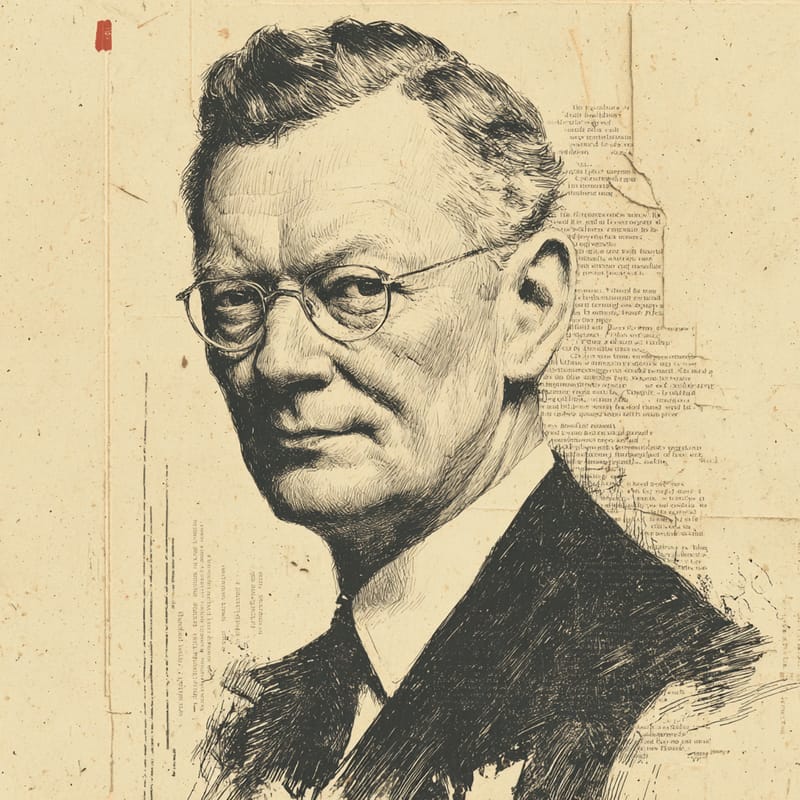
David Lange
Nuclear-free New Zealand
Moral foreign policy with a sharp debating wit.
Heterodox Social DemocratOne of 729 ideologies · enter the Social Democrat hall →- Role
- Prime Minister
- Era
- 1942–2005
- Region
- New Zealand
- Social band
- Heterodox
- Placement
- −38 · −26 · +30
§ Where David Lange stands
3 axesLange came from Labour's social-democratic tradition, but his government floated the dollar in March 1985, scrapped farm subsidies, corporatised state trading departments under the State-Owned Enterprises Act 1986 and introduced a goods and services tax. His left-of-centre placement reflects his revolt against that programme: in early 1988 he vetoed Roger Douglas's flat tax, called for a pause in reform and defended the welfare state.
A parliamentary democrat and lawyer by training, Lange widened citizens' means of holding the state to account. The Treaty of Waitangi Amendment Act 1985 let the Waitangi Tribunal hear Māori claims dating back to 1840, his government's 1985 white paper proposed a bill of rights, enacted in 1990, and as education minister he devolved school management to elected boards of trustees under the Tomorrow's Schools reforms of 1989.
Lange was socially progressive and grounded his politics in Methodist conscience. He voted for the Homosexual Law Reform Act 1986, which decriminalised sex between men, and he framed the New Zealand Nuclear Free Zone, Disarmament, and Arms Control Act 1987 as a moral stand, having argued at the Oxford Union in 1985 that nuclear weapons were morally indefensible.
How close are you to David Lange?
Three statements, one per axis. Answer them and we’ll drop you on the compass next to them.
§ The story
HistoricalDavid Russell Lange (1942–2005) was prime minister of New Zealand from 1984 to 1989. The son of a doctor in Otahuhu, South Auckland, he trained as a lawyer and worked for low-income clients before winning the Mangere seat for Labour at a 1977 by-election. A Methodist lay preacher with a quick wit, he became Labour leader in 1983 and, aged 41, led the party to a landslide in the snap election Robert Muldoon called for July 1984.
Lange's government made New Zealand nuclear-free, refusing a visit by the USS Buchanan in 1985 because Washington would neither confirm nor deny whether it carried nuclear arms; the United States then suspended its ANZUS security guarantee to New Zealand. At home his finance minister, Roger Douglas, drove some of the most radical free-market reforms in the developed world, known as Rogernomics. Lange came to oppose them, halting Douglas's flat-tax plan in early 1988 and sacking him that December, and he resigned in August 1989 after the Labour caucus voted Douglas back into cabinet. He left Parliament in 1996.
Notable for
- 01Nuclear-free legislation
- 02Oxford Union debate triumph
- 03Homosexual Law Reform Act
Key works & moments
- 1977Wins the Mangere seat for Labour at a by-election.
- 1984Leads Labour to a landslide in July's snap election and becomes prime minister.
- 1985Bars the USS Buchanan and argues at the Oxford Union that nuclear weapons are morally indefensible.
- 1986Votes for the Homosexual Law Reform Act, decriminalising sex between men.
- 1987Nuclear-free legislation becomes law and Labour wins a second term in August.
- 1989Resigns as prime minister after the caucus returns Roger Douglas to cabinet.
In their own words
“I can smell the uranium on it as you lean towards me!”
§ Minds closest to David Lange
All minds →



§ Also in the Social Democrat hall
Enter the hall →§ Common questions
4 answersWhat was David Lange's political ideology?
David Lange was a social democrat in the New Zealand Labour tradition: on the 99ideologies three-axis compass, a Heterodox Social Democrat. Economically he sits left of centre (−38), reflecting his defence of the welfare state and his break with the free-market Rogernomics his own government launched. On governance he was a liberal parliamentary democrat (−26), and socially he was progressive (+30), backing homosexual law reform and a nuclear-free foreign policy grounded in moral argument.
Was David Lange left-wing or right-wing?
Left-wing, though his government is remembered for right-wing economics. Lange led the Labour Party, and his instincts were social democratic: he defended public services, opposed nuclear weapons and supported gay law reform. But his ministers, led by Roger Douglas, floated the currency, cut subsidies and corporatised state enterprises, policies usually associated with the free-market right. Lange's attempt to halt them in 1987–88 and his sacking of Douglas show where his own sympathies lay.
Did David Lange support Rogernomics?
At first, yes; later, no. Lange's government launched the reforms after the 1984 currency crisis, floating the dollar, removing farm subsidies and corporatising state trading departments, and he defended them through the 1987 election. After the October 1987 share-market crash he concluded they had gone too far, vetoed Roger Douglas's flat-tax package in early 1988 and called for a pause. The feud split the cabinet: he sacked Douglas in December 1988 and resigned in August 1989.
Which minds are closest to David Lange?
On the 99ideologies three-axis compass, the minds closest to David Lange are Jens Stoltenberg (98% alike), Birgitte Nyborg (98% alike) and François Mitterrand (97% alike). The furthest is Adam Sutler (15% alike).