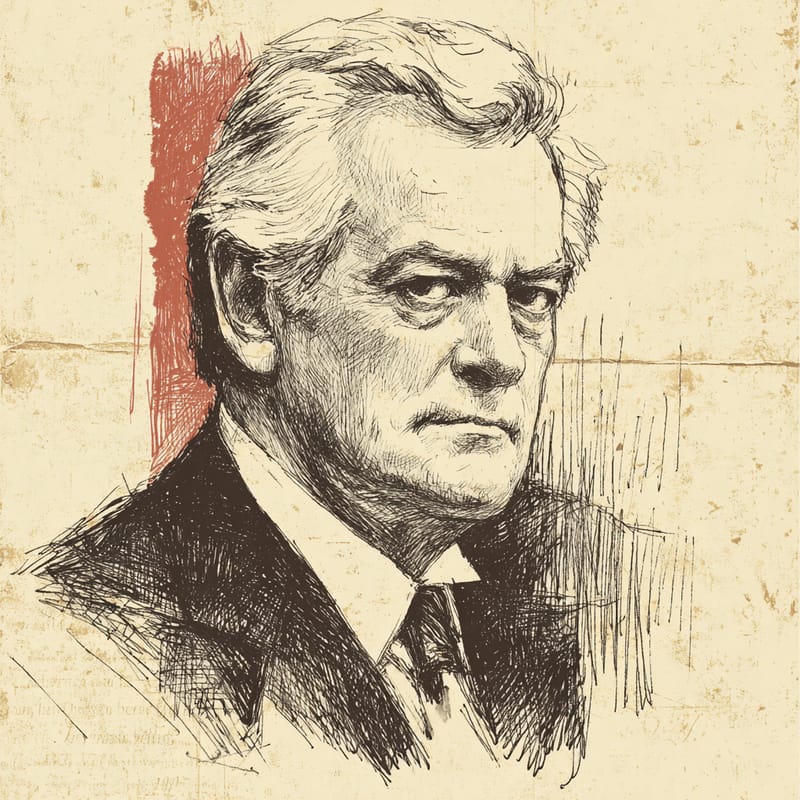
Gough Whitlam
Three years that changed Australia
A whirlwind of social reform, then a dramatic dismissal.
Reformist Social DemocratOne of 729 ideologies · enter the Social Democrat hall →- Role
- Prime Minister
- Era
- 1916–2014
- Region
- Australia
- Social band
- Reformist
- Placement
- −44 · −22 · +38
§ Where Gough Whitlam stands
3 axesWhitlam expanded the federal government's role in health, education and cities rather than nationalising industry. His government abolished university tuition fees in 1974, created Medibank, a universal public health insurance scheme, in 1975, introduced a supporting mother's benefit and funded sewerage and services in fast-growing suburbs. It also cut tariffs across the board by 25 per cent in 1973.
Whitlam was a democratic reformer who worked through parliament and lowered the voting age to 18 in 1973. His dismissal in 1975, after the Senate blocked supply, became Australia's most bitterly contested constitutional crisis; he denounced it as an abuse of the Crown's reserve powers but accepted the decision and fought the election rather than resist.
Whitlam's social reforms were sweeping. His government passed the Racial Discrimination Act and introduced no-fault divorce in the Family Law Act, both in 1975, appointed a women's adviser to the prime minister in 1973 and began returning land to Aboriginal people, symbolised by his pouring soil into the hand of the Gurindji leader Vincent Lingiari. It also adopted Advance Australia Fair as the anthem for most official occasions.
How close are you to Gough Whitlam?
Three statements, one per axis. Answer them and we’ll drop you on the compass next to them.
§ The story
HistoricalEdward Gough Whitlam (1916–2014) was prime minister of Australia from December 1972 to November 1975. The son of a senior federal public servant, he served as a navigator in the Royal Australian Air Force during the Second World War, became a barrister and entered parliament in 1952. As Labor leader from 1967 he modernised the party's platform and organisation, and in 1972, campaigning under the slogan It's Time, he ended 23 years of conservative government.
Whitlam's government moved at extraordinary speed: it ended conscription, withdrew the last troops from Vietnam, recognised the People's Republic of China, abolished university fees and created Medibank, the forerunner of Medicare. Rising inflation, ministerial scandals and the loans affair weakened it, and in October 1975 the opposition-controlled Senate blocked supply. On 11 November 1975 Governor-General Sir John Kerr dismissed him and appointed Malcolm Fraser caretaker prime minister, the only time a governor-general has dismissed an Australian prime minister, and Labor lost the ensuing election heavily.
Notable for
- 01Introduced Medibank
- 02Abolished university fees
- 03The 1975 dismissal
Key works & moments
- 1972Wins the It's Time election, ending 23 years of conservative rule.
- 1972Within weeks, ends conscription and recognises the People's Republic of China.
- 1974Abolishes university tuition fees.
- 1975Medibank begins; pours soil into Vincent Lingiari's hand, returning Gurindji land.
- Nov 1975Dismissed by Governor-General Sir John Kerr after the Senate blocks supply.
- 1977Resigns as Labor leader after a second election defeat.
In their own words
“Well may we say 'God save the Queen', because nothing will save the Governor-General!”
§ Minds closest to Gough Whitlam
All minds →




§ Also in the Social Democrat hall
Enter the hall →§ Common questions
4 answersWhat was Gough Whitlam's political ideology?
Gough Whitlam was a reforming social democrat: on the 99ideologies three-axis compass, a Reformist Social Democrat. Economically he sat left of centre (−44), creating universal health insurance and free university education while cutting tariffs. On governance he was a democratic reformer (−22) who lowered the voting age and accepted his 1975 dismissal at the ballot box. Socially he was progressive (+38), passing the Racial Discrimination Act and no-fault divorce and taking the first steps towards Aboriginal land rights.
Was Gough Whitlam left-wing or right-wing?
Left of centre. Whitlam led the Australian Labor Party, and his government expanded the federal welfare state, ended conscription, recognised communist China and championed Aboriginal land rights. Yet he was a moderniser rather than a socialist: he focused Labor on public services, cities and equal opportunity rather than on public ownership of industry, and he cut tariffs by a quarter, which places him in the social-democratic mainstream.
Why was Gough Whitlam dismissed?
Because the Senate, where the Liberal and Country party opposition under Malcolm Fraser had the numbers, blocked the government's budget bills in October 1975, threatening to leave it without money. Whitlam refused to call an election, arguing that a government with a majority in the House need not bow to the Senate. On 11 November 1975 Governor-General Sir John Kerr used the Crown's reserve powers to dismiss him and commissioned Fraser as caretaker on condition that he call an election, which Labor lost heavily.
Which minds are closest to Gough Whitlam?
On the 99ideologies three-axis compass, the minds closest to Gough Whitlam are Bruno Kreisky (98% alike), Gro Harlem Brundtland (97% alike) and Willy Brandt (97% alike). The furthest is Adam Sutler (13% alike).