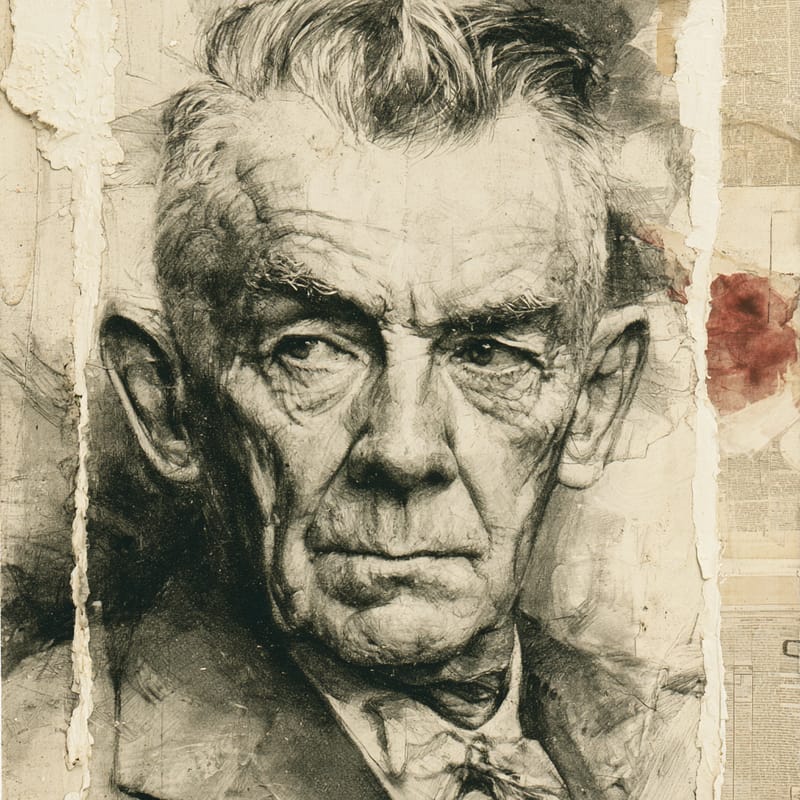
Ian Smith
Paleo-ConservativeOne of 729 ideologies · enter the Paleo-Conservative hall →- Role
- —
- Era
- —
- Region
- —
- Social band
- Centre (no modifier)
- Placement
- +75 · +50 · 0
§ Where Ian Smith stands
3 axesSmith's Rhodesia was a settler capitalist economy built on white-owned commercial farms, mines and industry. The 1969 Land Tenure Act divided the land roughly equally between about a quarter of a million whites and some five million Africans. Under UN sanctions his government relied on sanctions-busting trade through South Africa and Portuguese Mozambique and on state controls over foreign exchange, without abandoning private enterprise.
Smith governed through a parliament elected on property and education qualifications that kept the electorate overwhelmingly white, and under a state of emergency declared in 1965 and renewed throughout his rule. African nationalist leaders including Joshua Nkomo and Robert Mugabe were detained without trial for about a decade, the press was censored, and the 1969 constitution entrenched white control of parliament.
Smith defended white minority rule as necessary to preserve Western, Christian standards of government against African nationalism and communism, and in 1976 he declared that he did not believe in black majority rule ever. The Land Tenure Act kept land ownership and residence segregated by race, although Rhodesia never adopted South Africa's full apparatus of apartheid legislation.
How close are you to Ian Smith?
Three statements, one per axis. Answer them and we’ll drop you on the compass next to them.
§ The story
HistoricalIan Douglas Smith (1919–2007) was prime minister of Rhodesia from 1964 to 1979. Born in Selukwe, Southern Rhodesia, to British settler parents, he flew as a Royal Air Force fighter pilot in the Second World War, surviving a crash in North Africa and later being shot down over Italy, where he fought alongside partisans. A farmer, he entered the colony's parliament in 1948 and in 1962 helped found the Rhodesian Front, which won power that year on a platform of independence under white minority rule.
Rather than accept majority rule, Smith's government issued the Unilateral Declaration of Independence from Britain on 11 November 1965. No country recognised it; the United Nations imposed mandatory sanctions, and a guerrilla war with the ZANU and ZAPU nationalist movements claimed an estimated 20,000 to 30,000 lives. Under pressure from South Africa and the United States he accepted majority rule in principle in 1976 and agreed an internal settlement in 1978, but after the 1979 Lancaster House agreement power passed to Robert Mugabe. Smith sat in Zimbabwe's parliament as a critic of the new government until 1987.
Key works & moments
- 1962Co-founds the Rhodesian Front, which wins that year's election on a white-rule platform.
- 1964Becomes prime minister of the self-governing British colony of Southern Rhodesia.
- 1965Issues the Unilateral Declaration of Independence from Britain on 11 November.
- 1969A new constitution and the Land Tenure Act entrench white control; a republic follows in 1970.
- 1976Accepts majority rule in principle under pressure from Henry Kissinger and South Africa.
- 1979Attends the Lancaster House talks that lead to Zimbabwe's independence under majority rule in 1980.
In their own words
“I don't believe in black majority rule ever in Rhodesia, not in a thousand years.”
§ Minds closest to Ian Smith
All minds →




§ Also in the Paleo-Conservative hall
Enter the hall →§ Common questions
4 answersWhat was Ian Smith's political ideology?
Ian Smith was a white-minority conservative nationalist: on the 99ideologies three-axis compass, a Paleo-Conservative. Economically he sat firmly on the market right (+75), presiding over a settler capitalist economy of white-owned farms, mines and industry. On governance he was strongly authoritarian (+50), ruling under a permanent state of emergency with detention without trial and press censorship. Socially he defended a racially hierarchical order, declaring in 1976 that he would never accept black majority rule in Rhodesia.
Was Ian Smith left-wing or right-wing?
Right-wing. Smith championed private enterprise, anti-communism and the political supremacy of Rhodesia's white minority, and his Rhodesian Front was founded to resist British pressure for majority rule. He presented Rhodesia as a bastion of the West in the Cold War, while the nationalist movements fighting him drew support from China, which backed ZANU, and the Soviet Union, which backed ZAPU. Within white politics his party stood to the right of the establishment that had governed the colony before 1962.
Why did Ian Smith declare independence from Britain?
To preserve white minority rule. Britain was granting independence to its African colonies under majority rule, including its former federation partners Zambia and Malawi in 1964, and Harold Wilson's government insisted on guarantees of progress towards majority rule before Rhodesia could follow. When negotiations failed, Smith's cabinet issued the Unilateral Declaration of Independence on 11 November 1965, its text consciously echoing the American Declaration of 1776. Britain answered with sanctions rather than force, and the rebellion ended only in December 1979.
Which minds are closest to Ian Smith?
On the 99ideologies three-axis compass, the minds closest to Ian Smith are Daniel François Malan (100% alike), Zhu Rongji (91% alike) and Robert McNamara (90% alike). The furthest is Emma Goldman (5% alike).