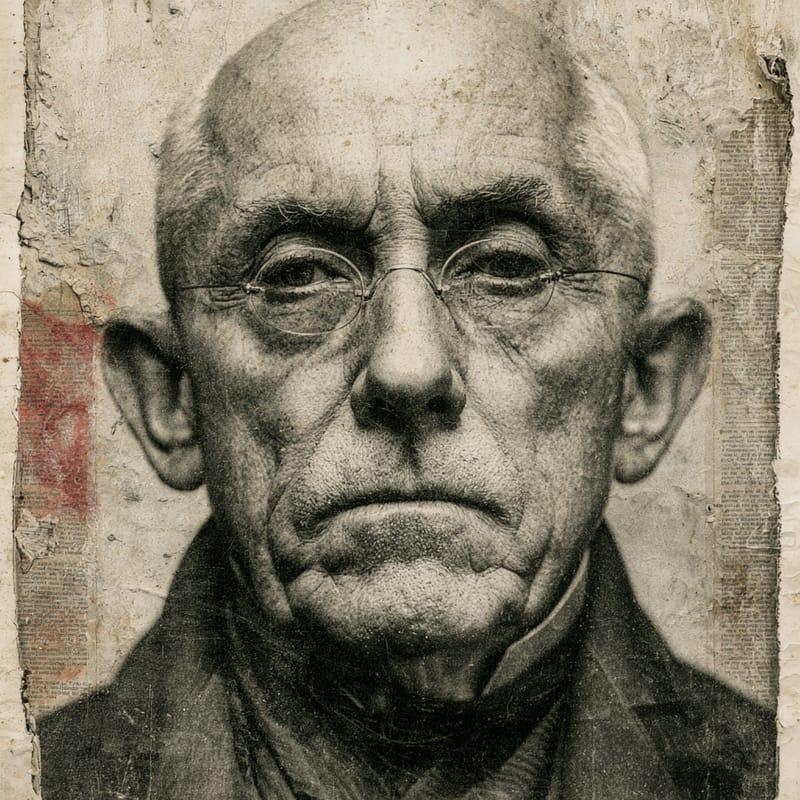
Daniel François Malan
Paleo-ConservativeOne of 729 ideologies · enter the Paleo-Conservative hall →- Role
- —
- Era
- —
- Region
- —
- Social band
- Centre (no modifier)
- Placement
- +75 · +50 · 0
§ Where Daniel François Malan stands
3 axesMalan's National Party defended private property and capitalism while using the state to lift poor Afrikaners and to control Black labour. His government consolidated the pass laws in 1952, extending them to African women, and passed the Native Labour (Settlement of Disputes) Act of 1953, which barred African workers from striking. Its economic populism protected white workers from Black competition rather than challenging private ownership.
Malan used parliamentary majorities to override opponents and the courts. The 1950 Suppression of Communism Act banned the Communist Party and defined communism so broadly that it could be used against almost any critic of apartheid. When judges struck down the 1951 law removing Coloured voters from the common roll, his government tried to overrule them with the 1952 High Court of Parliament Act, which the courts also voided.
Malan presented apartheid as Christian-national guardianship under which each racial group would develop separately beneath white rule. His government classified every South African by race, banned marriage across racial lines in 1949 and extended the ban on interracial sex in 1950, and segregated neighbourhoods and public amenities. As interior minister he had introduced the 1930 Quota Act, aimed at Jewish immigration from Eastern Europe.
How close are you to Daniel François Malan?
Three statements, one per axis. Answer them and we’ll drop you on the compass next to them.
§ The story
HistoricalDaniel François Malan (1874–1959) was prime minister of South Africa from 1948 to 1954. Born near Riebeek West in the Cape Colony, he studied at Victoria College in Stellenbosch and earned a doctorate in divinity at Utrecht before serving as a Dutch Reformed Church minister. In 1915 he left the pulpit to edit the new nationalist newspaper Die Burger, then entered parliament for J. B. M. Hertzog's National Party and served as minister of the interior, education and public health from 1924 to 1933.
When Hertzog merged his party with Jan Smuts's in 1934, Malan led the breakaway Purified National Party, which opposed South Africa's entry into the Second World War. He won the 1948 election on a platform of apartheid, taking a majority of seats with a minority of the vote, and his government enacted the system's founding laws, from the Prohibition of Mixed Marriages Act to the Population Registration and Group Areas Acts. The African National Congress answered with the 1952 Defiance Campaign. Malan retired in 1954; apartheid endured until the early 1990s.
Key works & moments
- 1915Leaves the Dutch Reformed ministry to become the first editor of the nationalist daily Die Burger.
- 1930As interior minister, introduces the Quota Act restricting immigration from Eastern Europe.
- 1934Leads the breakaway Purified National Party after Hertzog merges with Jan Smuts.
- 1948Wins the general election on an apartheid platform and becomes prime minister.
- 1950Passes the Population Registration, Group Areas and Suppression of Communism Acts.
- 1954Retires as prime minister and is succeeded by J. G. Strijdom.
§ Minds closest to Daniel François Malan
All minds →



§ Also in the Paleo-Conservative hall
Enter the hall →§ Common questions
4 answersWhat was Daniel François Malan's political ideology?
D. F. Malan was an Afrikaner nationalist and the prime minister who made apartheid law: on the 99ideologies three-axis compass, a Paleo-Conservative. Economically he sat firmly on the right (+75), defending private property while using the state to protect white workers and control Black labour. On governance he was strongly authoritarian (+50), banning communism and trying to override the courts to remove Coloured voters from the common roll. Socially he enforced a rigid racial hierarchy through apartheid's founding statutes, justified in Christian-national terms.
Was Daniel François Malan left-wing or right-wing?
Right-wing. Malan's National Party was nationalist, anti-communist, religiously conservative and committed to white supremacy, and it outlawed the Communist Party in 1950. It did use state power and patronage to lift poor Afrikaners, which gave its nationalism a populist economic edge, but it never challenged private ownership. Its defining commitment was a racial and national order, not economic redistribution, and it stood to the right of Jan Smuts's United Party, which it defeated in 1948.
Did D. F. Malan create apartheid?
He made it law, though he did not invent segregation. South Africa already had segregationist legislation such as the 1913 Natives Land Act and the 1923 Natives (Urban Areas) Act. Malan's National Party fought the 1948 election on apartheid, a programme set out in its 1947 Sauer Commission report, and his government passed the founding statutes on race classification, mixed marriages and group areas. Hendrik Verwoerd, his minister of native affairs from 1950, later developed it into grand apartheid and the homelands policy.
Which minds are closest to Daniel François Malan?
On the 99ideologies three-axis compass, the minds closest to Daniel François Malan are Ian Smith (100% alike), Zhu Rongji (91% alike) and Robert McNamara (90% alike). The furthest is Emma Goldman (5% alike).