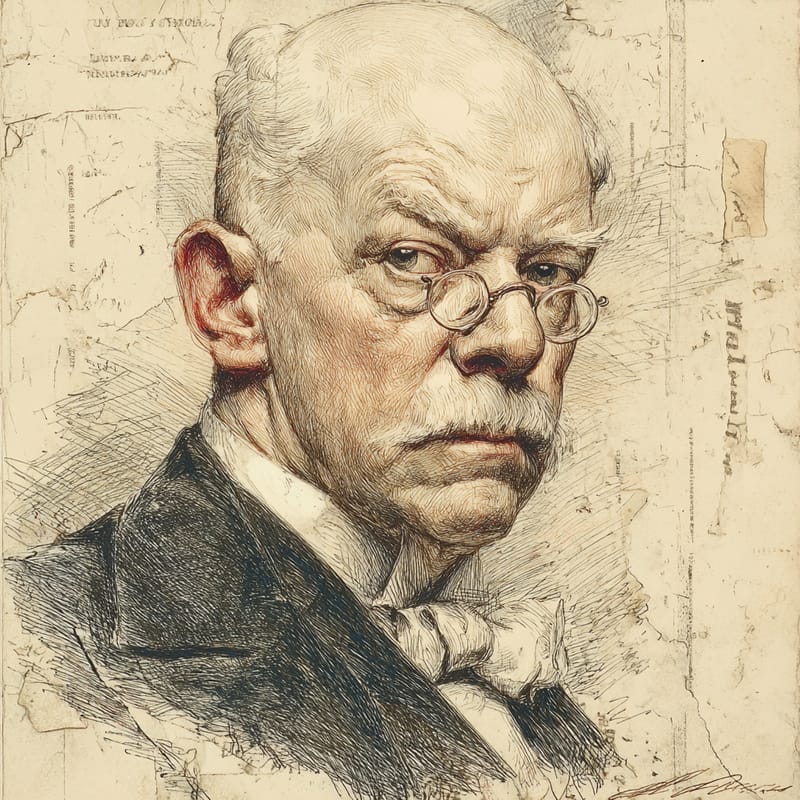
Robert A. Taft
Mr. Republican
Free markets, small government, non-intervention.
Traditional Paleo-ConservativeOne of 729 ideologies · enter the Paleo-Conservative hall →- Role
- Senator
- Era
- 1889–1953
- Region
- United States
- Social band
- Traditional
- Placement
- +72 · +42 · −55
§ Where Robert A. Taft stands
3 axesTaft opposed most of the New Deal as a threat to free enterprise and balanced budgets. His Labor Management Relations Act of 1947, better known as Taft–Hartley, banned the closed shop, let states pass right-to-work laws and allowed presidents to seek injunctions against strikes endangering national safety. He was no doctrinaire, though: he co-sponsored the Housing Act of 1949, which funded public housing, and backed federal aid to education.
Taft was a constitutional conservative who wanted power exercised through Congress and settled law. His labour law gave the federal government new tools against unions, including strike injunctions and anti-communist affidavits for union officers. Yet he resisted executive power, arguing in 1950 and 1951 that President Truman had no authority to send troops to Korea or to Europe without Congress's approval.
Taft's conservatism was that of the Midwestern business and professional class: he prized self-reliance, local community and settled law over planners and reformers. In a 1946 speech at Kenyon College he condemned the Nuremberg trials as ex post facto justice that would discredit the rule of law, and he opposed peacetime conscription as alien to American traditions of liberty.
How close are you to Robert A. Taft?
Three statements, one per axis. Answer them and we’ll drop you on the compass next to them.
§ The story
HistoricalRobert Alphonso Taft (1889–1953) was a United States senator from Ohio from 1939 until his death. The elder son of President William Howard Taft, he graduated first in his class from Harvard Law School, practised law in Cincinnati and served in the Ohio legislature in the 1920s and early 1930s, becoming speaker of the Ohio House. Elected to the Senate in 1938, he quickly became the leading Republican critic of Franklin Roosevelt's New Deal and earned the nickname Mr. Republican.
Taft sought the Republican presidential nomination in 1940, 1948 and 1952, losing each time to the party's internationalist eastern wing, finally in a bitter 1952 convention fight with Dwight Eisenhower. The Taft–Hartley Act of 1947 curbed union power over President Truman's veto, and his opposition to NATO and to open-ended military commitments abroad made him the voice of the non-interventionist Old Right. He became Senate majority leader in January 1953 and died of cancer that July. John F. Kennedy's Profiles in Courage praised his lonely attack on the Nuremberg trials.
Notable for
- 01Leader of the 'Old Right'
- 02Taft–Hartley Act
- 03Non-interventionist foreign policy
Key works & moments
- 1938Elected to the United States Senate from Ohio, taking his seat in January 1939.
- 1946Condemns the Nuremberg trials as ex post facto justice in a speech at Kenyon College.
- 1947The Taft–Hartley Act, restricting union power, passes over President Truman's veto.
- 1949Votes against ratifying the North Atlantic Treaty, which created NATO.
- 1951Publishes A Foreign Policy for Americans, opposing open-ended commitments abroad.
- 1952Loses the Republican nomination to Dwight Eisenhower after a bitter convention fight.
§ Minds closest to Robert A. Taft
All minds →


§ Also in the Paleo-Conservative hall
Enter the hall →§ Common questions
4 answersWhat was Robert A. Taft's political ideology?
Robert A. Taft was an Old Right conservative: on the 99ideologies three-axis compass, a Traditional Paleo-Conservative. Economically he sat firmly on the market right (+72), opposing the New Deal and curbing union power through the 1947 Taft–Hartley Act. On governance he leaned towards order and authority (+42), giving the federal government new powers over unions while insisting on congressional and constitutional limits. Socially he was traditional (−55), a Midwestern conservative who prized self-reliance, local community and settled law.
Was Robert Taft left-wing or right-wing?
Right-wing. Taft led Republican opposition to Franklin Roosevelt's New Deal and Harry Truman's Fair Deal, and his signature law curbed the power of trade unions. But he departed from later conservatism in important ways: he opposed NATO and large overseas military commitments, criticised the Nuremberg trials, and supported public housing and federal aid to education. That mix is why paleoconservatives and some libertarians both claim him as a forerunner.
Why was Robert Taft called Mr. Republican?
Because he embodied the party's conservative, Midwestern wing in the years when Democrats held the White House. From 1939 Taft was the most prominent Republican voice against the New Deal, he led the Senate Republican Policy Committee from 1947 and steered the Taft–Hartley Act into law, and he became majority leader in 1953. The nickname also carried irony: despite his standing in the party, he never won its presidential nomination, losing to candidates backed by its eastern, internationalist wing.
Which minds are closest to Robert A. Taft?
On the 99ideologies three-axis compass, the minds closest to Robert A. Taft are John Randolph of Roanoke (95% alike), Patrick Buchanan (94% alike) and Nigel Farage (93% alike). The furthest is Emma Goldman (0% alike).