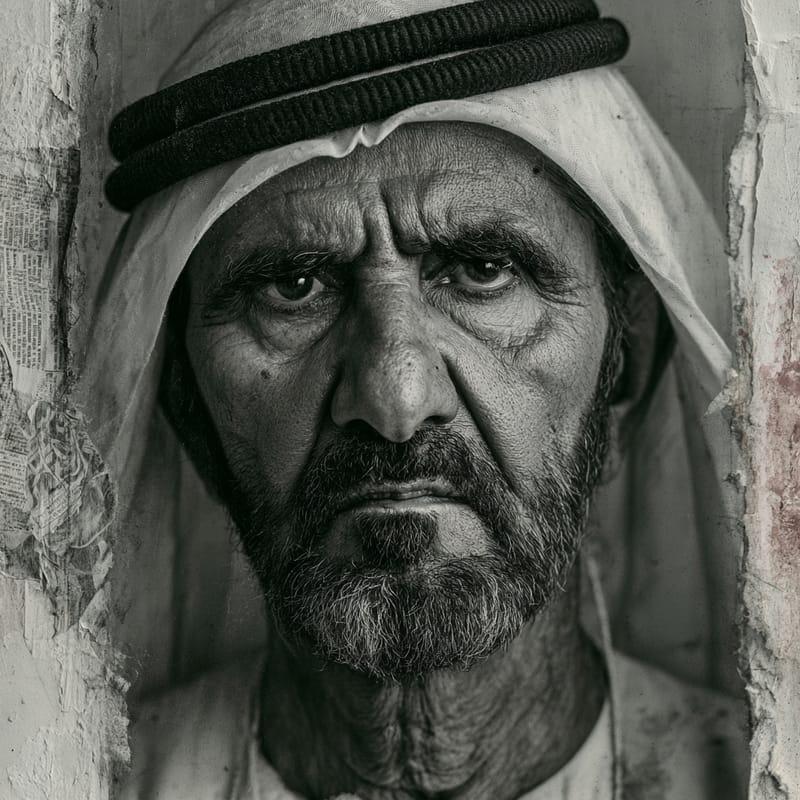
Mohammed bin Rashid Al Maktoum
National CapitalistOne of 729 ideologies · enter the National Capitalist hall →- Role
- —
- Era
- —
- Region
- —
- Social band
- Centre (no modifier)
- Placement
- +100 · +50 · 0
§ Where Mohammed bin Rashid Al Maktoum stands
3 axesDubai under Sheikh Mohammed is among the world's most open, low-tax economies: there is no personal income tax, and free zones such as the Dubai International Financial Centre, launched in 2004 with its own common-law courts, let foreign firms take full ownership. The state is also a dominant investor, with state-owned champions such as Emirates airline and the ports giant DP World leading the emirate's growth.
Dubai is a hereditary monarchy in which the ruler holds executive power, and the UAE he serves as prime minister has no political parties; its Federal National Council is a consultative body, half of whose members have been chosen by a limited electoral college since 2006. The 2012 cybercrime decree criminalises criticism of the rulers, and the activist Ahmed Mansoor was sentenced to ten years in 2018.
Sheikh Mohammed presents a cosmopolitan, modernising face within a conservative Islamic monarchy. In 2016 he created ministers of state for happiness and tolerance, federal reforms in 2020 allowed unmarried couples to live together and eased alcohol rules, and women have held half the Federal National Council's seats since 2019; yet same-sex relations remain illegal and Islam is the state religion.
How close are you to Mohammed bin Rashid Al Maktoum?
Three statements, one per axis. Answer them and we’ll drop you on the compass next to them.
§ The story
HistoricalSheikh Mohammed bin Rashid Al Maktoum (b. 1949) has ruled the emirate of Dubai since 2006, when he also became vice president and prime minister of the United Arab Emirates. The third son of Sheikh Rashid bin Saeed, who ruled Dubai from 1958 to 1990, he trained at the Mons Officer Cadet School in England and became the federation's first defence minister when the UAE was formed in 1971. Named crown prince by his elder brother Sheikh Maktoum in 1995, he was already the driving force behind Dubai's development before succeeding him.
Under his leadership Dubai became a global hub for aviation, finance and tourism, symbolised by Emirates airline, the Palm Jumeirah and the Burj Khalifa, though its debt-fuelled boom needed Abu Dhabi's help after the 2009 Dubai World crisis. Rights groups have long criticised the treatment of its migrant majority under the kafala sponsorship system. In a judgment published in 2020, London's High Court found, on the balance of probabilities, that he had orchestrated the forcible return of two of his daughters, Shamsa in 2000 and Latifa in 2018; he did not take part in the fact-finding and called the judgment one-sided.
Key works & moments
- 1971Becomes the first defence minister of the newly formed United Arab Emirates.
- 1985Backs the launch of Emirates, Dubai's state-owned airline.
- 2004Launches the Dubai International Financial Centre, a free zone with its own common-law courts.
- 2006Succeeds his brother as ruler of Dubai and becomes UAE vice president and prime minister.
- 2010Opens the world's tallest building, renamed Burj Khalifa in honour of Abu Dhabi's ruler.
- 2016Creates UAE ministers of state for happiness and for tolerance.
§ Minds closest to Mohammed bin Rashid Al Maktoum
All minds →


§ Also in the National Capitalist hall
Enter the hall →§ Common questions
4 answersWhat is Mohammed bin Rashid Al Maktoum's political ideology?
Sheikh Mohammed is a modernising hereditary ruler whose Dubai model fuses open markets with state ownership and one-family rule: on the 99ideologies three-axis compass, a National Capitalist. Economically he sits at the market extreme (+100), running a low-tax, free-zone economy built to attract global capital through state-owned champions. On governance he is clearly authoritarian (+50), heading a monarchy without parties or a legislature with real power. Socially he pairs a cosmopolitan, tolerance-branded image with a conservative Islamic legal order.
Is Mohammed bin Rashid Al Maktoum left-wing or right-wing?
Right of centre, though the left-right frame fits a Gulf monarchy awkwardly. His economic model is emphatically pro-business: no income tax, free zones, freehold property opened to foreign buyers in 2002 and state-owned firms run for profit and global expansion, with labour supplied by migrants who cannot form trade unions. Politically he presides over a monarchy rather than a party system, and socially his rule combines conservative religious law with selective liberalisation aimed at tourists, investors and expatriates.
Is Dubai an absolute monarchy?
In practice, yes. As ruler of Dubai, Sheikh Mohammed holds executive authority by inheritance, and there is no elected body in the emirate to check him. At federal level the UAE is a union of seven hereditary monarchies whose rulers sit on the Federal Supreme Council, which elects the president and vice president; the Federal National Council can debate and advise but cannot block federal laws. There are no political parties, and laws on cybercrime and public order restrict criticism of the rulers.
Which minds are closest to Mohammed bin Rashid Al Maktoum?
On the 99ideologies three-axis compass, the minds closest to Mohammed bin Rashid Al Maktoum are Crawford Murray MacLehose (90% alike), Daniel François Malan (90% alike) and Ian Smith (90% alike). The furthest is Emma Goldman (0% alike).