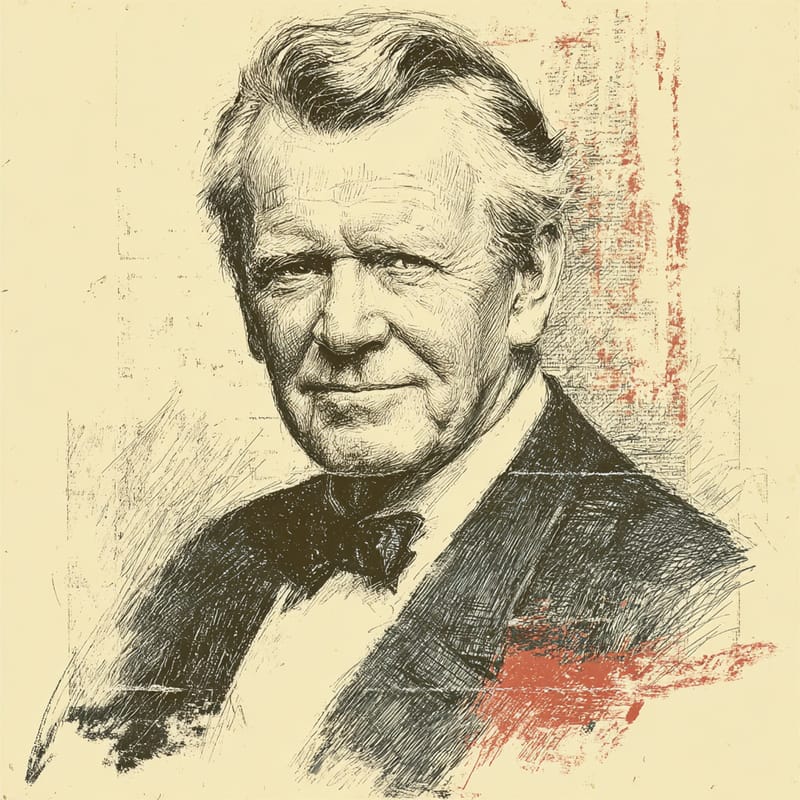
Patrick Buchanan
A nation, not an idea
Nationalism, protection, tradition.
Reactionary Paleo-ConservativeOne of 729 ideologies · enter the Paleo-Conservative hall →- Role
- Commentator & candidate
- Era
- b. 1938
- Region
- United States
- Social band
- Reactionary
- Placement
- +66 · +48 · −68
§ Where Patrick Buchanan stands
3 axesBuchanan is a tax-cutting capitalist who broke with free-trade orthodoxy. He campaigned against the North American Free Trade Agreement in 1993 and against the World Trade Organization, called for tariffs to protect American manufacturing in his presidential runs, and set out his case in The Great Betrayal (1998), which argued that globalisation was sacrificing American workers and national sovereignty.
Buchanan wants a strong, sovereign nation-state rather than a global order. He has called for sharp cuts to immigration and a fortified southern border, and A Republic, Not an Empire (1999) urged the United States to give up global interventionism, a stance that made him an early critic of the 1991 Gulf War and the 2003 invasion of Iraq.
A traditionalist Catholic, Buchanan opposes abortion and same-sex marriage and the secularisation of American culture. His 1992 Republican convention speech framed politics as a religious and cultural war for the soul of America, and The Death of the West (2002) warned that falling birth rates and mass immigration were dissolving the West's Christian and European identity.
How close are you to Patrick Buchanan?
Three statements, one per axis. Answer them and we’ll drop you on the compass next to them.
§ The story
LivingPatrick Joseph Buchanan (born 1938) is an American commentator, author and politician. Raised in a large Catholic family in Washington, DC, he studied at Georgetown University and Columbia's journalism school, wrote editorials for the St. Louis Globe-Democrat and in 1966 joined Richard Nixon's comeback team, becoming a White House speechwriter and adviser. He served as Ronald Reagan's White House communications director from 1985 to 1987 and became a fixture of political television on CNN's Crossfire and The McLaughlin Group.
Buchanan challenged President George H. W. Bush for the Republican nomination in 1992, ran again in 1996, winning the New Hampshire primary, and stood as the Reform Party candidate in 2000. His 1992 convention speech declaring a culture war became a landmark of American conservatism, and his campaigns against free trade, immigration and foreign intervention anticipated the later America First right. He co-founded The American Conservative magazine in 2002. William F. Buckley Jr. concluded in 1991 that remarks Buchanan made while opposing the Gulf War amounted to antisemitism, a charge Buchanan rejected.
Notable for
- 01Coined the 'culture war' speech
- 02'America First' nationalism
- 03Insurgent presidential runs
Key works & moments
- 1966Joins Richard Nixon's staff, later serving as a White House speechwriter and adviser.
- 1985Becomes Ronald Reagan's White House communications director.
- 1992Challenges President Bush and delivers the culture war speech at the Republican convention.
- 1996Wins the New Hampshire Republican primary in his second presidential run.
- 2000Runs for president as the Reform Party nominee.
- 2002Publishes The Death of the West and co-founds The American Conservative magazine.
In their own words
“There is a religious war going on in our country for the soul of America. It is a cultural war, as critical to the kind of nation we will one day be as was the Cold War itself.”
§ Minds closest to Patrick Buchanan
All minds →

§ Also in the Paleo-Conservative hall
Enter the hall →§ Common questions
4 answersWhat is Pat Buchanan's political ideology?
Pat Buchanan is a paleoconservative: on the 99ideologies three-axis compass, a Reactionary Paleo-Conservative. Economically he sits on the right (+66), a tax-cutting capitalist who rejects free trade in favour of tariffs and economic nationalism. On governance he leans authoritarian (+48), wanting a strong, sovereign nation-state with tight borders but no overseas empire. Socially he is strongly reactionary (−68), a traditionalist Catholic who in 1992 declared a culture war against abortion, secularism and the liberal agenda.
Is Pat Buchanan left-wing or right-wing?
Right-wing, of the paleoconservative kind. Buchanan served Nixon and Reagan and spent his career on the Republican right, but he broke with the post-Cold War conservative consensus on trade and war, opposing NAFTA and both wars against Iraq, positions that sometimes put him alongside parts of the left. His core commitments to nation, faith, tradition and immigration restriction place him firmly on the right, and many analysts see him as a forerunner of Donald Trump's America First politics.
What was Pat Buchanan's culture war speech?
It was his address to the Republican National Convention in Houston on 17 August 1992, after his failed primary challenge to President George H. W. Bush. Endorsing Bush, Buchanan told delegates that a religious and cultural war was under way for the soul of America and attacked the agenda of Bill and Hillary Clinton on abortion, gay rights, religious schools and women in combat. Supporters hailed it as a rallying cry for social conservatives; critics, including some Republicans, felt its harsh tone hurt Bush's campaign.
Which minds are closest to Patrick Buchanan?
On the 99ideologies three-axis compass, the minds closest to Patrick Buchanan are Samuel T. Francis (99% alike), John Randolph of Roanoke (98% alike) and Russell Kirk (98% alike). The furthest is Emma Goldman (0% alike).