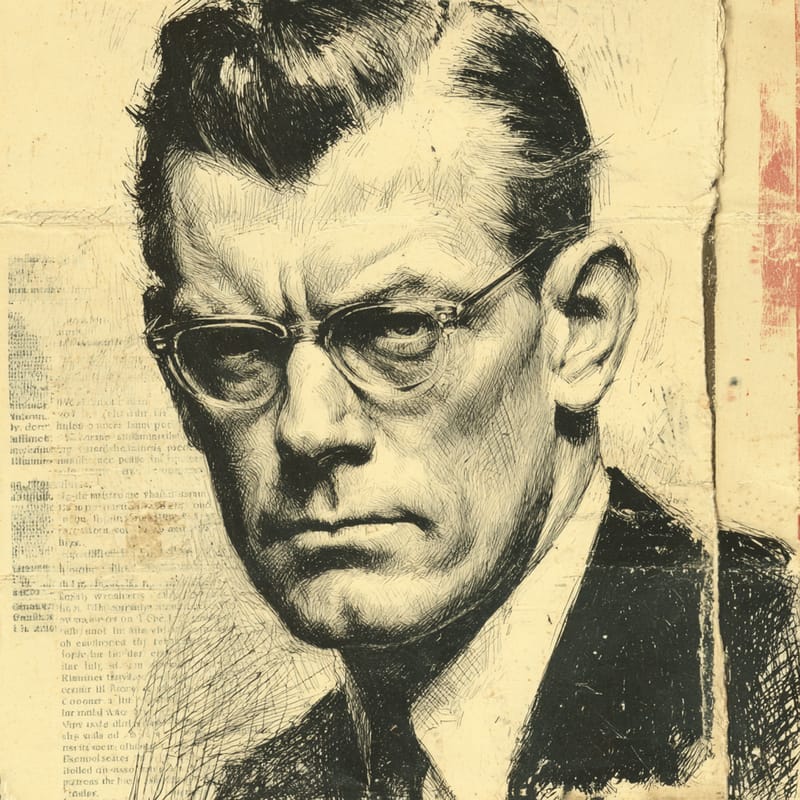
Robert McNamara
The whiz kid
Government by quantitative analysis.
TechnocratOne of 729 ideologies · enter the Technocrat hall →- Role
- Defense Secretary
- Era
- 1916–2009
- Region
- United States
- Social band
- Centre (no modifier)
- Placement
- +66 · +28 · 0
§ Where Robert McNamara stands
3 axesMcNamara brought corporate management to public life. At Ford he championed cost control and the compact Falcon, and at the Pentagon his Planning, Programming and Budgeting System, introduced in 1961, forced the services to justify spending by cost-effectiveness. At the World Bank from 1968 he expanded lending sharply and made the reduction of absolute poverty its goal, tempering his business instincts with a developmental agenda.
McNamara centralised power in the office of the defence secretary, overriding generals and admirals with civilian analysts and quantitative targets. He helped manage the 1962 Cuban missile crisis and the 1964 Gulf of Tonkin episode, and as the Vietnam War escalated, his upbeat public assessments fed a 'credibility gap' with the American public. He nonetheless remained a loyal servant of elected presidents.
McNamara's social outlook was managerial rather than ideological. In 1963 he ordered commanders to combat racial discrimination against Black servicemen off base, while his 1966 Project 100,000 lowered entry standards to draw poor recruits into the forces, many of whom went to Vietnam. In later life he campaigned for deep cuts in nuclear arsenals, following no clear traditional or progressive line.
How close are you to Robert McNamara?
Three statements, one per axis. Answer them and we’ll drop you on the compass next to them.
§ The story
HistoricalRobert Strange McNamara (1916–2009) was US defence secretary under Presidents John F. Kennedy and Lyndon B. Johnson from 1961 to 1968. A Californian educated at Berkeley and Harvard Business School, he applied statistical analysis to bombing operations in the Second World War, then joined the Ford Motor Company as one of its postwar 'Whiz Kids'. He rose through Ford's management to become, in 1960, the first company president from outside the Ford family in more than half a century, weeks before Kennedy recruited him.
At the Pentagon McNamara imposed systems analysis and centralised budgeting on the armed services, helped manage the Cuban missile crisis and became the chief manager of the escalating Vietnam War, tracked through statistics such as body counts. Privately doubting the war by 1967, he commissioned the study later leaked as the Pentagon Papers and left to lead the World Bank, which he ran until 1981 and turned towards fighting poverty. His 1995 memoir admitted the war had been a mistake, a confession many veterans and critics thought came decades too late.
Notable for
- 01Brought systems analysis to the Pentagon
- 02Led the World Bank
- 03Cautionary Vietnam record
Key works & moments
- 1946Joins the Ford Motor Company as one of the ten 'Whiz Kids' from Army Air Forces statistical control.
- 1961Becomes defence secretary and introduces the Planning, Programming and Budgeting System.
- 1962Advises Kennedy on the ExComm during the Cuban missile crisis.
- 1967Commissions the secret Vietnam study later known as the Pentagon Papers.
- 1968Leaves the Pentagon to become president of the World Bank, serving until 1981.
- 1995Publishes In Retrospect, conceding that the Vietnam War was a terrible mistake.
In their own words
“We were wrong, terribly wrong.”
§ Minds closest to Robert McNamara
All minds →

§ Also in the Technocrat hall
Enter the hall →§ Common questions
4 answersWhat was Robert McNamara's political ideology?
McNamara was a managerial technocrat rather than a partisan: on the 99ideologies three-axis compass, a Technocrat. Economically he leaned towards markets (+66), carrying corporate cost control and efficiency from Ford into government. On governance he favoured centralised, expert-led decision-making (+28), from systems analysis at the Pentagon to top-down management of the Vietnam War, and socially he sat at the centre (0), guided by data rather than by tradition or reform.
Was Robert McNamara left-wing or right-wing?
Neither in a conventional sense. McNamara served two Democratic presidents and later championed anti-poverty lending and nuclear arms control, positions associated with liberals, but he came from big business, built up America's nuclear and conventional forces and ran a war that the anti-war left came to see as his. He thought of himself as a problem-solver applying reason and numbers, which is why historians treat him as the archetype of the Cold War technocrat.
Why is Robert McNamara blamed for the Vietnam War?
Because he was its principal manager during the years of escalation. As defence secretary from 1961 to 1968 he oversaw the build-up from a few thousand military advisers to about half a million troops, backed the bombing of North Vietnam and judged progress by metrics such as enemy body counts. Critics called it 'McNamara's war'. In his 1995 memoir he admitted the policy had been wrong, which angered those who noted that he had kept his doubts private while Americans were still being sent to fight.
Which minds are closest to Robert McNamara?
On the 99ideologies three-axis compass, the minds closest to Robert McNamara are Mario Monti (97% alike), Zhu Rongji (96% alike) and Jean Monnet (96% alike). The furthest is Emma Goldman (13% alike).