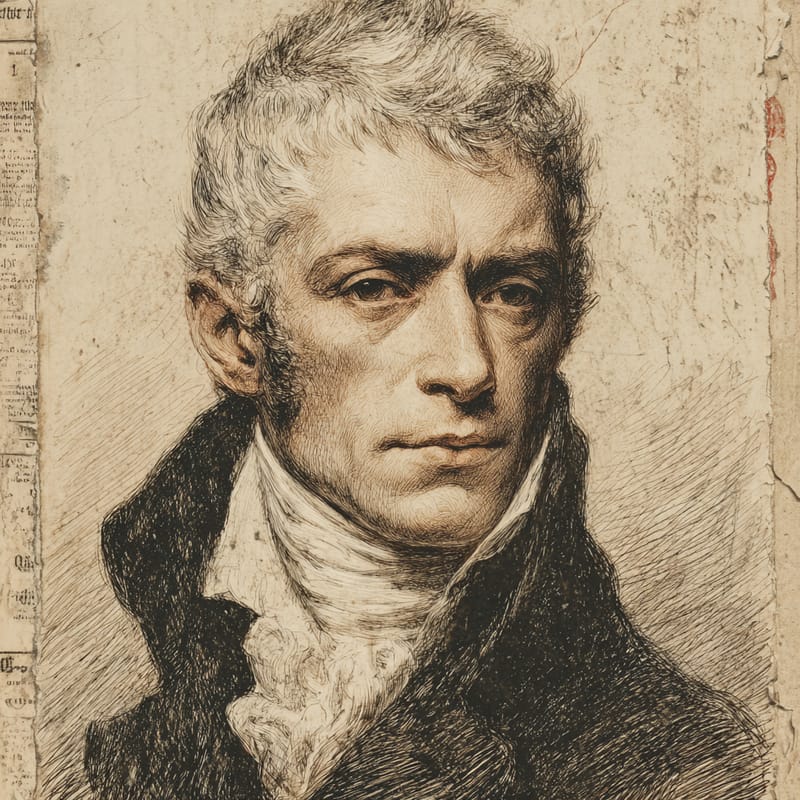
Joseph de Maistre
Throne and altar
The counter-Enlightenment.
Reactionary Paleo-ConservativeOne of 729 ideologies · enter the Paleo-Conservative hall →- Role
- Counter-revolutionary
- Era
- 1753–1821
- Region
- Savoy / France
- Social band
- Reactionary
- Placement
- +64 · +58 · −80
§ Where Joseph de Maistre stands
3 axesMaistre wrote little on economics, and his place right of centre reflects a defence of property and inherited rank rather than any theory of free markets. He treated the existing distribution of land and titles as part of a providential order that no assembly could legitimately remake, and Considerations on France (1797) presented the Revolution's levelling as a crime rather than a reform.
Maistre wanted hereditary monarchy and papal authority restored as the twin pillars of European order. His Essay on the Generative Principle of Political Constitutions (1814) denied that any nation could write its own constitution, and On the Pope (1819) made papal infallibility the keystone of politics. Yet his ideal was the customary, God-limited monarchy of the old regime, not a modern total state.
Few thinkers have rejected the Enlightenment so completely. Maistre mocked the universal rights of man, insisting in Considerations on France (1797) that he had met Frenchmen, Italians and Russians but never 'man'; he defended the Spanish Inquisition in letters written in 1815, and he attacked Voltaire, Rousseau and Bacon as corrupters of faith and authority.
How close are you to Joseph de Maistre?
Three statements, one per axis. Answer them and we’ll drop you on the compass next to them.
§ The story
HistoricalJoseph-Marie, comte de Maistre (1753–1821), was a magistrate, diplomat and Catholic philosopher from Savoy, then a duchy ruled by the kings of Sardinia. Born in Chambéry and trained in law at Turin, he sat in the Senate of Savoy and moved in mystical masonic circles until French revolutionary armies overran Savoy in 1792 and drove him into exile. In Lausanne he became a polemicist, and from 1803 to 1817 he served as the Sardinian king's envoy in St Petersburg, where he wrote most of his major works before returning to Turin.
Maistre's Considerations on France (1797) cast the Revolution as both a satanic crime and a providential punishment, and with Louis de Bonald he became a founding theorist of European reaction. He argued that legitimate constitutions grow from history and God, not from philosophers' blueprints, and his On the Pope (1819) helped prepare the ultramontane Catholicism that triumphed at the First Vatican Council in 1870. His fixation on sacrifice, war and the executioner as foundations of order has disturbed readers ever since, and Isaiah Berlin traced a line from him to fascism, a reading other scholars dispute.
Notable for
- 01'Considerations on France'
- 02Counter-Enlightenment thought
- 03Throne-and-altar reaction
Key works & moments
- 1792Flees Chambéry as French revolutionary armies occupy Savoy, beginning a quarter-century of exile.
- 1797Publishes Considerations on France, casting the Revolution as satanic crime and divine punishment.
- 1803Arrives in St Petersburg as Sardinia's envoy to Tsar Alexander I, a post he holds until 1817.
- 1814Publishes his Essay on the Generative Principle of Political Constitutions, denying that men can make constitutions.
- 1819Publishes On the Pope, arguing that papal infallibility is the foundation of European order.
- 1821Dies in Turin; his St Petersburg Dialogues, with its famous passage on the executioner, appears posthumously.
In their own words
“Every nation has the government it deserves.”
“There is no such thing as man in the world. In my lifetime I have seen Frenchmen, Italians, Russians, etc.; I even know, thanks to Montesquieu, that one can be a Persian; but as for man, I declare that I have never met him in my life; if he exists, he is unknown to me.”
§ Minds closest to Joseph de Maistre
All minds →

§ Also in the Paleo-Conservative hall
Enter the hall →§ Common questions
4 answersWhat was Joseph de Maistre's political ideology?
Joseph de Maistre was a Catholic monarchist and the archetypal counter-revolutionary: on the 99ideologies three-axis compass, a Reactionary Paleo-Conservative. Economically he sat right of centre (+64), defending inherited property and rank against revolutionary levelling. On governance he was clearly authoritarian (+58), championing hereditary monarchy and papal supremacy while denying that peoples can write their own constitutions. Socially he was deeply traditionalist (−80), rejecting the Enlightenment's rights of man in favour of faith, custom and Providence.
Was Joseph de Maistre left-wing or right-wing?
Right-wing, and at its founding edge: the very terms left and right came from the seating of the French revolutionary assemblies that Maistre spent his life condemning. He wanted throne and altar restored, hereditary hierarchy respected and the Revolution's principles of popular sovereignty and natural rights abandoned. His economics were those of the landed old regime rather than of laissez-faire liberals, so he belongs with the reactionary, religious right rather than the free-market right.
Was Joseph de Maistre a fascist?
No. Maistre died a century before fascism and wanted to restore Catholic hereditary monarchy, not to mobilise the masses behind a party, a leader or a nation. The question arises because Isaiah Berlin's essay Joseph de Maistre and the Origins of Fascism, published in 1990, argued that his contempt for abstract reason, cult of authority and fascination with violence and sacrifice anticipated twentieth-century fascism. Critics reply that Maistre was a legitimist of the old regime, closer to Catholic monarchists than to modern mass movements.
Which minds are closest to Joseph de Maistre?
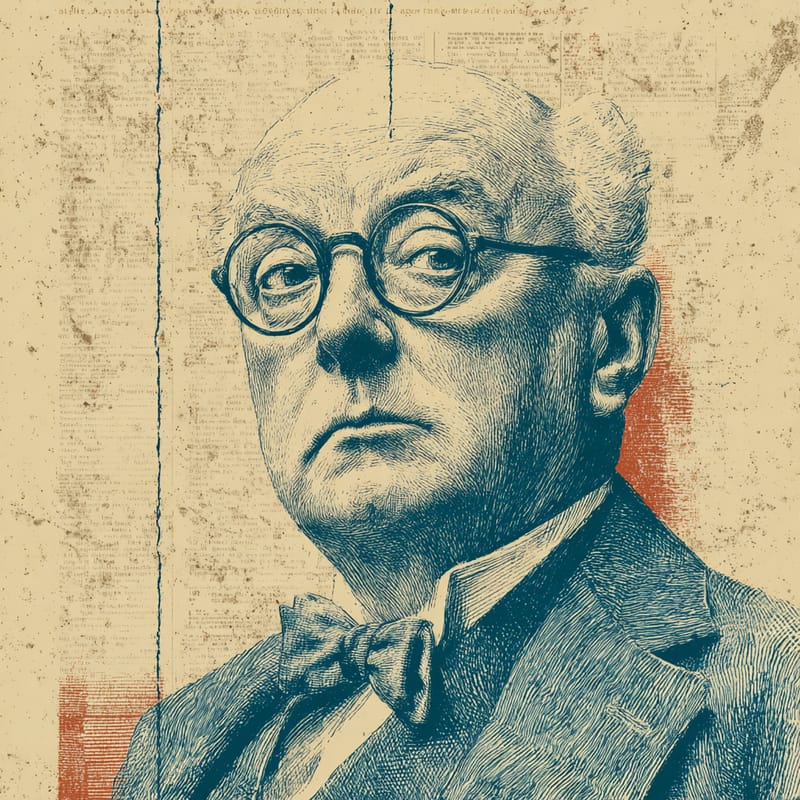
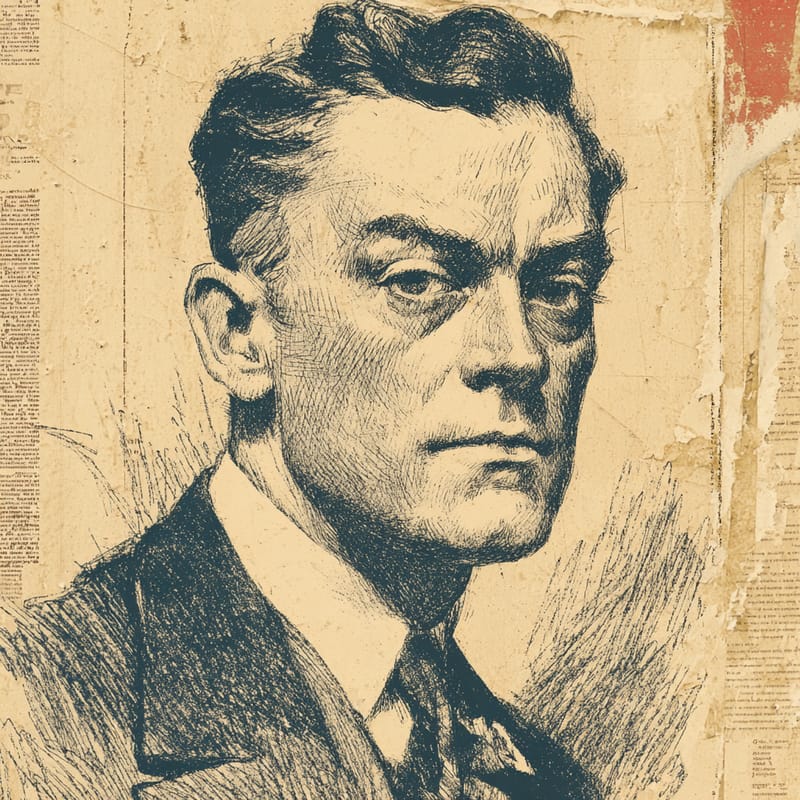
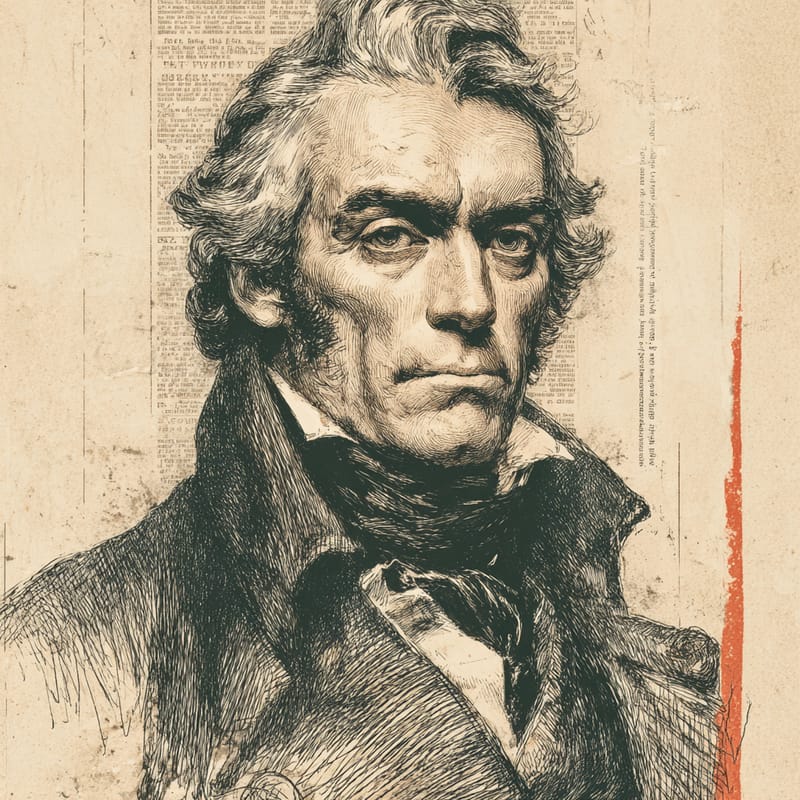
On the 99ideologies three-axis compass, the minds closest to Joseph de Maistre are Don Vito Corleone (95% alike), Samuel T. Francis (95% alike) and Patrick Buchanan (94% alike). The furthest is Emma Goldman (0% alike).