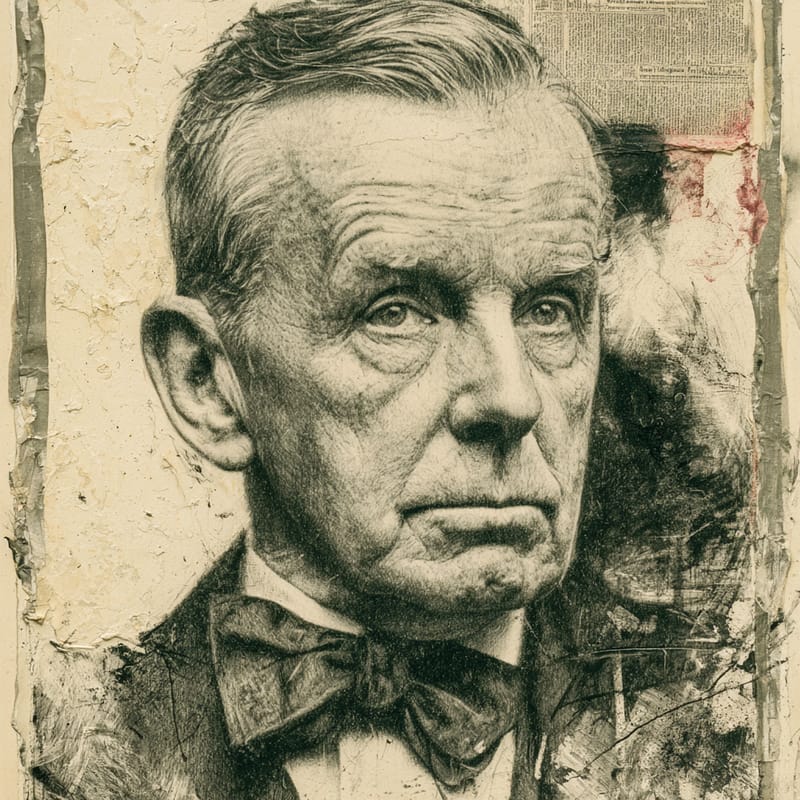
Lester B. Pearson
Welfare CapitalistOne of 729 ideologies · enter the Welfare Capitalist hall →- Role
- —
- Era
- —
- Region
- —
- Social band
- Centre (no modifier)
- Placement
- 0 · −25 · 0
§ Where Lester B. Pearson stands
3 axesPearson presided over the expansion of Canada's welfare state inside a firmly market economy. His minority governments created Canada Student Loans in 1964, the Canada Pension Plan in 1965 and the Canada Assistance Plan in 1966, and passed the Medical Care Act in 1966, while the 1965 Auto Pact with the United States opened continental free trade in cars and parts. Social insurance plus open trade defines his balance.
Pearson governed as a consensual parliamentarian, leading two minority governments that relied on bargaining with opposition parties and the provinces, including the 1964 deal that let Quebec run its own pension plan. The Public Service Staff Relations Act of 1967 extended collective bargaining to federal employees, and he settled the bitter 1964 flag debate through a parliamentary vote.
Pearson was a liberal reformer on identity and rights. He set up the Royal Commission on Bilingualism and Biculturalism in 1963, replaced the Red Ensign with the maple leaf flag in 1965, introduced in 1967 a points-based immigration system that judged applicants on skills rather than national origin, and created the Royal Commission on the Status of Women that same year.
How close are you to Lester B. Pearson?
Three statements, one per axis. Answer them and we’ll drop you on the compass next to them.
§ The story
HistoricalLester Bowles Pearson (1897–1972) was prime minister of Canada from 1963 to 1968. The son of a Methodist minister in Ontario, he served in the First World War, studied at Toronto and Oxford, taught history and in 1928 joined the Department of External Affairs. He became ambassador to Washington in 1945 and, as secretary of state for external affairs from 1948 to 1957, helped found NATO, presided over the UN General Assembly in 1952–53 and won the 1957 Nobel Peace Prize for proposing the UN Emergency Force that helped resolve the Suez crisis.
Chosen as Liberal leader in 1958, he suffered a landslide defeat that year but won minority governments in 1963 and 1965. Without ever holding a majority, his governments created the Canada Pension Plan, Canada Student Loans, the Canada Assistance Plan and national medicare, and gave Canada its maple leaf flag. He set up the Royal Commission on Bilingualism and Biculturalism as Quebec nationalism rose, introduced a points-based immigration system and signed the 1965 Auto Pact with the United States. His 1963 acceptance of American nuclear warheads and his 1965 call for a pause in bombing North Vietnam drew controversy.
Key works & moments
- 1948Becomes secretary of state for external affairs and helps found NATO the following year.
- 1956Proposes the UN Emergency Force to help resolve the Suez crisis.
- 1957Awarded the Nobel Peace Prize for his role in the Suez settlement.
- 1963Becomes prime minister at the head of a Liberal minority government.
- 1965The maple leaf flag is raised; the Auto Pact is signed and the Canada Pension Plan created.
- 1966The Medical Care Act lays the foundation of national public health insurance.
§ Minds closest to Lester B. Pearson
All minds →



§ Also in the Welfare Capitalist hall
Enter the hall →§ Common questions
4 answersWhat was Lester B. Pearson's political ideology?
Lester B. Pearson was a Liberal internationalist and welfare-state reformer: on the 99ideologies three-axis compass, a Welfare Capitalist. Economically he sits at the centre (0), building pensions, medicare and student loans on top of a market economy and freer trade with the United States. On governance he leaned liberal (−25), governing through minority-parliament compromise and federal-provincial bargaining. Socially he was a reforming liberal who promoted bilingualism, a new national flag and a non-discriminatory immigration system.
Was Lester B. Pearson left-wing or right-wing?
Centre-left in Canadian terms. Pearson led the Liberal Party, a centrist party, but his minority governments, often dependent on New Democratic Party votes, built much of Canada's welfare state: the Canada Pension Plan, the Canada Assistance Plan and national medicare. He was also a pro-trade, pro-NATO internationalist who accepted American nuclear warheads, so he combined social reform with cautious, market-friendly economics, the classic welfare-capitalist middle.
Why did Lester B. Pearson win the Nobel Peace Prize?
For his role in resolving the Suez crisis of 1956. After Britain, France and Israel invaded Egypt, Pearson, then Canada's foreign minister, proposed at the United Nations a multinational emergency force to separate the combatants and supervise a ceasefire, giving the invaders a face-saving way to withdraw. The General Assembly approved the plan, and the UN Emergency Force, commanded by Canada's E. L. M. Burns, became the first large-scale UN peacekeeping operation. He received the prize in 1957.
Which minds are closest to Lester B. Pearson?
On the 99ideologies three-axis compass, the minds closest to Lester B. Pearson are Ludwig Erhard (93% alike), B. Seebohm Rowntree (92% alike) and Léon Bourgeois (91% alike). The furthest is Adam Sutler (30% alike).