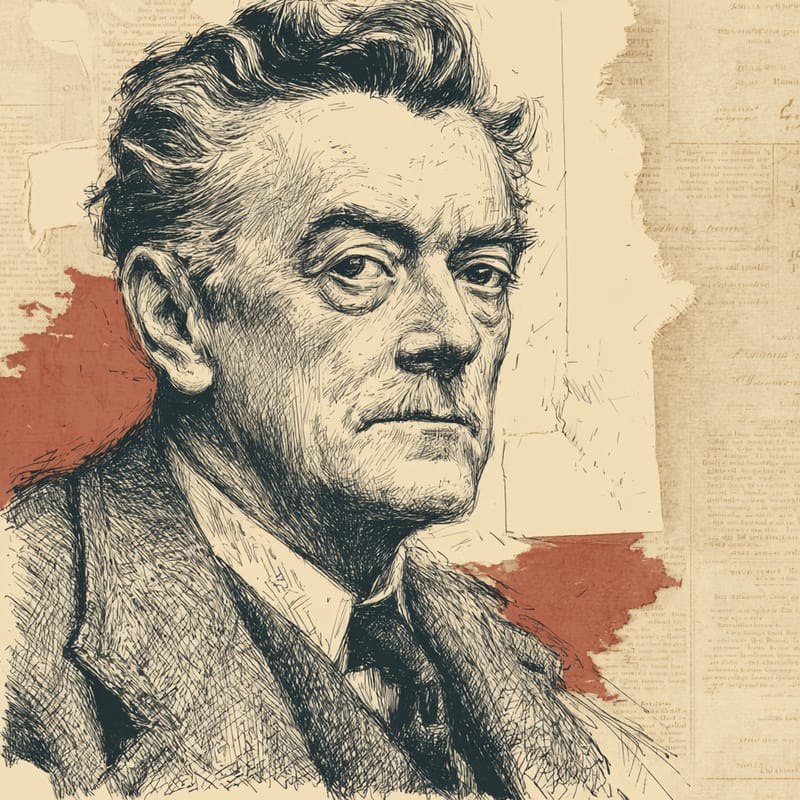
Jo Grimond
Revived the Liberals
A non-socialist radicalism.
Heterodox Liberal DemocratOne of 729 ideologies · enter the Liberal Democrat hall →- Role
- Liberal Party leader
- Era
- 1913–1993
- Region
- United Kingdom
- Social band
- Heterodox
- Placement
- −22 · −28 · +36
§ Where Jo Grimond stands
3 axesGrimond rejected both socialism and laissez-faire, setting out a non-socialist radicalism in The Liberal Future (1959) and championing the Liberal policy of co-ownership, under which employees would share in the profits and management of their firms. He backed the welfare state and public investment, which keeps him left of centre, but his hostility to nationalisation and to concentrated union and state power set his radicalism apart from Labour's.
A decentraliser and civil libertarian, Grimond championed home rule for Scotland within a federal Britain and wanted power pushed down to communities and workplaces. His strategy of realigning the left, pursued from his election as leader in 1956, aimed to break the two-party system rather than to strengthen the central state.
Grimond was a forward-looking internationalist who made the Liberals the first British party to back membership of the European Economic Community. The party he rebuilt championed the liberal social reforms of the 1960s, and its young MP David Steel piloted the Abortion Act 1967 through Parliament, a landmark of the permissive era.
How close are you to Jo Grimond?
Three statements, one per axis. Answer them and we’ll drop you on the compass next to them.
§ The story
HistoricalJoseph Grimond (1913–1993), always known as Jo, led the British Liberal Party from 1956 to 1967 and revived it from near-extinction. Born in St Andrews and educated at Eton and Balliol College, Oxford, he practised as a barrister, served as an army officer in the Second World War and worked for the United Nations Relief and Rehabilitation Administration in Europe before winning Orkney and Shetland in 1950, the seat he held until 1983. His wife, Laura Bonham Carter, was a granddaughter of the Liberal prime minister H. H. Asquith.
Taking over a party with six MPs, Grimond gave it an intellectual programme: British membership of the European Economic Community, co-ownership in industry and home rule for Scotland. The Liberal revival peaked with the Orpington by-election of 1962, and the party won nine seats in 1964 and twelve in 1966. His call for a realignment of the left, uniting non-socialist progressives in a new party, anticipated the SDP–Liberal Alliance of the 1980s. He returned briefly as caretaker leader in 1976 after Jeremy Thorpe's resignation, and later grew critical of the corporate state and trade-union power.
Notable for
- 01Revived the Liberal Party
- 02'March towards the sound of gunfire'
- 03Realignment of the left
Key works & moments
- 1950Elected MP for Orkney and Shetland, a seat he holds until 1983.
- 1956Becomes Liberal leader during the Suez crisis, succeeding Clement Davies.
- 1959Publishes The Liberal Future, setting out a radical non-socialist programme.
- 1962Liberals win the Orpington by-election, the high point of the Grimond revival.
- 1967Steps down as Liberal leader and is succeeded by Jeremy Thorpe.
- 1976Returns briefly as caretaker leader after Jeremy Thorpe's resignation.
§ Minds closest to Jo Grimond
All minds →

§ Also in the Liberal Democrat hall
Enter the hall →§ Common questions
4 answersWhat was Jo Grimond's political ideology?
Jo Grimond was a radical, non-socialist liberal: on the 99ideologies three-axis compass, a Heterodox Liberal Democrat. Economically he sits modestly left of centre (−22), backing the welfare state and worker co-ownership while opposing nationalisation. On governance he leaned towards liberty (−28), championing devolution, decentralisation and civil liberties, and socially he was progressive (+36), an internationalist who made the Liberals the first party to back Britain joining the Common Market.
Was Jo Grimond left-wing or right-wing?
Centre-left, by his own description a radical of the non-socialist left. Grimond wanted the Liberals to replace Labour as the main progressive party, uniting reformers who rejected both Conservatism and state socialism, and he backed the welfare state, worker participation and Scottish home rule. His suspicion of nationalisation, trade-union power and big government gave his radicalism a liberal-market edge, and in later life that scepticism of the state became more pronounced.
What did Jo Grimond mean by the realignment of the left?
He meant replacing the Labour Party, as then constituted, with a broad progressive party free of socialist dogma and trade-union control. Grimond believed many Labour moderates, especially the Gaitskellite revisionists, shared Liberal goals of reform, internationalism and decentralisation, and he urged them to join Liberals in a new radical force. The realignment did not happen in his time, but the 1981 SDP breakaway, the SDP–Liberal Alliance and the 1988 merger into the Liberal Democrats realised much of it.
Which minds are closest to Jo Grimond?
On the 99ideologies three-axis compass, the minds closest to Jo Grimond are President Laura Roslin (98% alike), Frank Church (97% alike) and Nick Clegg (97% alike). The furthest is Adam Sutler (17% alike).