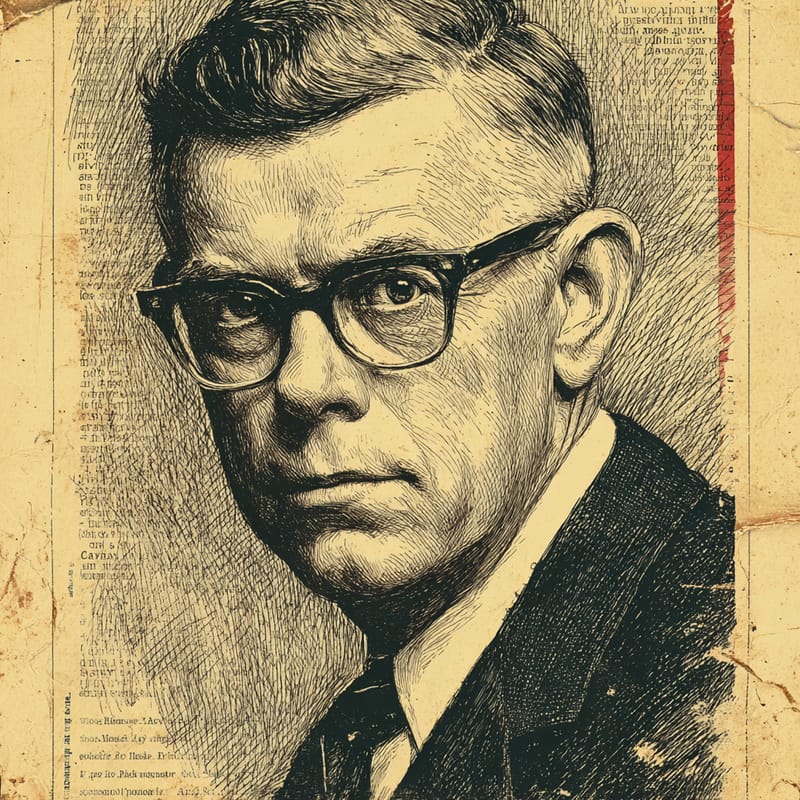
Frank Church
Reined in the secret state
Civil liberties against surveillance.
Reformist Liberal DemocratOne of 729 ideologies · enter the Liberal Democrat hall →- Role
- Senator
- Era
- 1924–1984
- Region
- United States
- Social band
- Reformist
- Placement
- −20 · −26 · +42
§ Where Frank Church stands
3 axesChurch was a New Deal liberal on economics. As chairman of the Senate Special Committee on Aging from 1971 he championed the 1972 law that tied Social Security benefits to the cost of living, and he backed federal programmes for the elderly and the rural poor. Representing a resource-dependent Western state, he never challenged the market economy, which places him moderately left of centre.
Church's defining cause was reining in the secret state. His 1975–76 committee documented abuses by the CIA, FBI and NSA, and its work produced the Senate Select Committee on Intelligence in 1976 and the Foreign Intelligence Surveillance Act of 1978, which required court warrants for national-security wiretaps. He also used Congress's power of the purse to limit presidential war-making in Indochina.
Church was a civil-libertarian liberal and a conservationist. He voted for the Civil Rights Act of 1964 and the Voting Rights Act of 1965, managed the Wilderness Act of 1964 on the Senate floor and was a principal sponsor of the Wild and Scenic Rivers Act of 1968, and his early opposition to the Vietnam War aligned him with the progressive dissent of the era.
How close are you to Frank Church?
Three statements, one per axis. Answer them and we’ll drop you on the compass next to them.
§ The story
HistoricalFrank Forrester Church (1924–1984) was a Democratic senator from Idaho from 1957 to 1981. Born in Boise, he served as an army intelligence officer in the China–Burma–India theatre during the Second World War, studied at Stanford and Harvard and, after surviving cancer as a young law student, was elected to the Senate in 1956 at the age of 32. He gave the keynote address at the 1960 Democratic National Convention, chaired the Senate Special Committee on Aging and, from 1979, the Foreign Relations Committee.
Church was one of the Senate's early critics of the Vietnam War, co-sponsoring the Cooper–Church amendment of 1970 and the Case–Church amendment of 1973 to restrict US military action in Indochina. In 1975–76 he chaired the select committee that exposed CIA plots to assassinate foreign leaders, the FBI's COINTELPRO operations against domestic dissenters and decades of NSA collection of international telegrams, leading to permanent intelligence committees and the Foreign Intelligence Surveillance Act of 1978. Critics charged that the inquiry damaged US intelligence. He sought the 1976 Democratic presidential nomination and lost his seat to Republican Steve Symms in 1980.
Notable for
- 01Chaired the Church Committee
- 02Intelligence-oversight reform
- 03Wilderness Act champion
Key works & moments
- 1956Elected to the US Senate from Idaho at the age of 32.
- 1964Manages the Wilderness Act through the Senate, protecting millions of acres of federal land.
- 1970Co-sponsors the Cooper–Church amendment limiting US ground operations in Cambodia.
- 1975Begins chairing the Church Committee's inquiry into CIA, FBI and NSA abuses.
- 1976Runs for the Democratic presidential nomination, winning several late primaries.
- 1980Loses his Senate seat to Republican Steve Symms.
In their own words
“That capability at any time could be turned around on the American people, and no American would have any privacy left, such is the capability to monitor everything: telephone conversations, telegrams, it doesn't matter. There would be no place to hide.”
§ Minds closest to Frank Church
All minds →


§ Also in the Liberal Democrat hall
Enter the hall →§ Common questions
4 answersWhat was Frank Church's political ideology?
Frank Church was a liberal Democrat with a strong civil-libertarian streak: on the 99ideologies three-axis compass, a Reformist Liberal Democrat. Economically he sits moderately left of centre (−20), defending Social Security and New Deal programmes. On governance he leaned towards liberty (−26), leading the most important investigation of US intelligence abuses and limiting presidential war-making, and socially he was progressive (+42), supporting civil rights and wilderness protection.
Was Frank Church left-wing or right-wing?
Left of centre by American standards. Church was a liberal Democrat who supported civil rights legislation, Social Security and Great Society programmes and environmental protection, opposed the Vietnam War early and fought to curb the CIA and FBI. Representing conservative Idaho, he tempered some positions, but his liberal record and his leading role in ratifying the Panama Canal treaties in 1978 made him a target for conservative groups, which helped defeat him in 1980.
What did the Church Committee find?
It documented decades of abuses by American intelligence agencies. The committee found that the CIA had plotted to assassinate foreign leaders, including Fidel Castro and Patrice Lumumba; that the FBI's COINTELPRO programme had spied on and sought to disrupt domestic political groups and harassed Martin Luther King Jr.; and that the NSA had for decades collected international telegrams sent by Americans. Its reports of 1975–76 led to permanent congressional intelligence committees and the Foreign Intelligence Surveillance Act of 1978.
Which minds are closest to Frank Church?
On the 99ideologies three-axis compass, the minds closest to Frank Church are Nick Clegg (99% alike), Paddy Ashdown (99% alike) and President Laura Roslin (99% alike). The furthest is Adam Sutler (16% alike).