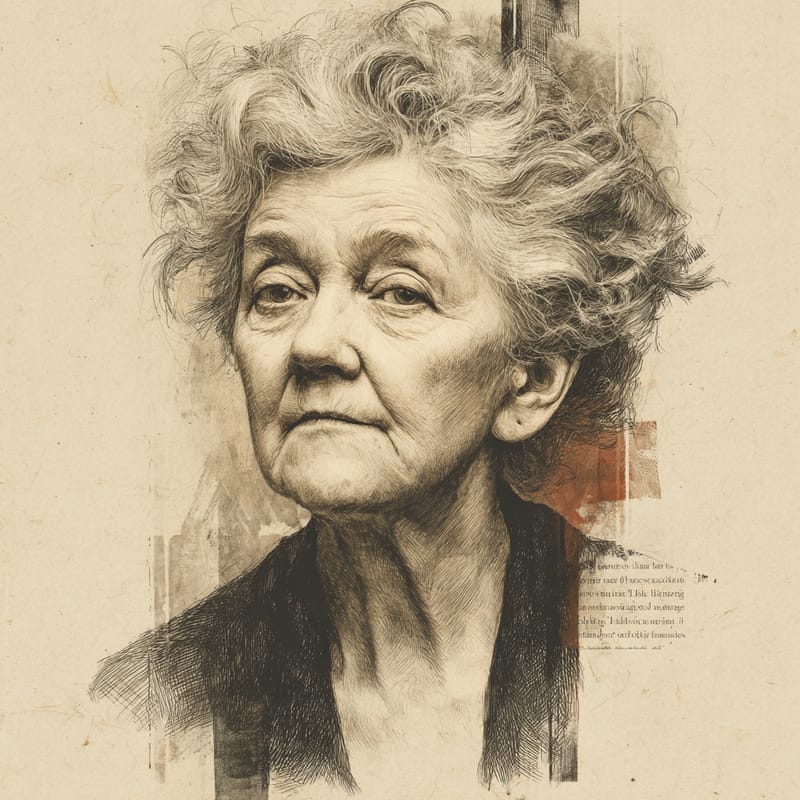
Shirley Williams
Broke the mould
Social-liberal centrism, made principle.
Reformist Liberal DemocratOne of 729 ideologies · enter the Liberal Democrat hall →- Role
- SDP co-founder
- Era
- 1930–2021
- Region
- United Kingdom
- Social band
- Reformist
- Placement
- −28 · −22 · +48
§ Where Shirley Williams stands
3 axesWilliams favoured a mixed economy with strong public services and redistribution, and as prices secretary from 1974 she administered price controls and food subsidies during high inflation. She broke with Labour as it moved towards sweeping nationalisation and withdrawal from the European Community in 1980–81, and in Politics Is for People (1981) she argued for a decentralised social democracy rather than state socialism.
A parliamentary democrat and decentraliser, Williams helped launch the SDP in 1981 to break the two-party system, campaigning for proportional representation and devolution. In the Lords she defended civil liberties and pressed amendments to the coalition government's Health and Social Care Bill in 2011–12, preferring negotiated reform to outright opposition.
Williams was a committed social progressive: as education secretary she pressed ahead with comprehensive reorganisation under the Education Act 1976, seeing selection at eleven as a barrier to equality, and in 1977 she joined the Grunwick picket line in support of mostly Asian women strikers. A practising Roman Catholic, she combined her faith with liberal positions on race, gender and European integration.
How close are you to Shirley Williams?
Three statements, one per axis. Answer them and we’ll drop you on the compass next to them.
§ The story
HistoricalShirley Williams (1930–2021) was a Labour cabinet minister who became one of the four founders of the Social Democratic Party and later a leading Liberal Democrat. The daughter of the writer Vera Brittain and the political scientist George Catlin, she studied at Somerville College, Oxford, served as general secretary of the Fabian Society in the early 1960s and was elected Labour MP for Hitchin in 1964. Under Harold Wilson and James Callaghan she served as secretary of state for prices and consumer protection from 1974 and for education and science from 1976 to 1979.
After losing her seat in 1979 and despairing of Labour's leftward turn, she joined Roy Jenkins, David Owen and Bill Rodgers in the Limehouse Declaration of January 1981. Her victory at the Crosby by-election that November made her the first MP elected for the SDP, which she served as president from 1982 to 1988, backing its merger with the Liberals. Made a life peer in 1993, she led the Liberal Democrats in the Lords from 2001 to 2004. Critics blamed her for the decline of grammar schools; admirers saw her as a model of principled, non-tribal politics.
Notable for
- 01Co-founded the SDP
- 02The 'Gang of Four'
- 03Lib Dem leader in the Lords
Key works & moments
- 1964Elected Labour MP for Hitchin.
- 1976Becomes secretary of state for education and science in James Callaghan's cabinet.
- 1981Signs the Limehouse Declaration with Jenkins, Owen and Rodgers, launching the SDP.
- 1981Wins the Crosby by-election, the first MP elected under the SDP banner.
- 1988Backs the SDP's merger with the Liberals, which creates the Liberal Democrats.
- 2001Becomes leader of the Liberal Democrats in the House of Lords.
§ Minds closest to Shirley Williams
All minds →


§ Also in the Liberal Democrat hall
Enter the hall →§ Common questions
4 answersWhat was Shirley Williams's political ideology?
Shirley Williams was a social democrat who moved from Labour to the SDP and the Liberal Democrats: on the 99ideologies three-axis compass, a Reformist Liberal Democrat. Economically she sits moderately left of centre (−28), favouring a mixed economy with strong public services. On governance she was a parliamentary democrat and reformer (−22) who backed proportional representation and devolution, and socially she was clearly progressive (+48), championing comprehensive schools, equality and European integration.
Was Shirley Williams left-wing or right-wing?
Centre-left. Williams spent two decades in the Labour Party and served in its cabinets, supporting comprehensive education, public services and trade-union rights. She left in 1981 because she believed Labour had moved too far left, towards unilateral nuclear disarmament, withdrawal from Europe and wholesale nationalisation, and she spent the rest of her career in the social-liberal centre. She was never a conservative: her politics remained egalitarian, internationalist and pro-European throughout.
Why did Shirley Williams leave the Labour Party?
Because she believed Labour had turned against her brand of democratic socialism. After the 1979 defeat the party's 1980 conference backed unilateral nuclear disarmament and withdrawal from the European Community, and a special conference at Wembley in January 1981 gave the unions the largest share of the vote in choosing the party leader. The next day, 25 January 1981, Williams, Roy Jenkins, David Owen and Bill Rodgers issued the Limehouse Declaration, and the SDP was launched that March.
Which minds are closest to Shirley Williams?
On the 99ideologies three-axis compass, the minds closest to Shirley Williams are Charles Kennedy (97% alike), Paddy Ashdown (97% alike) and Frank Church (96% alike). The furthest is Adam Sutler (14% alike).