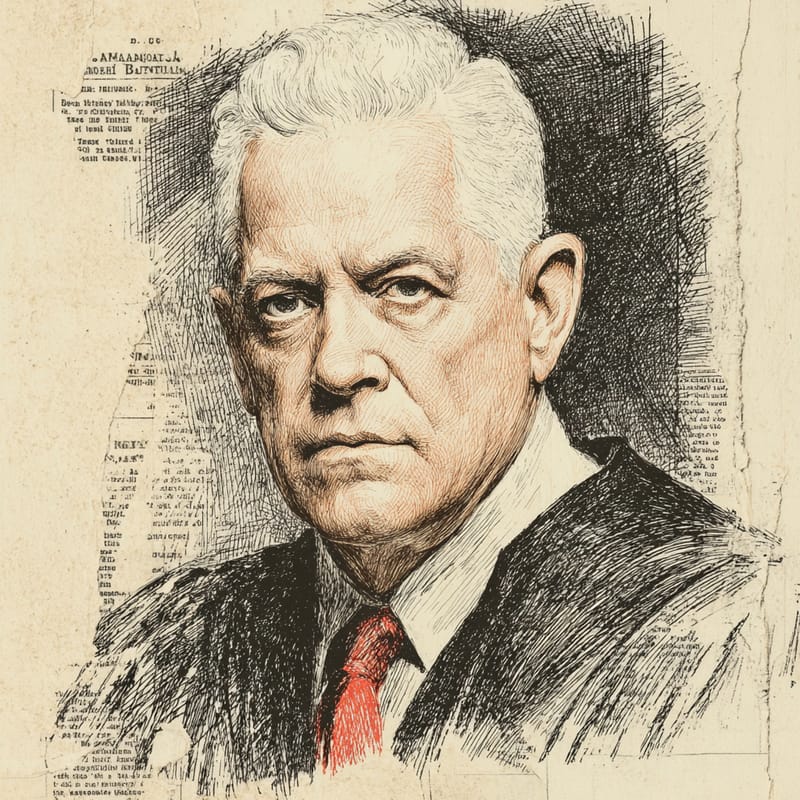
Earl Warren
The Warren Court
Rights expanded from the bench.
Reformist Liberal DemocratOne of 729 ideologies · enter the Liberal Democrat hall →- Role
- Chief Justice
- Era
- 1891–1974
- Region
- United States
- Social band
- Reformist
- Placement
- −18 · −24 · +44
§ Where Earl Warren stands
3 axesWarren was a progressive Republican rather than a New Dealer, but as governor of California he proposed a compulsory state health insurance plan in 1945, which the legislature rejected, and expanded state spending on highways, schools and the university system during the post-war boom. On the Court he accepted the regulatory state built since the 1930s, which leaves him only modestly left of centre.
Warren's Court expanded the rights of individuals against the state: Mapp v. Ohio (1961) excluded illegally seized evidence, Reynolds v. Sims (1964), which he wrote, imposed the rule of one person, one vote, and Miranda v. Arizona (1966), also his opinion, required police to warn suspects of their rights. He was no absolutist, however, upholding police stop-and-frisk in Terry v. Ohio in 1968.
Warren wrote Brown v. Board of Education (1954), steering the Court to a unanimous ruling that segregated public schools were unconstitutional, and Loving v. Virginia (1967), which struck down bans on interracial marriage. The record is not spotless: as California's attorney general in 1942 he pressed for the removal of Japanese Americans from the West Coast, a decision he later said he deeply regretted.
How close are you to Earl Warren?
Three statements, one per axis. Answer them and we’ll drop you on the compass next to them.
§ The story
HistoricalEarl Warren (1891–1974) was the fourteenth Chief Justice of the United States, serving from 1953 to 1969. Born in Los Angeles and raised in Bakersfield, he studied law at the University of California, Berkeley, and built a reputation as a tough, efficient prosecutor as district attorney of Alameda County from 1925 to 1939. A progressive Republican, he became California's attorney general in 1939 and was elected governor three times, in 1942, 1946 and 1950, and in 1948 he was Thomas Dewey's running mate on the Republican presidential ticket.
Appointed by Dwight Eisenhower in 1953, Warren led the Supreme Court through its most consequential era of liberal rulings, beginning with the unanimous Brown v. Board of Education decision of 1954 against school segregation and extending to voting equality, criminal due process and the separation of church and state. He also chaired the commission that investigated John F. Kennedy's assassination and concluded in 1964 that Lee Harvey Oswald acted alone. Conservatives campaigned to impeach him, and his record carries a lasting stain: as California's attorney general in 1942 he was a leading advocate of interning Japanese Americans.
Notable for
- 01Brown v. Board of Education
- 02Miranda rights
- 03The Warren Court
Key works & moments
- 1942As attorney general, urges the removal of Japanese Americans; elected governor of California in November.
- 1948Runs for vice-president on Thomas Dewey's Republican ticket, which loses to Harry Truman.
- 1953Appointed Chief Justice of the United States by Dwight Eisenhower.
- 1954Writes the unanimous Brown v. Board of Education decision against school segregation.
- 1964His commission reports on Kennedy's assassination; writes Reynolds v. Sims on voting equality.
- 1966Writes Miranda v. Arizona, requiring police to inform suspects of their rights.
In their own words
“We conclude that in the field of public education the doctrine of 'separate but equal' has no place. Separate educational facilities are inherently unequal.”
“Legislators represent people, not trees or acres. Legislators are elected by voters, not farms or cities or economic interests.”
§ Minds closest to Earl Warren
All minds →


§ Also in the Liberal Democrat hall
Enter the hall →§ Common questions
4 answersWhat was Earl Warren's political ideology?
Earl Warren was a progressive Republican who became the leading figure of American judicial liberalism: on the 99ideologies three-axis compass, a Reformist Liberal Democrat. Economically he sits modestly left of centre (−18), a governor who proposed state health insurance and accepted the regulatory state. On governance he leaned towards individual rights (−24), extending due process and voting equality, and socially he was strongly progressive (+44), above all through the Court's rulings against racial segregation.
Was Earl Warren left-wing or right-wing?
Liberal, despite his Republican label. Warren rose as a law-and-order prosecutor and a Republican governor, and he was his party's vice-presidential nominee in 1948. As Chief Justice, however, he led the most liberal Supreme Court in American history, striking down segregation, enforcing one person, one vote and expanding the rights of criminal suspects. Conservatives denounced the Warren Court for judicial activism, while liberals regard it as a high point of civil rights, which places him on the centre-left.
Was Earl Warren a Republican?
Yes. Warren was a lifelong Republican who served as California's Republican attorney general and governor, won the 1946 governorship with the nominations of both major parties under California's cross-filing system, ran for vice-president with Thomas Dewey in 1948 and sought the presidential nomination in 1952. Eisenhower, a Republican, appointed him Chief Justice in 1953. His liberal rulings angered many in his party, and the John Birch Society campaigned to impeach him.
Which minds are closest to Earl Warren?
On the 99ideologies three-axis compass, the minds closest to Earl Warren are Frank Church (99% alike), Nick Clegg (98% alike) and Paddy Ashdown (98% alike). The furthest is Adam Sutler (17% alike).