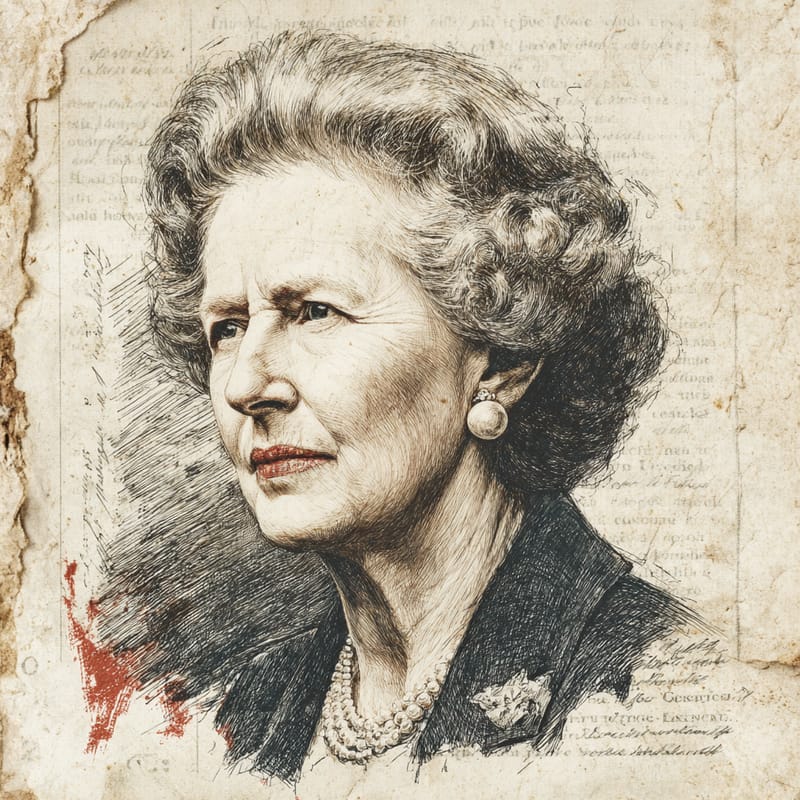
Margaret Thatcher
There is no alternative
Privatisation, monetarism, the enterprise society.
Rooted NeoliberalOne of 729 ideologies · enter the Neoliberal hall →- Role
- Prime Minister
- Era
- 1925–2013
- Region
- United Kingdom
- Social band
- Rooted
- Placement
- +35 · +10 · −30
§ Where Margaret Thatcher stands
3 axesThatcher's governments privatised British Telecom in 1984 and British Gas in 1986, sold council homes under the Housing Act 1980's right to buy and deregulated the City in the 1986 Big Bang. Yet she kept the National Health Service tax-funded and free at the point of use, telling the 1982 party conference it was safe with the Conservatives, which keeps her moderately rather than radically on the market side.
Thatcher governed through large parliamentary majorities but centralised power: the Local Government Act 1985 abolished the Greater London Council and the metropolitan county councils, and the 1988 broadcasting ban kept the voices of Sinn Féin and paramilitary-linked groups off the air. Police were coordinated nationally against the striking miners. Yet she submitted to her party's rules and resigned when her support collapsed in 1990.
Thatcher praised the Victorian values of thrift, family and self-reliance, and her government enacted Section 28 of the Local Government Act 1988, which banned councils from promoting homosexuality. Yet in the 1960s she had voted for the bills that became the Sexual Offences Act 1967 and the Abortion Act 1967, a liberal streak that keeps her moderately rather than strongly traditional.
How close are you to Margaret Thatcher?
Three statements, one per axis. Answer them and we’ll drop you on the compass next to them.
§ The story
HistoricalMargaret Hilda Thatcher, née Roberts (1925–2013), was prime minister of the United Kingdom from 1979 to 1990, the first woman to hold the office and the longest continuously serving prime minister of the 20th century. A grocer's daughter from Grantham, she read chemistry at Oxford, worked as a research chemist and then qualified as a barrister. Elected MP for Finchley in 1959, she served as Edward Heath's education secretary from 1970 and defeated him for the Conservative leadership in 1975.
Thatcher broke with the post-war consensus of nationalised industry, union bargaining and full-employment policy. Her governments privatised British Telecom, British Gas, British Airways and the water industry, sold council houses to their tenants, curbed union power and defeated the 1984–85 miners' strike, while unemployment passed three million in the early 1980s. Victory in the 1982 Falklands War and her survival of the IRA's Brighton bombing in 1984 cemented her image of resolve. Admirers credit her with reviving the British economy; critics blame her for deindustrialisation and division. The poll tax and splits over Europe led to her fall in 1990.
Notable for
- 01Privatised state industries
- 02Broke the miners' strike
- 03Reshaped the postwar consensus
Key works & moments
- 1959Elected MP for Finchley, the seat she holds until 1992.
- 1975Defeats Edward Heath to become leader of the Conservative Party.
- 1979Becomes Britain's first woman prime minister after winning the general election.
- 1982Sends a task force that retakes the Falkland Islands from Argentina.
- 1984–85Defeats the year-long miners' strike; British Telecom is privatised.
- 1990Resigns after a leadership challenge, months after riots against the poll tax.
In their own words
“You turn if you want to. The lady's not for turning.”
“We have not successfully rolled back the frontiers of the state in Britain, only to see them re-imposed at a European level with a European super-state exercising a new dominance from Brussels.”
§ Minds closest to Margaret Thatcher
All minds →


§ Also in the Neoliberal hall
Enter the hall →§ Common questions
4 answersWhat was Margaret Thatcher's political ideology?
Margaret Thatcher was a free-market conservative who gave her name to Thatcherism: on the 99ideologies three-axis compass, a Rooted Neoliberal. Economically she sat moderately on the market side (+35), privatising state industries and curbing trade unions while keeping the NHS publicly funded. On governance she leaned slightly authoritarian (+10), centralising power over local government and taking a hard line on public order, and socially she was moderately traditional (−30), preaching family and self-reliance while having voted to decriminalise homosexuality in the 1960s.
Was Margaret Thatcher left-wing or right-wing?
Right-wing. Thatcher led the Conservative Party for 15 years and remains the defining figure of the modern British right, remembered for privatisation, lower income taxes, union reform and a hard line against the Soviet Union. But she was a radical rather than a cautious traditionalist, attacking the post-war consensus that earlier Conservative governments had accepted, and some of her positions resist easy labels: she voted for the liberal social reforms of the 1960s and kept the NHS universal and free.
What was Thatcherism?
Thatcherism was the governing creed of Margaret Thatcher's governments from 1979 to 1990: free markets at home and a strong state at the centre. It combined monetarism, privatisation of state industries, lower direct taxes, the sale of council houses and laws restricting trade-union power with firm defence, tough policing and fierce defence of national sovereignty, especially against European integration. The political scientist Andrew Gamble summed it up in the title of his 1988 book The Free Economy and the Strong State. Its legacy shaped both later Conservative and New Labour governments.
Which minds are closest to Margaret Thatcher?
On the 99ideologies three-axis compass, the minds closest to Margaret Thatcher are Ronald Reagan (97% alike), Harold Macmillan (95% alike) and John McCain (95% alike). The furthest is Emma Goldman (20% alike).