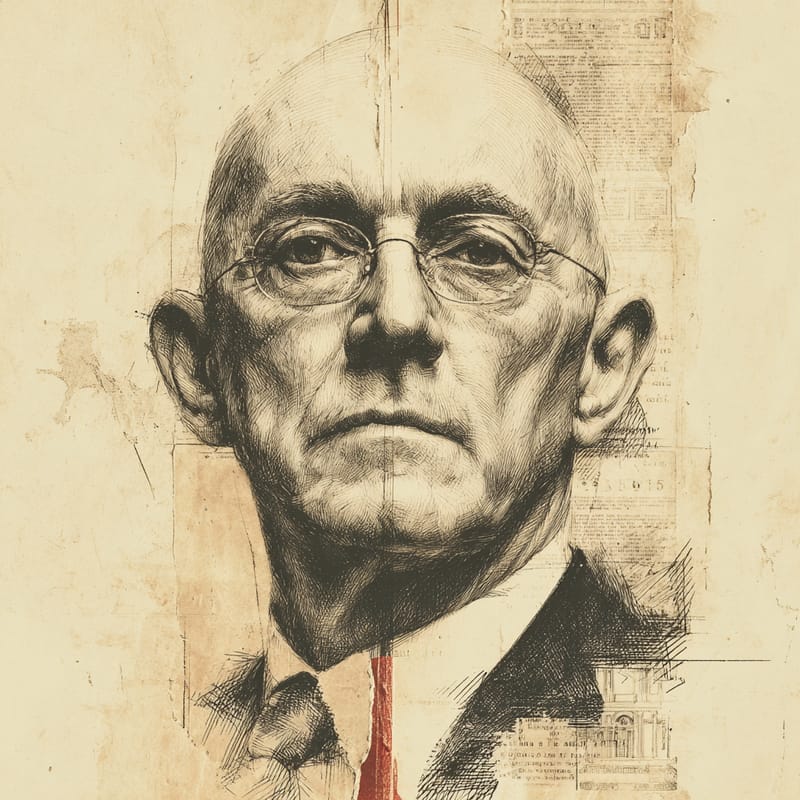
Robert Rubin
Wall Street in Washington
Free capital and balanced budgets.
NeoliberalOne of 729 ideologies · enter the Neoliberal hall →- Role
- Treasury Secretary
- Era
- b. 1938
- Region
- United States
- Social band
- Centre (no modifier)
- Placement
- +30 · −2 · +10
§ Where Robert Rubin stands
3 axesRubin's policy mix combined fiscal discipline with financial liberalisation: he pressed for deficit reduction in the 1993 budget, supported free trade and open capital markets, and with Alan Greenspan and Lawrence Summers resisted the 1998 move by the Commodity Futures Trading Commission toward regulating over-the-counter derivatives. He accepted a safety net and progressive taxation, which places him clearly but not radically right of centre.
Rubin was a technocratic manager of a globalising economy who worked through institutions such as the Treasury, the Federal Reserve and the International Monetary Fund. When Congress balked at the 1995 Mexican rescue, he used the Treasury's Exchange Stabilization Fund instead, showing a preference for expert executive action within established law, which leaves him at the centre.
Rubin is a socially moderate establishment liberal who has kept a low profile on cultural controversies. A lifelong Democrat, he co-founded the Hamilton Project at the Brookings Institution in 2006 to promote growth combined with broadly shared prosperity and economic security, and he served as co-chair of the Council on Foreign Relations, placing him mildly on the progressive side.
How close are you to Robert Rubin?
Three statements, one per axis. Answer them and we’ll drop you on the compass next to them.
§ The story
LivingRobert Edward Rubin (born 1938) is an American banker and official who served as US secretary of the Treasury from 1995 to 1999 under Bill Clinton. Born in New York City and raised partly in Miami Beach, he graduated from Harvard and Yale Law School, practised law briefly and joined Goldman Sachs in 1966, rising through its risk-arbitrage business to become co-senior partner from 1990 to 1992. In 1993 he became the first director of Clinton's new National Economic Council, before succeeding Lloyd Bentsen at the Treasury in January 1995.
Rubin championed deficit reduction in the 1993 budget, arguing that lower deficits would bring down interest rates and spur private investment, an approach dubbed Rubinomics. At the Treasury he organised the 1995 rescue of Mexico, helped manage the Asian financial crisis of 1997–98 and backed a strong dollar and freer capital flows. He opposed regulating over-the-counter derivatives and supported financial modernisation. After leaving office he became a senior figure at Citigroup, which needed a huge federal rescue in 2008, drawing criticism of his role in financial deregulation.
Notable for
- 01Architect of 1990s fiscal policy
- 02Financial deregulation
- 03Goldman Sachs co-chair
Key works & moments
- 1966Joins Goldman Sachs, where he later builds its risk-arbitrage business.
- 1990–92Serves as co-senior partner of Goldman Sachs.
- 1993Becomes the first director of the National Economic Council and champions deficit reduction.
- 1995Becomes Treasury secretary and arranges the rescue of Mexico through the Exchange Stabilization Fund.
- 1997–98Helps manage the Asian financial crisis alongside the IMF and the Federal Reserve.
- 2003Publishes his memoir, In an Uncertain World, written with Jacob Weisberg.
§ Minds closest to Robert Rubin
All minds →


§ Also in the Neoliberal hall
Enter the hall →§ Common questions
4 answersWhat is Robert Rubin's political ideology?
Robert Rubin is a centrist, market-oriented Democrat: on the 99ideologies three-axis compass, a Neoliberal. Economically he sits clearly right of centre (+30), combining deficit reduction, free trade and financial liberalisation with acceptance of a safety net. On governance he is at the centre (−2), a technocratic manager working through established institutions, and socially he is mildly progressive (+10), a moderate establishment liberal who has stayed out of cultural battles.
Is Robert Rubin left-wing or right-wing?
Centre-right on economics within a centre-left party. Rubin has spent his political life as a Democrat and supported progressive taxation and anti-poverty programmes, but his signature priorities, budget discipline, free trade, open capital markets and light regulation of finance, align with the market-friendly centre. Critics on the left see him as a symbol of Wall Street's influence over the Democratic Party, while admirers credit him with helping deliver the prosperity of the 1990s.
What was Rubinomics?
Rubinomics was the economic strategy associated with Robert Rubin in the Clinton administration. Its core claim was that reducing the federal deficit would lower long-term interest rates, boost private investment and confidence, and so produce faster growth than additional public spending. Combined with free trade, a strong dollar and open financial markets, it accompanied the boom and budget surpluses of the late 1990s, though critics later linked its deregulatory side to the financial crisis of 2008.
Which minds are closest to Robert Rubin?
On the 99ideologies three-axis compass, the minds closest to Robert Rubin are Manmohan Singh (99% alike), Milton Friedman (97% alike) and Alan Greenspan (96% alike). The furthest is Pol Pot (31% alike).