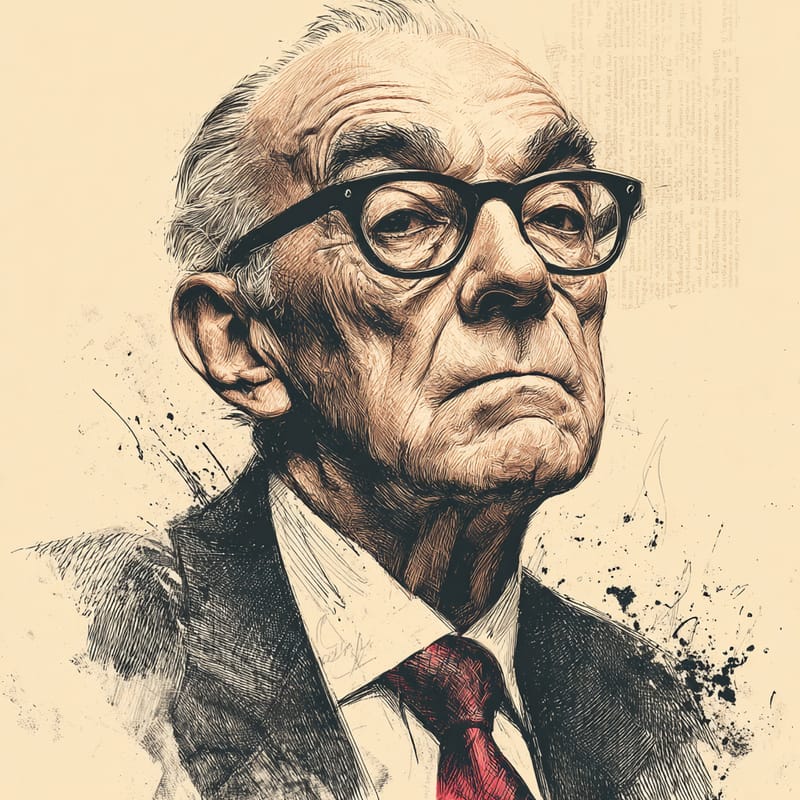
Alan Greenspan
The maestro
Light-touch finance and the long boom.
NeoliberalOne of 729 ideologies · enter the Neoliberal hall →- Role
- Fed Chair
- Era
- b. 1926
- Region
- United States
- Social band
- Centre (no modifier)
- Placement
- +33 · 0 · 0
§ Where Alan Greenspan stands
3 axesGreenspan trusted markets to discipline finance: in 1998 he opposed the Commodity Futures Trading Commission's move to regulate over-the-counter derivatives, and he supported the Gramm–Leach–Bliley Act of 1999. But he was no laissez-faire purist in office, cutting rates aggressively after the 1987 crash and in the 2001 recession, and his 1983 Social Security commission recommended higher payroll taxes, which keeps him moderately rather than radically pro-market.
Greenspan embodies technocratic central-bank independence. Appointed by Reagan and reappointed by the elder Bush, Bill Clinton and the younger Bush, he exercised broad discretionary power over interest rates without formal rules, a long way from the gold standard he had defended in the 1960s. He worked within institutions rather than against them, neither shrinking nor expanding the state's reach, which places him at the governance centre.
Greenspan has kept largely clear of cultural politics. His outlook was formed in Ayn Rand's secular, individualist circle, which he joined in the 1950s, and Rand stood beside him at his 1974 swearing-in, but as a public official he spoke almost entirely about economics and took no prominent part in debates over religion or abortion. That reticence, rather than any social programme, places him at the centre.
How close are you to Alan Greenspan?
Three statements, one per axis. Answer them and we’ll drop you on the compass next to them.
§ The story
LivingAlan Greenspan (born 1926) is an American economist who chaired the Federal Reserve from 1987 to 2006, the second-longest tenure in its history. Raised in Manhattan's Washington Heights, he studied clarinet at Juilliard and played in a touring swing band before taking economics degrees at New York University, and from 1954 he ran the consulting firm Townsend-Greenspan. He chaired President Gerald Ford's Council of Economic Advisers from 1974 to 1977 and a bipartisan commission on Social Security before Ronald Reagan chose him to succeed Paul Volcker.
Greenspan's Fed steered the economy through the 1987 stock-market crash, the long expansion of the 1990s and the dot-com bust, and Bob Woodward's 2000 book Maestro captured his reputation. He opposed regulating over-the-counter derivatives, backed the 1999 law that removed barriers between commercial and investment banking, and held the Fed's benchmark rate at 1 per cent from mid-2003 to mid-2004. After the 2008 crash critics blamed those choices for feeding the housing bubble, and in October 2008 he told a congressional committee that he had found a flaw in his view of how markets work.
Notable for
- 0118 years as Fed Chair
- 02Presided over the 'Great Moderation'
- 03Conceded a flaw in his market model, 2008
Key works & moments
- 1974Sworn in as chairman of President Ford's Council of Economic Advisers.
- 1983His bipartisan commission's recommendations shape the Social Security rescue, which raises payroll taxes.
- 1987Becomes Fed chairman; after the October crash the Fed pledges to supply liquidity.
- 1996Warns of irrational exuberance in asset prices in a speech at the American Enterprise Institute.
- 2003–04Holds the Fed's benchmark interest rate at 1 per cent after the dot-com bust.
- 2008Tells Congress he has found a flaw in his model of self-regulating markets.
In their own words
“But how do we know when irrational exuberance has unduly escalated asset values, which then become subject to unexpected and prolonged contractions as they have in Japan over the past decade?”
§ Minds closest to Alan Greenspan
All minds →

§ Also in the Neoliberal hall
Enter the hall →§ Common questions
4 answersWhat is Alan Greenspan's political ideology?
Alan Greenspan is a free-market conservative shaped by Ayn Rand's circle: on the 99ideologies three-axis compass, a Neoliberal. Economically he is moderately pro-market (+33), favouring light regulation of finance while running an activist central bank. On governance he sits at the centre (0), a technocrat who exercised power through independent institutions rather than seeking to shrink or expand them, and socially he is also at the centre (0), having stayed largely outside cultural debates.
Is Alan Greenspan left-wing or right-wing?
Right of centre, though in office he was more pragmatic than partisan. Greenspan served in Republican administrations, was first appointed to the Fed by Ronald Reagan and has championed deregulated finance and free trade. But Bill Clinton reappointed him twice, he welcomed Clinton's 1993 deficit-reduction plan, which raised taxes, and his commission's 1983 Social Security rescue increased payroll taxes. On the social questions that divide left and right he has kept a low profile.
Did Alan Greenspan cause the 2008 financial crisis?
Not single-handedly, but he is widely judged to share the blame. Critics point to the Fed's low interest rates in 2002–04, his opposition to regulating over-the-counter derivatives and the Fed's failure to use its authority over mortgage-lending standards as subprime lending boomed; the Financial Crisis Inquiry Commission criticised that failure in 2011. Greenspan has argued that global savings, not Fed policy, drove down long-term mortgage rates, but in October 2008 he conceded that his trust in lenders' self-interest had been misplaced.
Which minds are closest to Alan Greenspan?
On the 99ideologies three-axis compass, the minds closest to Alan Greenspan are Milton Friedman (97% alike), Manmohan Singh (97% alike) and Robert Rubin (96% alike). The furthest is Emma Goldman (29% alike).