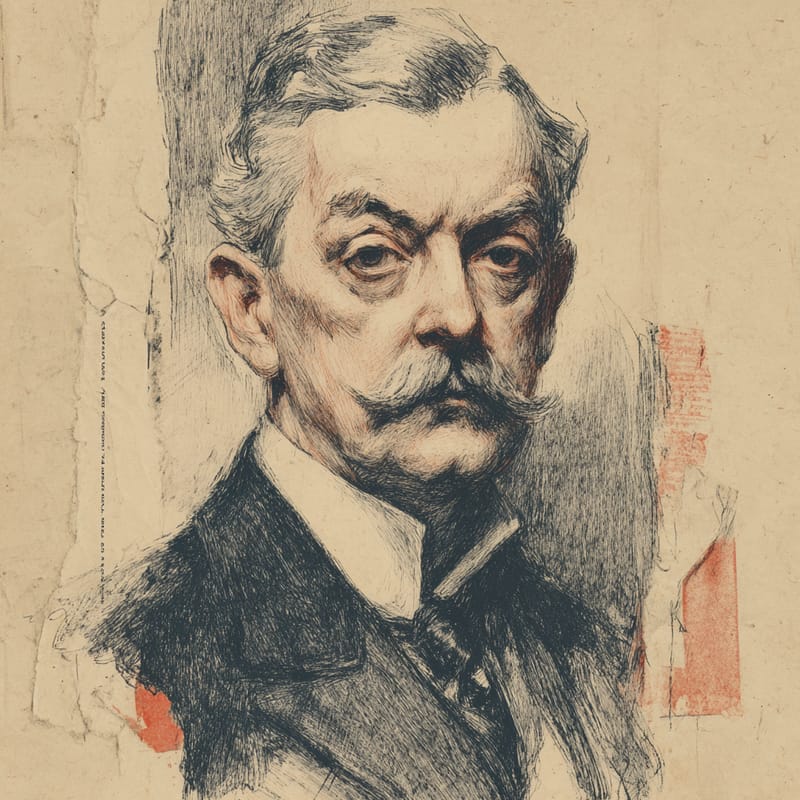
Harold Macmillan
You've never had it so good
One-nation market conservatism.
Rooted Liberal ConservativeOne of 729 ideologies · enter the Liberal Conservative hall →- Role
- Prime Minister
- Era
- 1894–1986
- Region
- United Kingdom
- Social band
- Rooted
- Placement
- +44 · +8 · −22
§ Where Harold Macmillan stands
3 axesMacmillan's The Middle Way (1938) argued for a planned mixed economy, and as housing minister he met a target of 300,000 new homes a year. As prime minister he accepted the resignation of his Treasury ministers in 1958 rather than make the spending cuts they demanded, and created the National Economic Development Council in 1962, though the Rent Act 1957, which decontrolled many private tenancies, showed his market side.
Macmillan was a patrician institutionalist who governed through cabinet, Parliament and the civil service, and he managed decolonisation by negotiated independence. He could wield prime-ministerial power ruthlessly, sacking a third of his cabinet in the Night of the Long Knives in July 1962, and he secured Britain's nuclear deterrent through the 1962 Nassau agreement with John F. Kennedy for Polaris missiles.
Macmillan's social outlook was paternalist one-nation Toryism: concern for the poor combined with respect for tradition, church and hierarchy. His government declined to act on the 1957 Wolfenden Report's call to decriminalise homosexuality, while adopting its proposals against street prostitution in 1959, and the Commonwealth Immigrants Act 1962 imposed the first controls on immigration from the Commonwealth.
How close are you to Harold Macmillan?
Three statements, one per axis. Answer them and we’ll drop you on the compass next to them.
§ The story
HistoricalMaurice Harold Macmillan (1894–1986), later 1st Earl of Stockton, was Conservative prime minister of the United Kingdom from 1957 to 1963. A grandson of the founder of the Macmillan publishing house, he was educated at Eton and Oxford and wounded on the Somme with the Grenadier Guards. As MP for Stockton-on-Tees he saw interwar unemployment at first hand and became a critic of appeasement. After the war he served as housing minister, minister of defence, foreign secretary and chancellor before succeeding Anthony Eden after the Suez crisis.
Nicknamed Supermac, Macmillan presided over rising living standards and won the 1959 election comfortably, while accelerating Britain's withdrawal from Africa and rebuilding the American alliance after Suez. His government applied to join the European Economic Community in 1961, only for Charles de Gaulle to veto the bid in 1963. The sacking of seven cabinet ministers in July 1962 and the Profumo affair damaged his authority, and he resigned on health grounds in October 1963. In old age he likened Margaret Thatcher's privatisations to selling off the family silver.
Notable for
- 01'Most have never had it so good'
- 02One-nation conservatism
- 03Decolonisation 'wind of change'
Key works & moments
- 1938Publishes The Middle Way, a case for a planned mixed economy.
- 1951–54As housing minister, meets the Conservative target of 300,000 new homes a year.
- 1957Succeeds Anthony Eden as prime minister and tells a Bedford rally most have never had it so good.
- 1959Wins the general election with a majority of 100 seats.
- 1960Delivers his wind of change speech to the South African Parliament in Cape Town.
- 1963De Gaulle vetoes his bid to join the EEC; he resigns that October.
In their own words
“Most of our people have never had it so good.”
“The wind of change is blowing through this continent, and, whether we like it or not, this growth of national consciousness is a political fact.”
§ Minds closest to Harold Macmillan
All minds →

§ Also in the Liberal Conservative hall
Enter the hall →§ Common questions
4 answersWhat was Harold Macmillan's political ideology?
Harold Macmillan was a one-nation Conservative: on the 99ideologies three-axis compass, a Rooted Liberal Conservative. Economically he sat clearly on the market side (+44) but within the post-war mixed economy, pairing private enterprise with full employment, mass housebuilding and the welfare state. On governance he leaned slightly authoritarian (+8) as a patrician institutionalist who governed through cabinet and Parliament, and socially he was moderately traditional (−22), paternalist and cautious on moral reform.
Was Harold Macmillan left-wing or right-wing?
Centre-right. Macmillan led the Conservative Party and believed in private enterprise, but he belonged to its moderate, one-nation wing. In the 1930s The Middle Way had urged economic planning, and as prime minister he chose growth and full employment over spending cuts, accepted the welfare state and the industries Labour had nationalised, and hastened decolonisation. Thatcherite critics later saw him as the embodiment of the consensus politics they rejected, and he in turn criticised their privatisations.
What was Harold Macmillan's wind of change speech?
It was his address to the South African Parliament in Cape Town on 3 February 1960, at the end of a tour of African countries. Speaking to an all-white legislature, Macmillan said the growth of African national consciousness was a political fact that Britain would accept, signalling faster decolonisation and implicitly rejecting apartheid. Nigeria became independent later that year and many other British colonies followed during the 1960s, while South Africa became a republic and left the Commonwealth in 1961.
Which minds are closest to Harold Macmillan?
On the 99ideologies three-axis compass, the minds closest to Harold Macmillan are Nicolas Sarkozy (96% alike), Brian Mulroney (96% alike) and John McCain (96% alike). The furthest is Emma Goldman (20% alike).