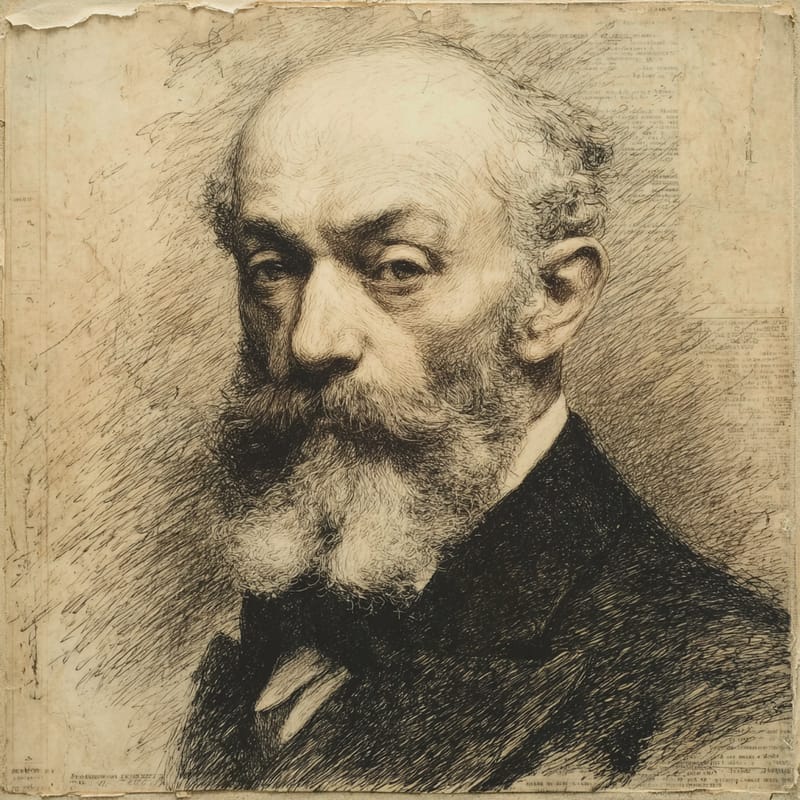
Jules Ferry
Free schools, free markets
The liberal republic, built.
Heterodox Liberal CapitalistOne of 729 ideologies · enter the Liberal Capitalist hall →- Role
- Prime Minister
- Era
- 1832–1893
- Region
- France
- Social band
- Heterodox
- Placement
- +26 · −18 · +18
§ Where Jules Ferry stands
3 axesFerry was a liberal of the propertied republican bourgeoisie who favoured sound finance and private enterprise, as he showed in Les Comptes fantastiques d'Haussmann (1868), an attack on the Second Empire's debt-financed rebuilding of Paris. In his Chamber speech of 28 July 1885 he justified colonies as outlets for French capital and manufactured goods in an age of protectionism, an imperial liberal capitalism that places him on the market side.
Ferry was a parliamentary republican who entrenched civil liberties: the press law of 29 July 1881 and the law on public meetings that year abolished prior authorisation, the Waldeck-Rousseau law of 1884 legalised trade unions and the municipal law of 1884 codified elected local government. His anticlerical decrees of 1880, which dissolved the Jesuits and forced other teaching orders to seek authorisation, showed the limits of his liberalism.
Ferry was a secular progressive in education: the laws of 16 June 1881 and 28 March 1882 made primary schooling free, compulsory from six to thirteen and secular, and the Camille Sée law of 1880 opened state secondary schools to girls. His progressivism stopped at empire: in July 1885 he told the Chamber that superior races had a duty to civilise inferior ones.
How close are you to Jules Ferry?
Three statements, one per axis. Answer them and we’ll drop you on the compass next to them.
§ The story
HistoricalJules Ferry (1832–1893) was a French republican statesman, twice prime minister, in 1880–81 and 1883–85, and the founder of free, compulsory and secular primary education. A lawyer from Saint-Dié in the Vosges, he made his name attacking the Second Empire, notably in his 1868 pamphlet on Baron Haussmann's finances, Les Comptes fantastiques d'Haussmann, and was elected a deputy for Paris in 1869. As mayor of Paris during the Prussian siege of 1870–71, he was blamed for food shortages and nicknamed Ferry-la-Famine.
As minister of public instruction from 1879 he passed the laws of 1881 and 1882 making primary schooling free, compulsory and secular, expelled the Jesuits from teaching and opened state secondary education to girls. His governments also freed the press in 1881 and legalised trade unions and restored divorce in 1884. He was equally the architect of colonial expansion in Tunisia, Tonkin, Madagascar and the Congo, which he defended in racial terms; a reverse at Lạng Sơn brought down his government in 1885 and left him reviled as Ferry-Tonkin. He died in 1893, weeks after becoming president of the Senate.
Notable for
- 01Free secular public schooling
- 02Republican institution-building
- 03Liberal economic policy
Key works & moments
- 1868Publishes Les Comptes fantastiques d'Haussmann, attacking the Second Empire's finances.
- 1870Becomes mayor of besieged Paris in the Government of National Defence.
- 1881Law of 16 June makes public primary schooling free; France imposes a protectorate on Tunisia.
- 1882Law of 28 March makes primary education compulsory and secular.
- 1885Falls from power over Tonkin, then defends colonial expansion in the Chamber in July.
- 1893Elected president of the Senate weeks before his death.
In their own words
“I repeat that the superior races have a right, because they have a duty. They have the duty to civilise the inferior races.”
§ Minds closest to Jules Ferry
All minds →

§ Also in the Liberal Capitalist hall
Enter the hall →§ Common questions
4 answersWhat was Jules Ferry's political ideology?
Jules Ferry was a moderate republican liberal, one of the so-called Opportunists of the early Third Republic: on the 99ideologies three-axis compass, a Heterodox Liberal Capitalist. Economically he sits on the market side (+26), a defender of private enterprise and of colonies as outlets for capital. On governance he was a parliamentary liberal (−18) who freed the press and legalised unions, and socially he was progressive in a secular sense (+18), founding free, compulsory, lay schooling while holding racial views of empire.
Was Jules Ferry left-wing or right-wing?
In his own time he stood on the republican left, against monarchists, Bonapartists and the political power of the Catholic Church, and his school laws remain a founding achievement of French secularism. By later standards his economics were those of the liberal centre-right, and he was hostile to socialism and to the Paris Commune. His enthusiasm for colonial conquest drew attacks both from the radical left, led by Georges Clemenceau, and from nationalists who wanted France focused on Germany.
Why is Jules Ferry controversial?
Because the founder of France's free, secular school system was also an architect of colonial conquest who justified it in racial terms. In a speech to the Chamber of Deputies on 28 July 1885 he declared that superior races had a right and a duty to civilise inferior races, and his governments extended French rule over Tunisia, Tonkin and Madagascar. Schools across France bear his name, and when François Hollande honoured him on taking office in 2012, he also condemned Ferry's colonial views.
Which minds are closest to Jules Ferry?
On the 99ideologies three-axis compass, the minds closest to Jules Ferry are John Bright (96% alike), Bill Clinton (94% alike) and Robert Rubin (93% alike). The furthest is Pol Pot (29% alike).