
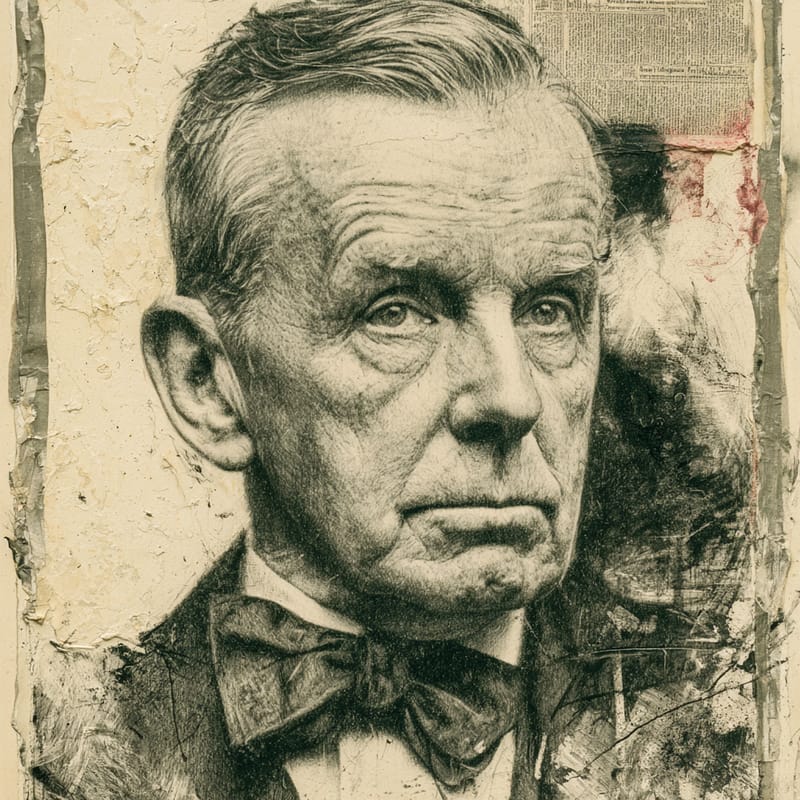
William Beveridge
Slew the five giants
The blueprint for the welfare state.
Heterodox Welfare CapitalistOne of 729 ideologies · enter the Welfare Capitalist hall →- Role
- Economist & reformer
- Era
- 1879–1963
- Region
- United Kingdom
- Social band
- Heterodox
- Placement
- +4 · −22 · +22
§ Where William Beveridge stands
3 axesBeveridge was a Liberal who wanted capitalism made secure, not replaced. His 1942 plan rested on flat-rate contributions and flat-rate benefits set at subsistence, deliberately leaving room for private saving and voluntary insurance above that floor, and Full Employment in a Free Society (1944) sought full employment through state management of demand while preserving private enterprise. That combination places him just on the market side of the centre.
Beveridge believed in expert inquiry, parliamentary government and civil liberty. In Full Employment in a Free Society (1944) he listed essential liberties that no employment policy should touch, among them freedom of speech, association and choice of occupation, and in Voluntary Action (1948) he warned against the state crowding out friendly societies, mutual aid and philanthropy.
Beveridge's progressivism lay in universality: his report named Want, Disease, Ignorance, Squalor and Idleness as the giants to be slain and offered every citizen the same insurance as of right, aiming to replace the stigma of the means-tested Poor Law. His vision was nonetheless rooted in its time, treating married women as dependants insured largely through their husbands' contributions.
How close are you to William Beveridge?
Three statements, one per axis. Answer them and we’ll drop you on the compass next to them.
§ The story
HistoricalWilliam Henry Beveridge (1879–1963) was a British economist and social reformer whose 1942 report laid the foundations of the post-war welfare state. Born in Rangpur in Bengal, the son of a judge in the Indian Civil Service, he was educated at Charterhouse and Balliol College, Oxford, and worked at the Toynbee Hall settlement in London's East End before joining the Board of Trade under Winston Churchill in 1908. There he helped design the labour exchanges of 1909 and the unemployment insurance scheme of the 1911 National Insurance Act, and later directed the London School of Economics from 1919 to 1937.
Asked in 1941 to review social insurance, he produced Social Insurance and Allied Services in 1942, proposing a universal, contributory system of flat-rate benefits for sickness, unemployment, old age and widowhood, alongside family allowances, a national health service and full employment. The report became a bestseller and was largely enacted by the Attlee government, through the National Insurance Act 1946. Beveridge followed it with Full Employment in a Free Society (1944), sat briefly as Liberal MP for Berwick-upon-Tweed and entered the Lords in 1946. Critics noted its subsistence-level benefits and its assumption that married women would depend on their husbands.
Notable for
- 01The Beveridge Report (1942)
- 02Designed universal social insurance
- 03Defined the 'five giants'
Key works & moments
- 1909Publishes Unemployment: A Problem of Industry and helps create Britain's labour exchanges.
- 1911Helps shape the unemployment insurance scheme in the National Insurance Act.
- 1919Becomes director of the London School of Economics, serving until 1937.
- 1942Publishes Social Insurance and Allied Services, the Beveridge Report, which becomes a bestseller.
- 1944Publishes Full Employment in a Free Society and is elected Liberal MP for Berwick-upon-Tweed.
- 1946The National Insurance Act enacts much of his plan; he enters the House of Lords.
In their own words
“A revolutionary moment in the world's history is a time for revolutions, not for patching.”
“Want is one only of five giants on the road of reconstruction and in some ways the easiest to attack. The others are Disease, Ignorance, Squalor and Idleness.”
§ Minds closest to William Beveridge
All minds →




§ Also in the Welfare Capitalist hall
Enter the hall →§ Common questions
4 answersWhat was William Beveridge's political ideology?
William Beveridge was a social liberal: on the 99ideologies three-axis compass, a Heterodox Welfare Capitalist. Economically he sits just on the market side of the centre (+4), designing universal social insurance to secure, not replace, a private-enterprise economy. On governance he was a liberal democrat (−22) who insisted that full employment must not cost basic freedoms, and socially he was moderately progressive (+22), pursuing equal social rights for all while assuming a traditional family structure.
Was William Beveridge left-wing or right-wing?
Neither firmly; he was a Liberal of the centre. His report became the founding document of the welfare state that Labour built after 1945, which leads many to associate him with the left. But Beveridge sat as a Liberal, defended private enterprise, free choice of occupation and voluntary action, and designed benefits at subsistence level to leave room for personal saving. He is best understood as a reforming liberal who wanted to remove insecurity from a market economy.
What were the five giants in the Beveridge Report?
Want, Disease, Ignorance, Squalor and Idleness. Beveridge's 1942 report named them as the evils that post-war reconstruction must defeat, while tackling only the first directly: a universal system of social insurance would abolish want by guaranteeing a minimum income during sickness, unemployment, old age and widowhood. The other giants were left to related reforms, which followed in the Education Act 1944, the National Health Service from 1948, housing programmes and the commitment to full employment.
Which minds are closest to William Beveridge?
On the 99ideologies three-axis compass, the minds closest to William Beveridge are B. Seebohm Rowntree (98% alike), Léon Bourgeois (95% alike) and Pierre Mendès France (94% alike). The furthest is Adam Sutler (27% alike).