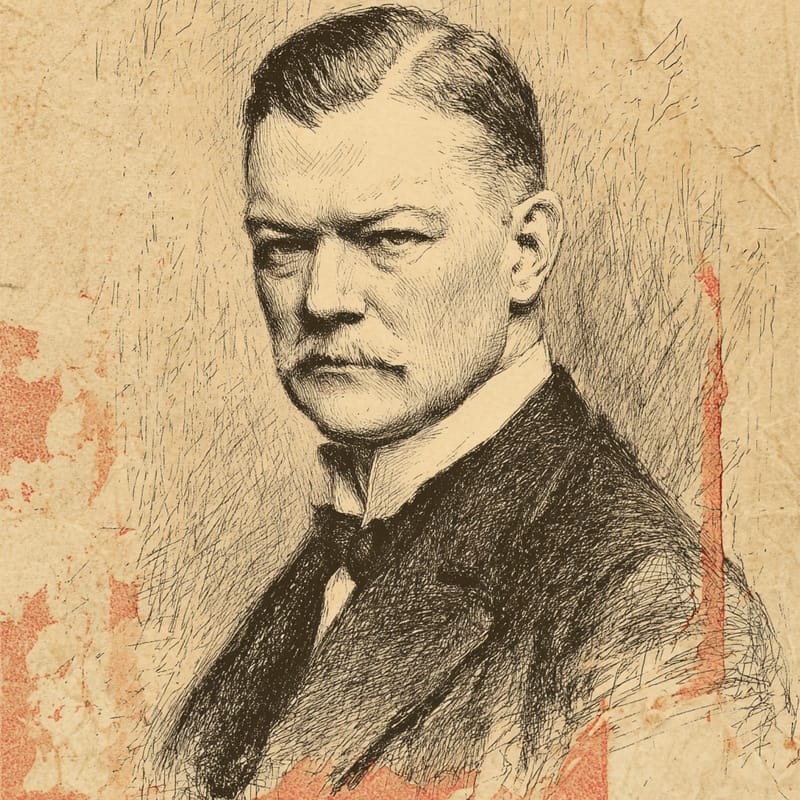
Herbert Hoover
Rugged individualism
Voluntarism over the state.
Rooted Liberal CapitalistOne of 729 ideologies · enter the Liberal Capitalist hall →- Role
- President
- Era
- 1874–1964
- Region
- United States
- Social band
- Rooted
- Placement
- +34 · −16 · −20
§ Where Herbert Hoover stands
3 axesHoover's American Individualism (1922) praised equality of opportunity and voluntary cooperation between business, labour and government, and as president he preferred to coax private action rather than command it. Yet he signed the protectionist Smoot–Hawley Tariff in 1930, created the Reconstruction Finance Corporation in 1932 and raised the top income-tax rate from 25 to 63 per cent, which keeps him well short of laissez-faire.
Hoover believed federal power should be limited and that local governments, charities and voluntary associations should carry the burden of relief; the 1932 Emergency Relief and Construction Act he signed lent money to the states rather than paying relief directly. His book The Challenge to Liberty (1934) attacked the New Deal as regimentation, though in 1932 he called in the army to clear the Bonus Army marchers from central Washington.
Hoover's social outlook was that of a Quaker-raised moralist who prized self-reliance, thrift and character. He defended Prohibition in the 1928 campaign and kept enforcing it as president, and his administration's 1931 deportation drive targeted Mexican immigrants as the slump deepened. Yet his famine-relief work in Belgium, central Europe and Soviet Russia showed a strong humanitarian streak.
How close are you to Herbert Hoover?
Three statements, one per axis. Answer them and we’ll drop you on the compass next to them.
§ The story
HistoricalHerbert Clark Hoover (1874–1964) was the 31st president of the United States, serving from 1929 to 1933. Born to a Quaker family in West Branch, Iowa, and orphaned young, he studied geology at Stanford and made a fortune as a mining engineer and consultant in Australia, China and beyond. During and after the First World War he won international fame organising food relief for occupied Belgium and post-war Europe, then served as commerce secretary under Warren Harding and Calvin Coolidge from 1921 to 1928.
Hoover entered the White House in 1929 as a celebrated problem-solver, and the Wall Street crash that October made his presidency synonymous with the Great Depression. He went further than earlier presidents in using federal power against a slump, creating the Reconstruction Finance Corporation in 1932, yet he long resisted direct federal relief for the unemployed and signed the Smoot–Hawley Tariff in 1930. The army's eviction of the Bonus Army veterans from Washington in 1932 deepened his unpopularity before his landslide defeat by Franklin Roosevelt. In retirement he attacked the New Deal and led two commissions on government reorganisation.
Notable for
- 01'American Individualism'
- 02Pre-Depression commerce secretary
- 03Voluntarist philosophy
Key works & moments
- 1914Organises the Commission for Relief in Belgium to feed the German-occupied country.
- 1922Publishes American Individualism, his credo of voluntary cooperation over state control.
- 1928Defeats Al Smith for the presidency after campaigning for 'rugged individualism'.
- 1930Signs the Smoot–Hawley Tariff despite a petition from more than 1,000 economists.
- 1932Creates the Reconstruction Finance Corporation, then loses in a landslide to Franklin Roosevelt.
- 1947Chairs the first Hoover Commission on reorganising the federal executive, appointed by Harry Truman.
In their own words
“We were challenged with a peace-time choice between the American system of rugged individualism and a European philosophy of diametrically opposed doctrines—doctrines of paternalism and state socialism.”
§ Minds closest to Herbert Hoover
All minds →

§ Also in the Liberal Capitalist hall
Enter the hall →§ Common questions
4 answersWhat was Herbert Hoover's political ideology?
Herbert Hoover was a Republican individualist who believed in voluntary cooperation between business, labour and government rather than either pure laissez-faire or state planning: on the 99ideologies three-axis compass, a Rooted Liberal Capitalist. Economically he sat on the market side (+34), defending private enterprise while using tariffs and federal credit. On governance he leaned libertarian (−16), insisting that relief belonged to localities and charities, and socially he was moderately traditional (−20), a Quaker-raised moralist who enforced Prohibition.
Was Herbert Hoover left-wing or right-wing?
Right of centre, though more interventionist than his laissez-faire reputation suggests. Hoover defended private enterprise, opposed a federal dole and spent his later years attacking the New Deal as a threat to liberty, which places him on the right. But as president he used federal credit against the Depression through the Reconstruction Finance Corporation, backed public works and raised taxes on high incomes in 1932, and some historians see him as a forerunner of the New Deal he later denounced.
Did Herbert Hoover cause the Great Depression?
No, though his response is widely judged inadequate. The Depression had deep international roots, including the 1929 stock-market crash, fragile banks, war debts and the gold standard, and it began only months into his term. Economists criticise him for signing the Smoot–Hawley Tariff in 1930, which invited retaliation, and for the 1932 tax increase, while others note he did more than any earlier president to fight a slump. Voters blamed him: in 1932 he carried only six states.
Which minds are closest to Herbert Hoover?
On the 99ideologies three-axis compass, the minds closest to Herbert Hoover are Barry Goldwater (97% alike), Wilhelm Röpke (97% alike) and Calvin Coolidge (97% alike). The furthest is Pol Pot (22% alike).