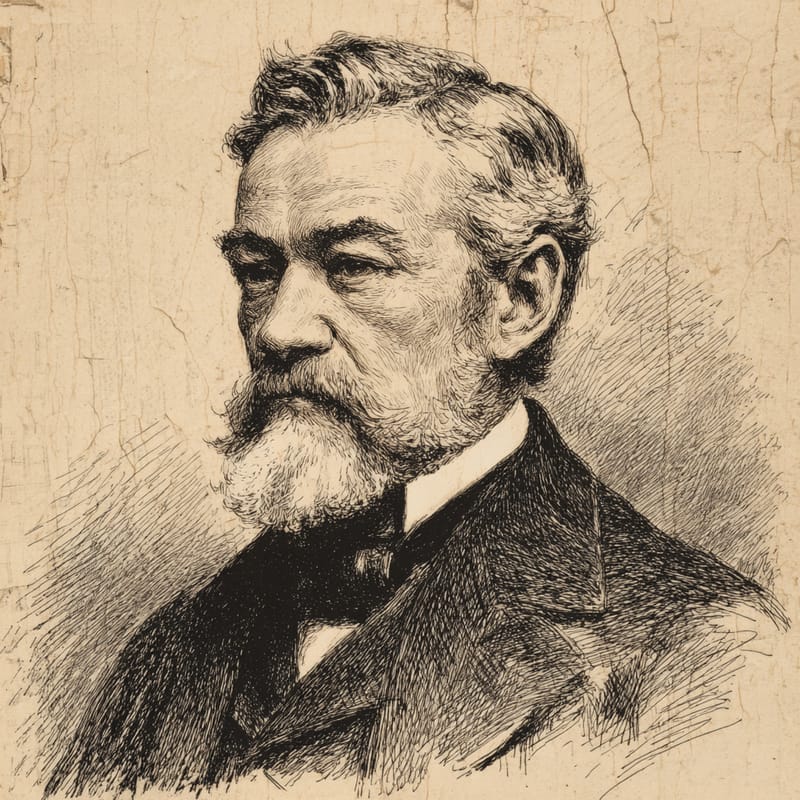
John Bright
The tribune of liberty
Free trade and the people's vote.
Heterodox Liberal CapitalistOne of 729 ideologies · enter the Liberal Capitalist hall →- Role
- Statesman
- Era
- 1811–1889
- Region
- United Kingdom
- Social band
- Heterodox
- Placement
- +32 · −24 · +14
§ Where John Bright stands
3 axesBright was a free-trade radical who saw tariffs on food as a tax levied by landlords on the poor, and the 1846 repeal of the Corn Laws was his defining victory. A mill owner wary of state interference, he opposed the Ten Hours Act of 1847 limiting factory hours. Yet he backed Irish tenants' right to buy their land, written into the 1870 Land Act as the Bright clauses.
Bright believed government should answer to the governed, and he spent the 1860s addressing vast public meetings for an extended franchise that fed into the Second Reform Act of 1867. He attacked aristocratic privilege and the established Church of Ireland, disestablished in 1869, and opposed military adventures such as the Crimean War and the 1882 bombardment of Alexandria on principle.
Bright's progressivism was rooted in Quaker dissent rather than secular radicalism. He fought for religious equality, including the abolition of compulsory church rates, achieved in 1868, and during the American Civil War he championed the Union and the end of slavery even as the cotton famine hit Lancashire's mills. His Quaker sobriety and later opposition to Irish Home Rule kept him short of the radical left.
How close are you to John Bright?
Three statements, one per axis. Answer them and we’ll drop you on the compass next to them.
§ The story
HistoricalJohn Bright (1811–1889) was the son of a Quaker cotton-mill owner in Rochdale, Lancashire, and became one of the most celebrated orators of Victorian radicalism. With Richard Cobden he led the Anti-Corn Law League's campaign against tariffs on imported grain, entering the Commons for Durham in 1843. He sat for Manchester from 1847 to 1857 and then for Birmingham until his death, and served in William Gladstone's cabinets as President of the Board of Trade and Chancellor of the Duchy of Lancaster.
Bright's significance lay in joining free trade to democracy. The repeal of the Corn Laws in 1846 secured the first cause, and his mass meetings of the 1860s helped bring about the Second Reform Act of 1867, which enfranchised many urban working men. He paid for his convictions: opposition to the Crimean War cost him his Manchester seat in 1857, and he resigned from the cabinet over the bombardment of Alexandria in 1882. His break with Gladstone over Irish Home Rule in 1886 made him a Liberal Unionist in his last years.
Notable for
- 01Anti-Corn Law League
- 02Reform Act campaigner
- 03Opposed the Crimean War
Key works & moments
- 1843Wins a by-election at Durham, entering the Commons as a free-trade radical.
- 1846Parliament repeals the Corn Laws after the Anti-Corn Law League's campaign led by Cobden and Bright.
- 1855Delivers his 'Angel of Death' speech against the Crimean War in the House of Commons.
- 1857Loses his Manchester seat over his anti-war stance, then is elected for Birmingham.
- 1867The Second Reform Act extends the vote to many urban working men after his reform campaign.
- 1882Resigns from Gladstone's cabinet in protest at the British bombardment of Alexandria.
In their own words
“The Angel of Death has been abroad throughout the land; you may almost hear the beating of his wings.”
§ Minds closest to John Bright
All minds →

§ Also in the Liberal Capitalist hall
Enter the hall →§ Common questions
4 answersWhat was John Bright's political ideology?
John Bright was a Victorian free-trade radical and Liberal: on the 99ideologies three-axis compass, a Heterodox Liberal Capitalist. Economically he sat on the market side of centre (+32), a champion of free trade and opponent of factory regulation who still backed state help for Irish tenants to buy land. On governance he leaned libertarian (−24), campaigning for a wider franchise and against war and aristocratic privilege, and socially he was mildly progressive (+14), a Quaker fighting for religious equality and against slavery.
Was John Bright left-wing or right-wing?
Left-wing by the standards of his own century: a radical who challenged the landed aristocracy, the established church and the war-making state. By modern standards the picture is mixed: his free-trade, anti-regulation economics sits on the market right, while his democratic and anti-war politics belong to the liberal left. He is best understood as a classical liberal radical, the voice of Manchester's manufacturing middle class against the landed interest, rather than as a forerunner of socialism.
Why did John Bright oppose the Crimean War?
Because he judged it unnecessary, ruinous and immoral. A Quaker and a firm believer in non-intervention, Bright argued that Britain had no vital interest in defending the Ottoman Empire against Russia and that diplomacy could have prevented the conflict. In the Commons on 23 February 1855 he delivered his 'Angel of Death' speech on the soldiers dying in the Crimea. The stance made him deeply unpopular and cost him his Manchester seat at the 1857 general election.
Which minds are closest to John Bright?
On the 99ideologies three-axis compass, the minds closest to John Bright are Jules Ferry (96% alike), Milton Friedman (92% alike) and Robert Rubin (91% alike). The furthest is Pol Pot (26% alike).