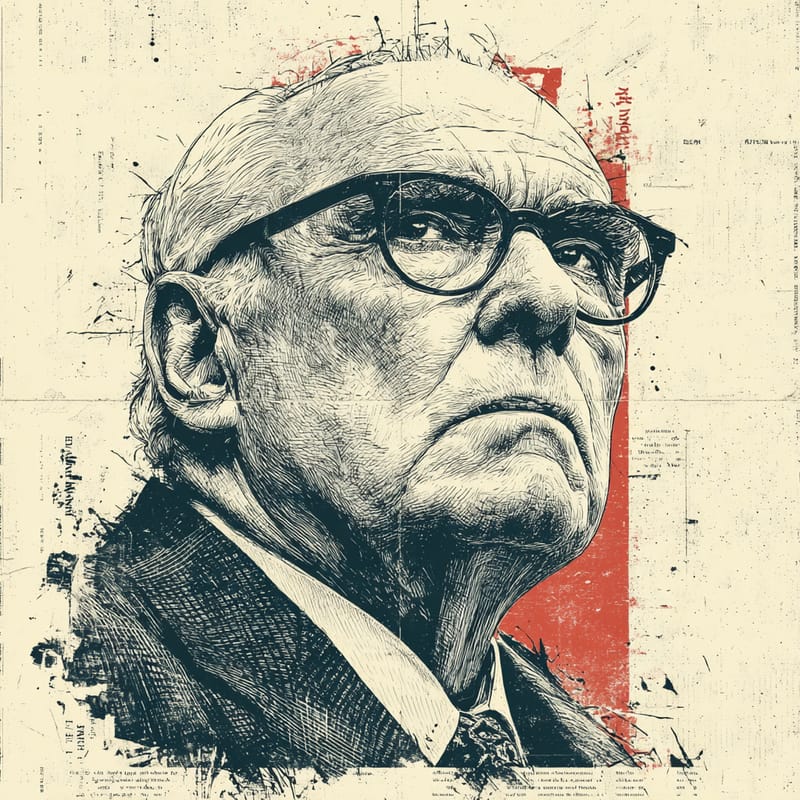
Helmut Kohl
Chancellor of unity
Reunified Germany; deepened Europe.
Rooted ConservativeOne of 729 ideologies · enter the Conservative hall →- Role
- Chancellor
- Era
- 1930–2017
- Region
- Germany
- Social band
- Rooted
- Placement
- +48 · +20 · −36
§ Where Helmut Kohl stands
3 axesKohl defended the social market economy rather than pursuing Thatcherite radicalism. His governments trimmed spending and taxes in the 1980s and, through the Treuhand agency, privatised thousands of East German state enterprises after 1990, but they preserved a large welfare state and financed reunification partly through the solidarity surcharge introduced in 1991.
Kohl was a patient institutionalist and formidable party manager who came to power through a constructive vote of no confidence in 1982 and governed for sixteen years in coalition with the Free Democrats. He was willing to pool national sovereignty in Europe, championing the Maastricht Treaty of 1992, though the 1999 donations scandal exposed how personally he had controlled party finances.
A Catholic Christian democrat, Kohl promised a spiritual and moral turn when he took office in 1982 and championed family, nation and Europe's Christian heritage. His government tightened Germany's constitutional right of asylum in 1993 after a surge in applications, and in 1985 he took Ronald Reagan to the Bitburg war cemetery, a gesture of reconciliation that provoked protests because members of the Waffen-SS were buried there.
How close are you to Helmut Kohl?
Three statements, one per axis. Answer them and we’ll drop you on the compass next to them.
§ The story
HistoricalHelmut Kohl (1930–2017) was chancellor of West Germany from 1982 and of reunified Germany until 1998, the longest-serving chancellor since Otto von Bismarck. Born into a Catholic family in Ludwigshafen, he joined the Christian Democratic Union as a teenager, earned a doctorate in history at Heidelberg and became minister-president of Rhineland-Palatinate in 1969. He led the CDU from 1973 to 1998, narrowly lost the 1976 federal election, and became chancellor in 1982 when the Free Democrats abandoned Helmut Schmidt and backed a constructive vote of no confidence.
Kohl's defining achievement was German reunification. After the Berlin Wall fell he issued a ten-point plan for unity in November 1989, pushed through monetary union with East Germany in July 1990 and secured Soviet and Western consent in the Two Plus Four Treaty, and Germany reunited on 3 October 1990. With François Mitterrand he drove European integration through the Maastricht Treaty of 1992, which set the path to the euro. His reputation suffered from a party-financing scandal in 1999–2000, when he admitted taking secret donations and refused to name the donors.
Notable for
- 01German reunification
- 02Maastricht Treaty and the euro
- 0316 years as chancellor
Key works & moments
- 1982Becomes chancellor after a constructive vote of no confidence topples Helmut Schmidt.
- 1984Joins hands with François Mitterrand at Verdun in a gesture of Franco-German reconciliation.
- 1989Presents a ten-point plan for German unity after the fall of the Berlin Wall.
- 1990Presides over German reunification on 3 October and wins the first all-German election.
- 1992The Maastricht Treaty he championed is signed, setting Europe on course for a single currency.
- 1999Admits receiving undeclared party donations, deepening the CDU finance scandal.
§ Minds closest to Helmut Kohl
All minds →

§ Also in the Conservative hall
Enter the hall →§ Common questions
4 answersWhat was Helmut Kohl's political ideology?
Helmut Kohl was a Christian democrat in the tradition of Konrad Adenauer: on the 99ideologies three-axis compass, a Rooted Conservative. Economically he sat right of centre (+48), defending the social market economy while trimming spending and privatising East German industry after reunification. On governance he was a patient institutionalist and party manager (+20) who pooled sovereignty in Europe, and socially he leaned traditional (−36), a Catholic conservative who promised a spiritual and moral turn and tightened asylum law in 1993.
Was Helmut Kohl left-wing or right-wing?
Centre-right. Kohl led the Christian Democratic Union, the main party of the German right, and governed with the liberal Free Democrats, favouring markets, NATO and traditional values. But like most post-war Christian democrats he accepted a large welfare state and consensus with the unions, and his passion for European integration put him at odds with nationalist conservatives, so he belongs to the moderate, pro-European mainstream of the right.
How did Helmut Kohl reunify Germany?
By moving fast when the opportunity opened. After the Berlin Wall fell in November 1989, Kohl seized the initiative with a ten-point plan for unity, campaigned for the pro-unification Alliance for Germany in East Germany's first free election in March 1990, and offered a currency union that converted wages and savings at a generous rate. He reassured Mikhail Gorbachev with financial aid and a cap on German forces, won American backing, and secured the Two Plus Four Treaty, which let a united Germany remain in NATO.
Which minds are closest to Helmut Kohl?
On the 99ideologies three-axis compass, the minds closest to Helmut Kohl are Benjamin Disraeli (96% alike), George H. W. Bush (96% alike) and José María Aznar (96% alike). The furthest is Emma Goldman (13% alike).