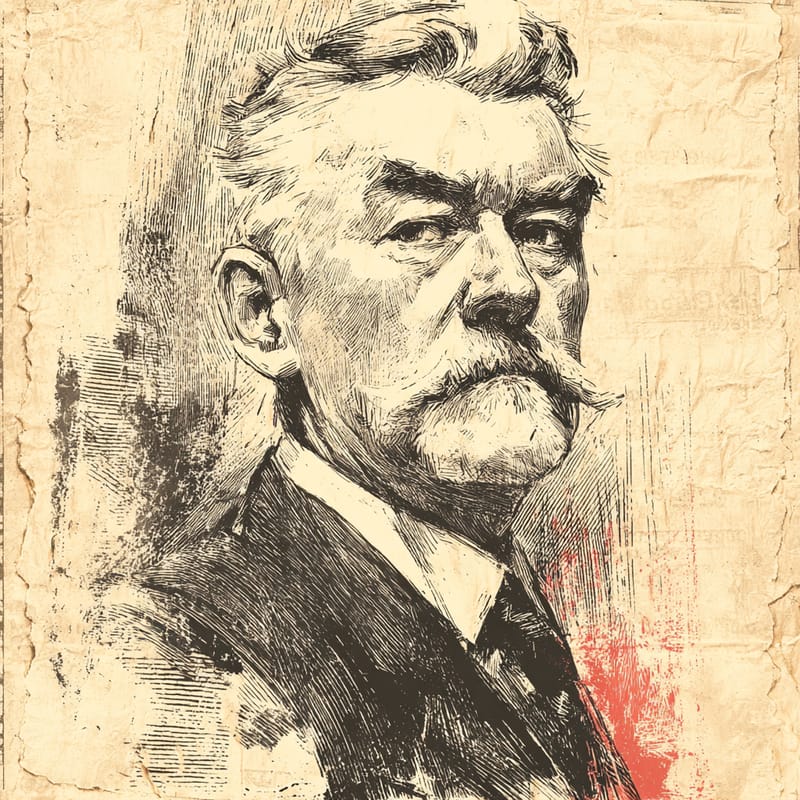
Robert Menzies
The forgotten people's champion
Founded Australia's Liberal Party; Crown and middle class.
Traditional ConservativeOne of 729 ideologies · enter the Conservative hall →- Role
- Prime Minister
- Era
- 1894–1978
- Region
- Australia
- Social band
- Traditional
- Placement
- +50 · +26 · −50
§ Where Robert Menzies stands
3 axesMenzies stood for private enterprise against Labor's socialisation agenda, winning office in 1949 after Ben Chifley's attempt to nationalise the private banks. Yet he governed as a pragmatist within the mixed economy, keeping high tariffs, Keynesian demand management and the welfare system he inherited, adding subsidised voluntary health insurance through the 1953 National Health Act, and funding universities after the 1957 Murray Report.
A constitutional monarchist and parliamentarian, Menzies nonetheless favoured a strong state against perceived subversion. His Communist Party Dissolution Act of 1950 was struck down by the High Court, and voters narrowly rejected a 1951 referendum to give him the power, while the 1954 Petrov defection led to a royal commission into Soviet espionage. He also reintroduced conscription through the 1964 National Service Act.
Menzies was an ardent loyalist to Britain and the Crown who championed thrift, home ownership, family and respectability, themes of his 1942 'Forgotten People' broadcast. His government expanded immigration from Europe while keeping the White Australia policy largely intact, though the 1958 Migration Act abolished the notorious dictation test, and from 1963 he opened the door to federal aid for church schools.
How close are you to Robert Menzies?
Three statements, one per axis. Answer them and we’ll drop you on the compass next to them.
§ The story
HistoricalSir Robert Gordon Menzies (1894–1978) was Australia's longest-serving prime minister, holding office from 1939 to 1941 and again from 1949 to 1966. A storekeeper's son from the Victorian Wimmera, he became a leading constitutional barrister, served in Victorian state politics and entered federal parliament for Kooyong in 1934, becoming attorney-general under Joseph Lyons. He succeeded Lyons as leader of the United Australia Party in 1939, led Australia into the Second World War and was forced out by his own side in 1941.
In opposition Menzies rebuilt the non-Labor side, founding the Liberal Party in 1944–45 and courting what he called the 'forgotten people' of the middle class. He returned in 1949 by campaigning against bank nationalisation and socialism, then won six more elections in a row, presiding over full employment, mass immigration, expanded universities and the ANZUS alliance. His attempt to outlaw the Communist Party failed in the High Court and at a 1951 referendum, and his 1964 reintroduction of conscription and 1965 commitment of combat troops to Vietnam bitterly divided the country after he retired.
Notable for
- 01Founded the Liberal Party of Australia
- 0216 years as prime minister
- 03Anchored the postwar middle class
Key works & moments
- 1939Becomes prime minister in April and announces in September that Australia is at war.
- 1942Delivers the 'Forgotten People' radio broadcast, setting out his middle-class conservatism.
- 1944–45Founds the Liberal Party of Australia from the remnants of the United Australia Party.
- 1949Defeats Ben Chifley's Labor government, beginning more than 16 unbroken years in office.
- 1951Australia signs the ANZUS Treaty; his referendum to ban the Communist Party narrowly fails.
- 1966Retires in January as Australia's longest-serving prime minister.
In their own words
“It is my melancholy duty to inform you officially that, in consequence of a persistence by Germany in her invasion of Poland, Great Britain has declared war upon her and that, as a result, Australia is also at war.”
§ Minds closest to Robert Menzies
All minds →

§ Also in the Conservative hall
Enter the hall →§ Common questions
4 answersWhat was Robert Menzies's political ideology?
Menzies was a liberal conservative in the British tradition: on the 99ideologies three-axis compass, a Traditional Conservative. Economically he sat right of centre (+50), defending private enterprise against socialism while keeping tariffs and the welfare state. On governance he leaned towards order and state authority (+26), seeking to outlaw communism within a constitutional monarchy, and socially he was firmly traditional (−50), devoted to the Crown, family, church and the British connection.
Was Robert Menzies left-wing or right-wing?
Right-wing, as the founder and first leader of the Liberal Party, Australia's main centre-right party. Menzies opposed Labor's plans to nationalise banking, fought communism at home and abroad and celebrated the self-reliant middle class. His conservatism was managerial rather than radical, however: he accepted Keynesian economics, protection for industry and a welfare state, so he resembled Britain's postwar consensus conservatives more than later free-market reformers.
Why did Robert Menzies try to ban the Communist Party?
Because he saw Australian communists as agents of a hostile power in the early Cold War. Having campaigned on the issue in 1949, his government passed the Communist Party Dissolution Act in 1950, as Australian troops went to Korea. The High Court struck the law down in 1951, ruling that it exceeded the Commonwealth's constitutional powers, and Menzies then sought the power by referendum in September 1951. Opposition leader H. V. Evatt campaigned against it on civil-liberties grounds, and it was narrowly defeated.
Which minds are closest to Robert Menzies?
On the 99ideologies three-axis compass, the minds closest to Robert Menzies are Konrad Adenauer (98% alike), Shinzo Abe (98% alike) and John Howard (97% alike). The furthest is Emma Goldman (8% alike).