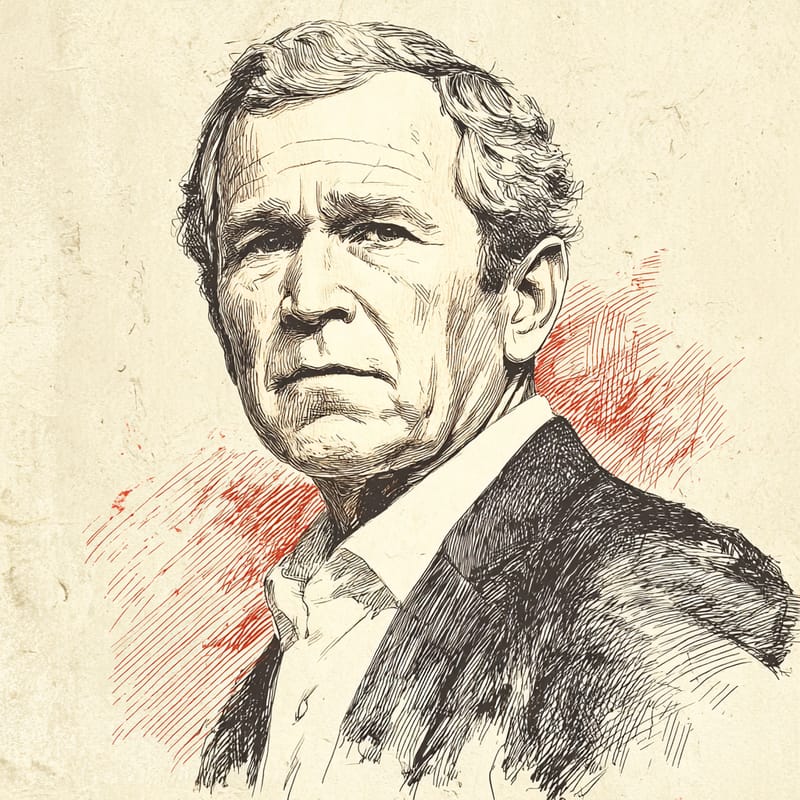
George W. Bush
Compassionate conservatism
Tax cuts, faith, and the war on terror.
Traditional Liberal ConservativeOne of 729 ideologies · enter the Liberal Conservative hall →- Role
- President
- Era
- b. 1946
- Region
- United States
- Social band
- Traditional
- Placement
- +52 · +10 · −40
§ Where George W. Bush stands
3 axesBush's Economic Growth and Tax Relief Reconciliation Act of 2001 and the 2003 tax law cut income-tax rates and taxes on dividends and capital gains, and in 2005 he campaigned unsuccessfully for private Social Security accounts. Yet he also created the Medicare prescription-drug benefit in 2003, imposed steel tariffs in 2002 and signed the 2008 bank rescue, which keeps him well short of the free-market pole.
After the 11 September attacks Bush signed the USA PATRIOT Act, created the Department of Homeland Security, authorised warrantless surveillance by the National Security Agency and detained terrorism suspects at Guantánamo Bay. But he governed within the constitutional order, seeking authority from Congress after the Supreme Court struck down his military commissions in Hamdan v. Rumsfeld in 2006, and left office after two elected terms.
A born-again evangelical, Bush opened a White House office for faith-based initiatives in 2001, limited federal funding for embryonic stem-cell research that year, signed the Partial-Birth Abortion Ban Act of 2003 and endorsed a constitutional amendment banning same-sex marriage in 2004. He tempered this with support for a path to legal status for undocumented immigrants and appointed Colin Powell and Condoleezza Rice as the first two Black secretaries of state.
How close are you to George W. Bush?
Three statements, one per axis. Answer them and we’ll drop you on the compass next to them.
§ The story
LivingGeorge Walker Bush (born 1946) is an American politician who served as the 43rd president of the United States from 2001 to 2009. The eldest son of President George H. W. Bush, he grew up in Texas, graduated from Yale and Harvard Business School, flew jets in the Texas Air National Guard and worked in the oil industry before becoming managing general partner of the Texas Rangers baseball team. He was elected governor of Texas in 1994 and won the 2000 presidential election after the Supreme Court halted the Florida recount in Bush v. Gore.
Bush campaigned as a compassionate conservative, passing large tax cuts, the No Child Left Behind education law and a Medicare prescription-drug benefit, but the attacks of 11 September 2001 redefined his presidency. He launched wars in Afghanistan and, in 2003, Iraq, where the weapons of mass destruction cited as justification were never found. Detention without trial at Guantánamo Bay and harsh interrogation methods, including waterboarding, drew wide condemnation. His second term was marked by the response to Hurricane Katrina and the 2008 financial crisis, while his PEPFAR programme against AIDS is widely credited with saving millions of lives.
Notable for
- 01Bush tax cuts
- 02Post-9/11 security policy
- 03'Compassionate conservatism'
Key works & moments
- 1994Elected governor of Texas, defeating the Democratic incumbent Ann Richards.
- 2000Wins the presidency after the Supreme Court's Bush v. Gore ruling ends the Florida recount.
- 2001Signs major tax cuts; after the September 11 attacks, launches war in Afghanistan and signs the Patriot Act.
- 2002Signs the No Child Left Behind Act, negotiated with the Democrat Ted Kennedy.
- 2003Orders the invasion of Iraq, launches PEPFAR and signs the Medicare prescription-drug benefit.
- 2008Signs the $700 billion Troubled Asset Relief Program as the financial crisis deepens.
In their own words
“Either you are with us, or you are with the terrorists.”
“The best hope for peace in our world is the expansion of freedom in all the world.”
§ Minds closest to George W. Bush
All minds →



§ Also in the Liberal Conservative hall
Enter the hall →§ Common questions
4 answersWhat is George W. Bush's political ideology?
George W. Bush is an evangelical conservative Republican who campaigned on compassionate conservatism: on the 99ideologies three-axis compass, a Traditional Liberal Conservative. Economically he sits clearly on the market side (+52), cutting taxes in 2001 and 2003 while expanding Medicare and approving the 2008 bank rescue. On governance he leans authoritarian (+10), having enlarged surveillance and detention powers after 11 September, and socially he is traditional (−40), restricting federal stem-cell funding and backing a constitutional ban on same-sex marriage.
Is George W. Bush left-wing or right-wing?
Right-wing. Bush is a conservative Republican who cut taxes, appointed conservative justices such as John Roberts and Samuel Alito, opposed abortion and same-sex marriage and pursued an assertive foreign policy. Yet many conservatives criticised him for expanding government: the Medicare drug benefit, No Child Left Behind and rising deficits made him a big-government conservative in their eyes, and his support for a path to legal status for undocumented immigrants in 2006–07 split his party.
What was compassionate conservatism?
It was the governing philosophy George W. Bush campaigned on in 2000: conservative ends pursued with active concern for the poor. Rather than simply shrinking government, it promised to use federal power and money to support religious charities, raise school standards and help the disadvantaged through markets and voluntary groups. In office it produced the White House Office of Faith-Based and Community Initiatives in 2001, the No Child Left Behind Act of 2002 and PEPFAR, but the label faded as the war on terror came to dominate his presidency.
Which minds are closest to George W. Bush?
On the 99ideologies three-axis compass, the minds closest to George W. Bush are Francis Urquhart (99% alike), José María Aznar (97% alike) and Robert Peel (96% alike). The furthest is Emma Goldman (13% alike).