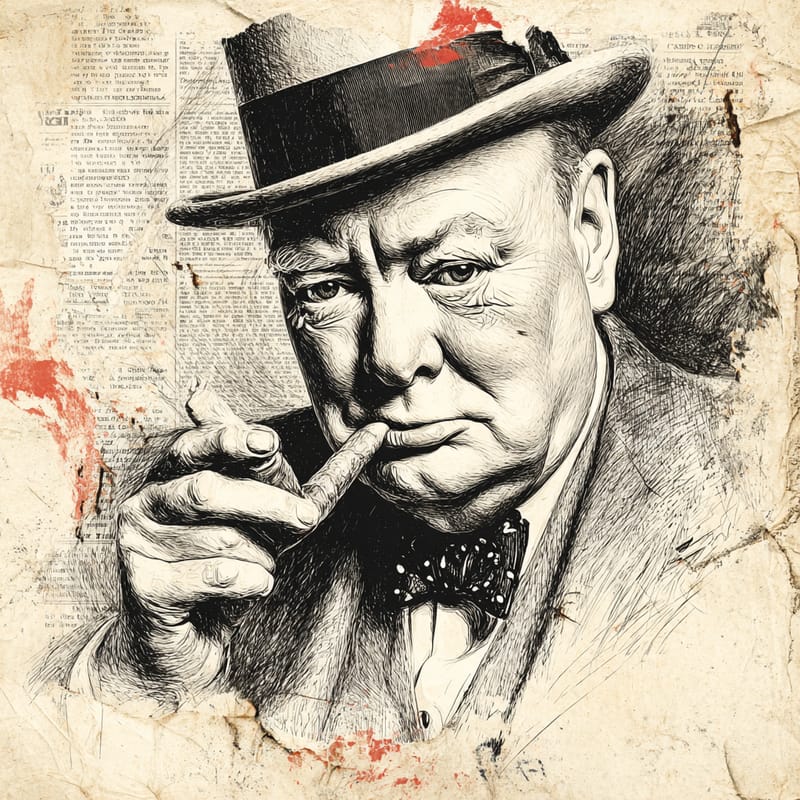
Winston Churchill
The wartime lion
Imperial tradition and parliamentary resolve against tyranny.
Traditional ConservativeOne of 729 ideologies · enter the Conservative hall →- Role
- Prime Minister
- Era
- 1874–1965
- Region
- United Kingdom
- Social band
- Traditional
- Placement
- +50 · +32 · −42
§ Where Winston Churchill stands
3 axesChurchill was a free-trader who left the Conservatives for the Liberals over tariffs in 1904, and as chancellor he returned Britain to the gold standard at its pre-war parity in 1925, a decision widely judged a mistake. As a Liberal minister he introduced labour exchanges and the Trade Boards Act of 1909, but in a 1945 election broadcast he warned that socialism would require some form of Gestapo.
Churchill revered Parliament and the Crown but believed in strong executive leadership in crisis. As prime minister from 1940 he also made himself minister of defence to direct the war, and his government interned thousands of enemy aliens and detained the fascist leader Oswald Mosley without trial. As home secretary in 1911 he deployed troops during a national railway strike.
Churchill was a romantic traditionalist steeped in monarchy, aristocracy and empire. He led Conservative resistance to Indian self-government in the early 1930s, opposing the Government of India Act 1935, expressed views on race that are widely criticised, and in A History of the English-Speaking Peoples (1956–58) celebrated Britain's national and imperial past.
How close are you to Winston Churchill?
Three statements, one per axis. Answer them and we’ll drop you on the compass next to them.
§ The story
HistoricalSir Winston Leonard Spencer Churchill (1874–1965) was prime minister of the United Kingdom from 1940 to 1945 and from 1951 to 1955. Born at Blenheim Palace, the son of the Conservative politician Lord Randolph Churchill, he served as a cavalry officer and war correspondent, escaping from a Boer prison camp in 1899, before entering Parliament in 1900. He crossed to the Liberals in 1904 and back to the Conservatives in the 1920s, holding a string of senior offices, from home secretary and First Lord of the Admiralty to chancellor of the exchequer.
Churchill spent the 1930s out of office, warning against German rearmament and opposing the 1938 Munich Agreement. Made prime minister in May 1940, he refused to seek terms with Hitler after the fall of France, and his speeches and alliances with Franklin Roosevelt and, later, Joseph Stalin carried Britain through the war, yet voters rejected him in 1945. His record also includes the failed Gallipoli campaign of 1915 and his government's response to the 1943 Bengal famine, in which an estimated 2–3 million people died. He won the Nobel Prize in Literature in 1953.
Notable for
- 01Led Britain through the Second World War
- 02Nobel Prize in Literature, 1953
- 03Defined Cold-War rhetoric ('iron curtain')
Key works & moments
- 1909As president of the Board of Trade, introduces trade boards and labour exchanges.
- 1925As chancellor, returns Britain to the gold standard at the pre-war parity.
- 1940Becomes prime minister and vows to fight on after the fall of France.
- 1945Leads Britain to victory in Europe but loses the July general election.
- 1946Warns of an iron curtain across Europe in a speech at Fulton, Missouri.
- 1953Wins the Nobel Prize in Literature during his second premiership.
In their own words
“I have nothing to offer but blood, toil, tears and sweat.”
“From Stettin in the Baltic to Trieste in the Adriatic, an iron curtain has descended across the Continent.”
§ Minds closest to Winston Churchill
All minds →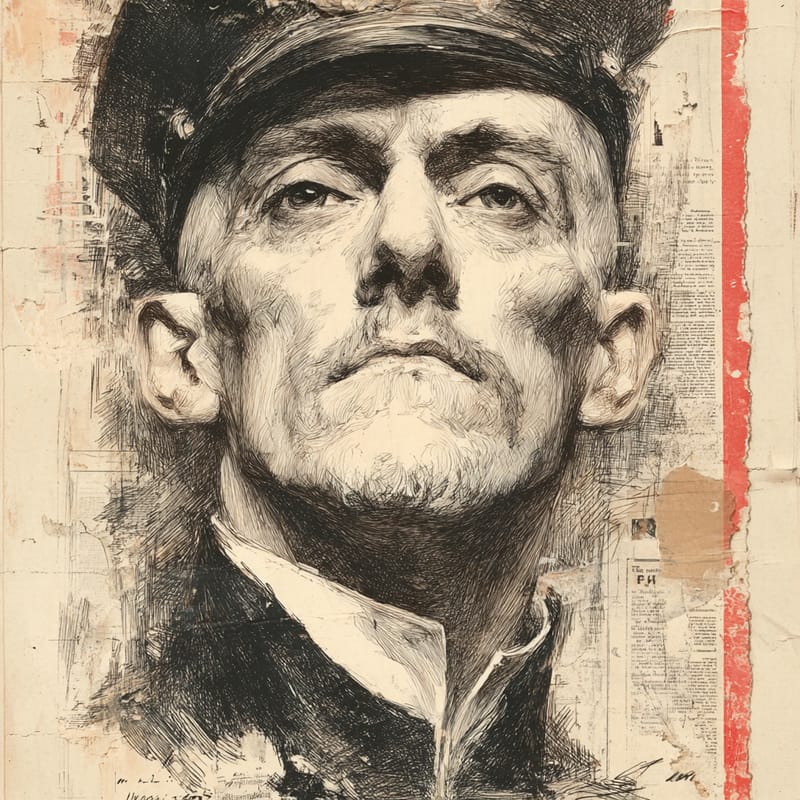

§ Also in the Conservative hall
Enter the hall →§ Common questions
4 answersWhat was Winston Churchill's political ideology?
Winston Churchill was a traditional conservative with a liberal, free-trade past: on the 99ideologies three-axis compass, a Traditional Conservative. Economically he sat right of centre (+50), a free-trader who restored the gold standard and opposed socialism, though as a Liberal he helped found some of Britain's early welfare measures. On governance he favoured strong executive leadership within Parliament and monarchy (+32), and socially he was a romantic traditionalist (−42), devoted to the Crown, the aristocratic order and the British Empire.
Was Winston Churchill left-wing or right-wing?
Right-wing for most of his career, with significant exceptions. Churchill spent about twenty years as a Liberal, when he helped pioneer minimum wages in sweated trades and labour exchanges, and he led a wartime coalition with Labour. But he was an imperialist who opposed Indian self-government, fought the 1945 election as a passionate opponent of socialism and led the Conservative Party for fifteen years, so his politics belong to the traditional, patriotic right.
Was Winston Churchill responsible for the Bengal famine?
Historians disagree about how far, but his government's record is heavily criticised. An estimated 2–3 million people died in Bengal in 1943 after a cyclone, the loss of rice imports from Japanese-occupied Burma, wartime inflation and failures by the colonial and provincial governments. Critics argue that Churchill's war cabinet was slow to send relief and restricted food shipments to India, and that his hostile remarks about Indians reflected indifference; defenders point to shipping shortages and competing wartime demands.
Which minds are closest to Winston Churchill?
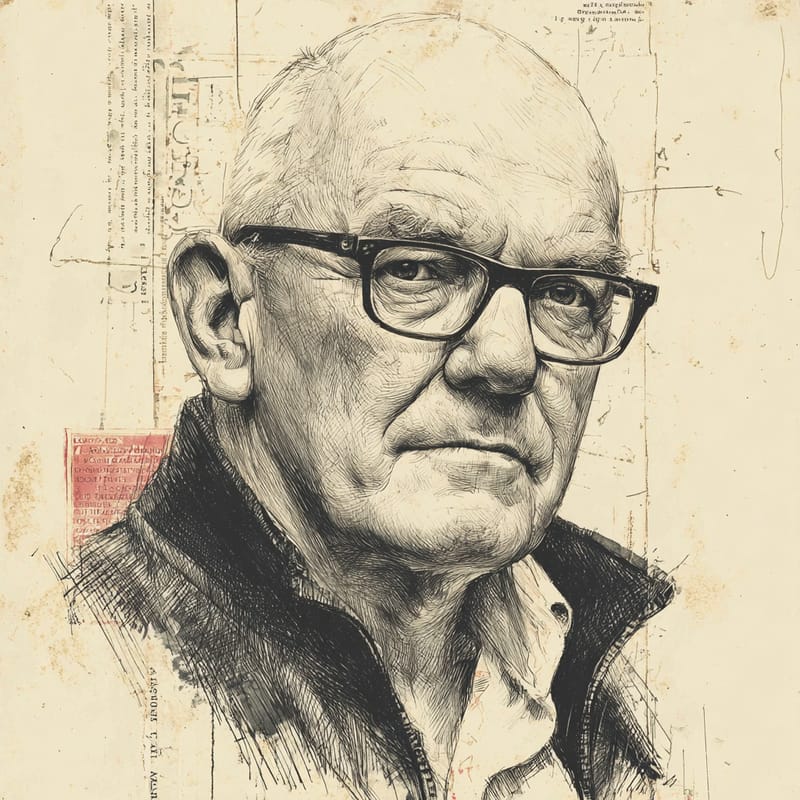
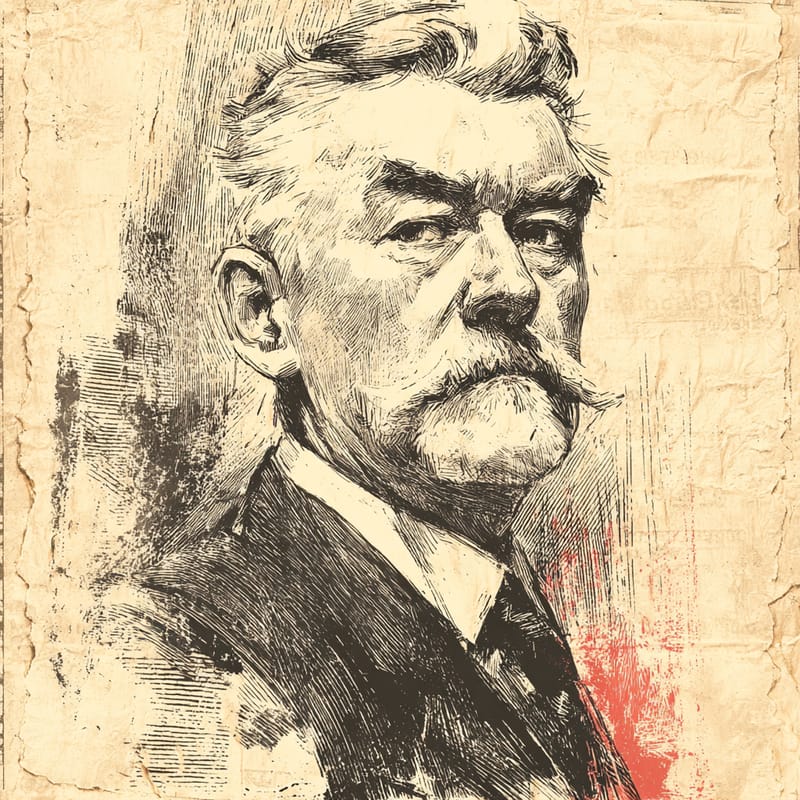
On the 99ideologies three-axis compass, the minds closest to Winston Churchill are Charles de Gaulle (98% alike), John Howard (97% alike) and Robert Menzies (96% alike). The furthest is Emma Goldman (9% alike).