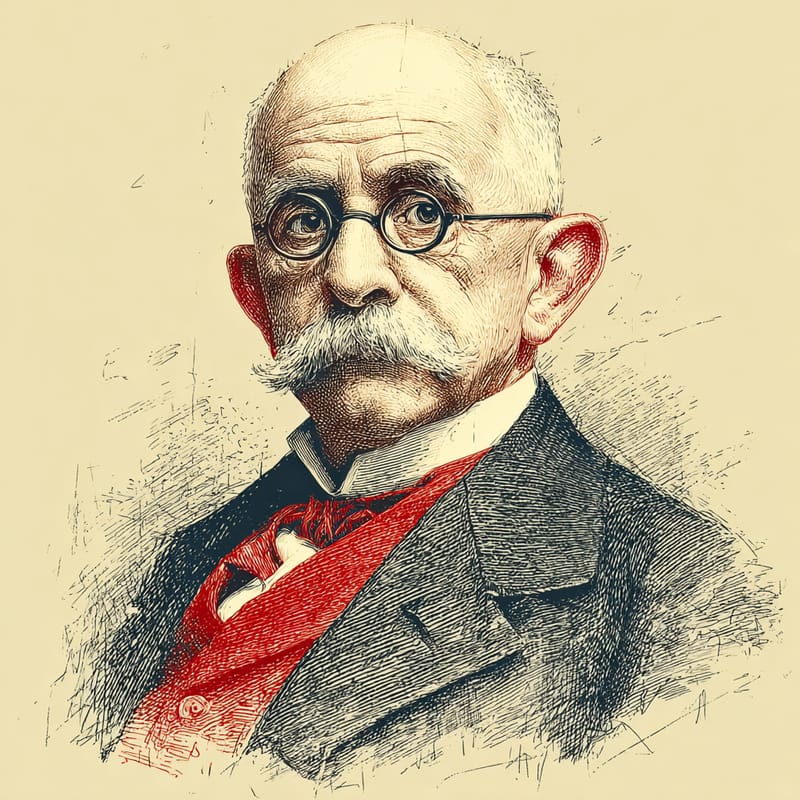
Ludwig von Mises
Human action
The impossibility of socialist calculation.
Rooted Classical LiberalOne of 729 ideologies · enter the Classical Liberal hall →- Role
- Economist
- Era
- 1881–1973
- Region
- Austria / US
- Social band
- Rooted
- Placement
- +60 · −50 · −15
§ Where Ludwig von Mises stands
3 axesMises argued in 'Economic Calculation in the Socialist Commonwealth' (1920) and Socialism (1922) that without private ownership of the means of production there are no market prices, and without prices planners cannot calculate costs. Human Action (1949) defended unhampered markets and the gold standard and blamed booms and busts on central-bank credit expansion. He rejected even the middle way of interventionism as unstable.
Mises wanted a state confined to protecting life, property and contract, a programme set out in Liberalism (1927), and he opposed price controls, inflationary finance and economic nationalism. He was no anarchist, defending government as the necessary apparatus of compulsion, and his pragmatic acceptance of authoritarian bulwarks against Bolshevism in the 1920s marks the limit of his anti-statism.
Mises was a secular rationalist who opposed paternalism, arguing in Human Action that a state entitled to ban drugs could equally censor books and ideas. But he defended the bourgeois order of family, property and contract against socialist cultural theories in Socialism (1922), and in The Anti-Capitalistic Mentality (1956) traced hostility to capitalism to resentment, which places him slightly on the traditional side.
How close are you to Ludwig von Mises?
Three statements, one per axis. Answer them and we’ll drop you on the compass next to them.
§ The story
HistoricalLudwig von Mises (1881–1973) was an Austrian-American economist, born in Lemberg in Austrian Galicia, now Lviv in Ukraine, and educated at the University of Vienna under Eugen von Böhm-Bawerk. His Theory of Money and Credit (1912) established his reputation. For a quarter of a century he worked as an economist for the Vienna Chamber of Commerce, advising governments and running a private seminar that helped train Friedrich Hayek and others, before leaving for Geneva in 1934 and the United States in 1940.
Mises's 1920 essay arguing that rational economic calculation is impossible without market prices opened the socialist calculation debate, and his treatise Human Action (1949) became the founding text of the modern Austrian school and a cornerstone of American libertarianism. In New York he led a seminar at NYU from 1945 to 1969, paid for by private donors. Critics fault his rejection of empirical testing, and his 1927 claim in Liberalism that Fascism had, for the moment, saved European civilisation, while calling it only an emergency makeshift, remains controversial.
Notable for
- 01'Human Action'
- 02The socialist calculation problem
- 03Dean of the Austrian School
Key works & moments
- 1912Publishes The Theory of Money and Credit.
- 1920Publishes 'Economic Calculation in the Socialist Commonwealth', launching the socialist calculation debate.
- 1922Publishes Socialism, a comprehensive critique of collectivist economics.
- 1927Publishes Liberalism and co-founds the Austrian Institute for Business Cycle Research with Hayek.
- 1940Emigrates to the United States after six years teaching in Geneva.
- 1949Publishes Human Action, his treatise on economics as the science of human choice.
In their own words
“Human action is purposeful behavior.”
“Where there is no free market, there is no pricing mechanism; without a pricing mechanism, there is no economic calculation.”
§ Minds closest to Ludwig von Mises
All minds →



§ Also in the Classical Liberal hall
Enter the hall →§ Common questions
4 answersWhat was Ludwig von Mises's political ideology?
Ludwig von Mises was an uncompromising classical liberal and the leading economist of the Austrian school: on the 99ideologies three-axis compass, a Rooted Classical Liberal. Economically he sat firmly on the market side (+60), defending private property, sound money and unhampered markets. On governance he wanted a minimal state (−50) confined to protecting life, property and contract. Socially he was slightly traditional (−15), a secular rationalist who defended bourgeois institutions against socialist critiques.
Was Ludwig von Mises left-wing or right-wing?
Right-wing in economic terms, though he called himself a liberal in the nineteenth-century sense. Mises opposed socialism, interventionism and the welfare state, and his ideas inspired the American libertarian movement and free-market conservatives. But he was a secular rationalist and an opponent of nationalism and protectionism rather than a cultural conservative, and he grounded his case for markets in reason and utility rather than religion or tradition. He is best described as a radical classical liberal.
What was Mises's economic calculation problem?
It is the argument that a socialist economy cannot allocate resources rationally. In his 1920 essay Mises argued that once the state owns all the means of production, there are no markets for capital goods and therefore no prices for them. Without such prices, planners cannot compare the costs of different ways of producing things or tell whether a project creates or destroys value. Socialist economists such as Oskar Lange answered with models of market socialism, and Hayek extended the case by stressing dispersed knowledge.
Which minds are closest to Ludwig von Mises?
On the 99ideologies three-axis compass, the minds closest to Ludwig von Mises are Friedrich Hayek (98% alike), William Gladstone (95% alike) and Alexis de Tocqueville (94% alike). The furthest is Pol Pot (8% alike).