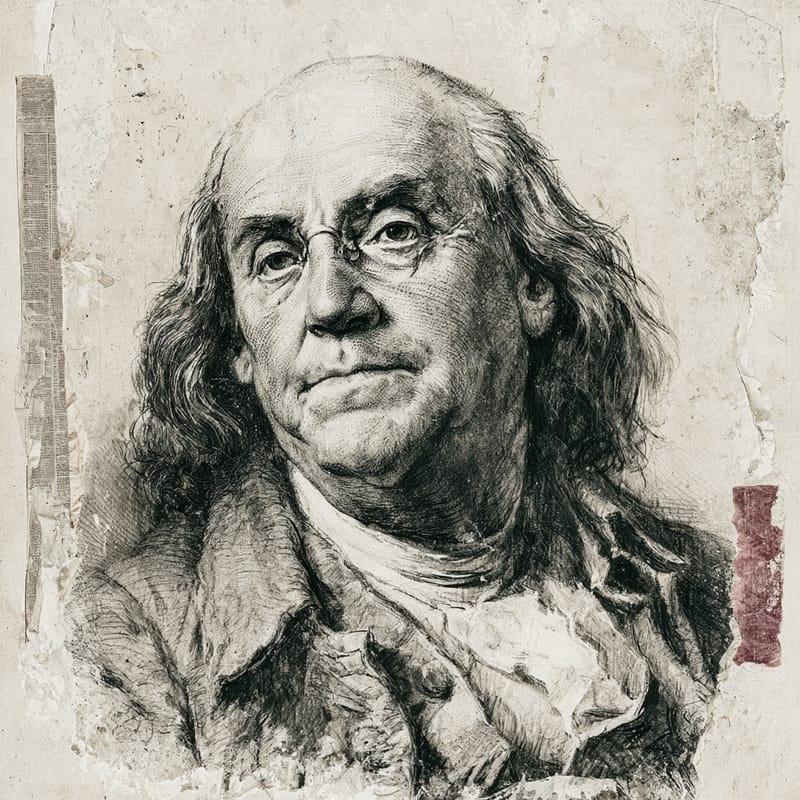
Benjamin Franklin
Fiscal ConservativeOne of 729 ideologies · enter the Fiscal Conservative hall →- Role
- —
- Era
- —
- Region
- —
- Social band
- Centre (no modifier)
- Placement
- +75 · 0 · 0
§ Where Benjamin Franklin stands
3 axesFranklin preached thrift and industry in Poor Richard's Almanack and The Way to Wealth (1758), and his 1766 essay On the Price of Corn and Management of the Poor argued that generous poor relief encouraged idleness. Yet he was no laissez-faire thinker: his 1729 pamphlet A Modest Enquiry into the Nature and Necessity of a Paper Currency defended public paper money, and he won public funds for the Pennsylvania Hospital.
Franklin sought union and stable government without concentrated power. His Albany Plan of 1754 proposed a common council for the colonies, and at the 1787 Constitutional Convention he urged delegates to sign despite their doubts. But he preferred a single-chamber legislature, presided over the convention that gave Pennsylvania a unicameral assembly and plural executive in 1776, and proposed that the president serve without pay.
Franklin was a deist who backed religious toleration and civic self-improvement. His views on race and immigration changed over his life: in his 1751 Observations Concerning the Increase of Mankind he complained that German immigrants were swamping Pennsylvania, and he owned enslaved people for decades, but in 1787 he became president of the Pennsylvania Abolition Society and in 1790 signed its petition asking Congress to abolish slavery.
How close are you to Benjamin Franklin?
Three statements, one per axis. Answer them and we’ll drop you on the compass next to them.
§ The story
HistoricalBenjamin Franklin (1706–1790) was an American printer, writer, scientist and statesman, one of the Founding Fathers of the United States. Born in Boston, the fifteenth child of a candle and soap maker, he left for Philadelphia at 17 and built a printing business, publishing the Pennsylvania Gazette and Poor Richard's Almanack. His experiments on electricity, published in London from 1751, made him internationally famous, and he founded a subscription library, a fire company, an academy that became the University of Pennsylvania and the American Philosophical Society.
Franklin served as Pennsylvania's agent in London, helped draft the Declaration of Independence in 1776 and, as American envoy in Paris, secured the 1778 alliance with France and helped negotiate the 1783 Treaty of Paris. At 81 he was the oldest delegate to the Constitutional Convention of 1787. A slaveholder for much of his life whose newspaper printed advertisements for the sale of enslaved people, he became president of the Pennsylvania Abolition Society in his last years and in 1790 signed its petition urging Congress to end slavery.
Key works & moments
- 1732Begins publishing Poor Richard's Almanack, a vehicle for maxims on thrift and industry.
- 1751Experiments and Observations on Electricity is published in London, making him famous across Europe.
- 1754Proposes the Albany Plan of Union for the American colonies.
- 1776Serves on the committee that drafts the Declaration of Independence.
- 1778Secures the treaty of alliance with France as American envoy in Paris.
- 1787Attends the Constitutional Convention and becomes president of the Pennsylvania Abolition Society.
In their own words
“Remember that Time is Money.”
“Those who would give up essential Liberty, to purchase a little temporary Safety, deserve neither Liberty nor Safety.”
§ Minds closest to Benjamin Franklin
All minds →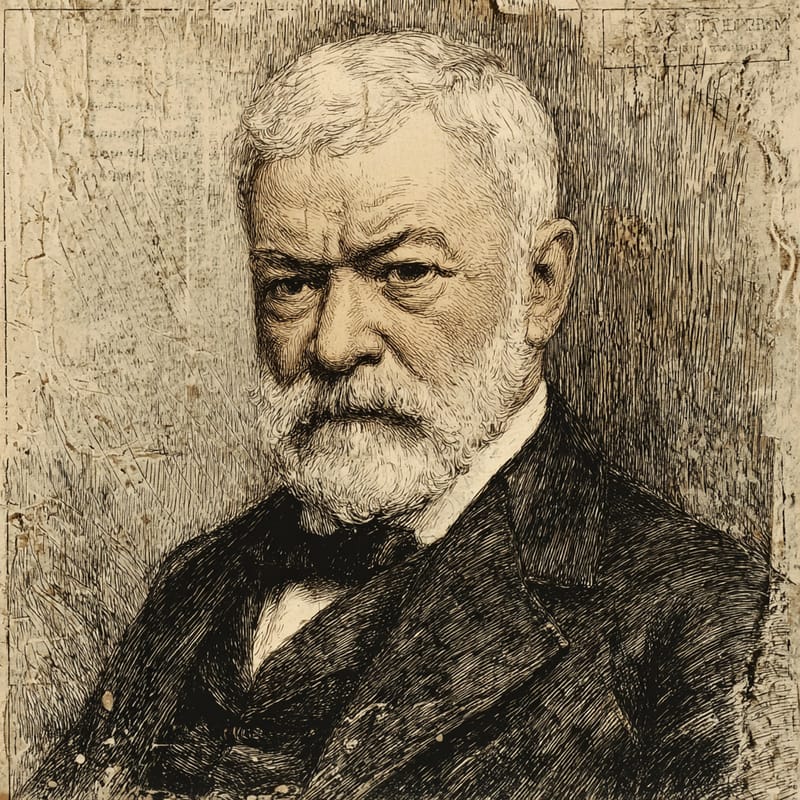




§ Also in the Fiscal Conservative hall
Enter the hall →§ Common questions
4 answersWhat was Benjamin Franklin's political ideology?
Benjamin Franklin was an Enlightenment republican who prized thrift, enterprise and civic self-help: on the 99ideologies three-axis compass, a Fiscal Conservative. Economically he sits firmly on the market side (+75), preaching industry and frugality and warning that generous poor relief bred idleness, though he also defended paper money. On governance he sits at the centre (0), seeking union and order while distrusting concentrated power. Socially he was a deist and advocate of religious toleration who ended his life as an abolitionist.
Was Benjamin Franklin left-wing or right-wing?
Neither label fits an eighteenth-century revolutionary neatly. Franklin's economic outlook, built on thrift, self-reliance and suspicion of generous poor relief, is associated today with the right, and he became a hero to American advocates of free enterprise. But he was also a radical democrat by the standards of his time, favouring a single-chamber legislature and an unpaid executive, a builder of public institutions and, in old age, an abolitionist, positions the left can also claim.
Did Benjamin Franklin own slaves?
Yes. Franklin owned several enslaved people over a period of decades, including household servants who travelled with him to London, and his Pennsylvania Gazette carried advertisements for the sale of enslaved people and for runaways. His views changed in later life: he came to condemn slavery as morally wrong and economically harmful, became president of the Pennsylvania Society for Promoting the Abolition of Slavery in 1787 and, in 1790, months before his death, signed its petition asking Congress to abolish slavery and the slave trade.
Which minds are closest to Benjamin Franklin?
On the 99ideologies three-axis compass, the minds closest to Benjamin Franklin are Andrew Carnegie (91% alike), Pete Peterson (91% alike) and Mario Monti (91% alike). The furthest is Pol Pot (16% alike).