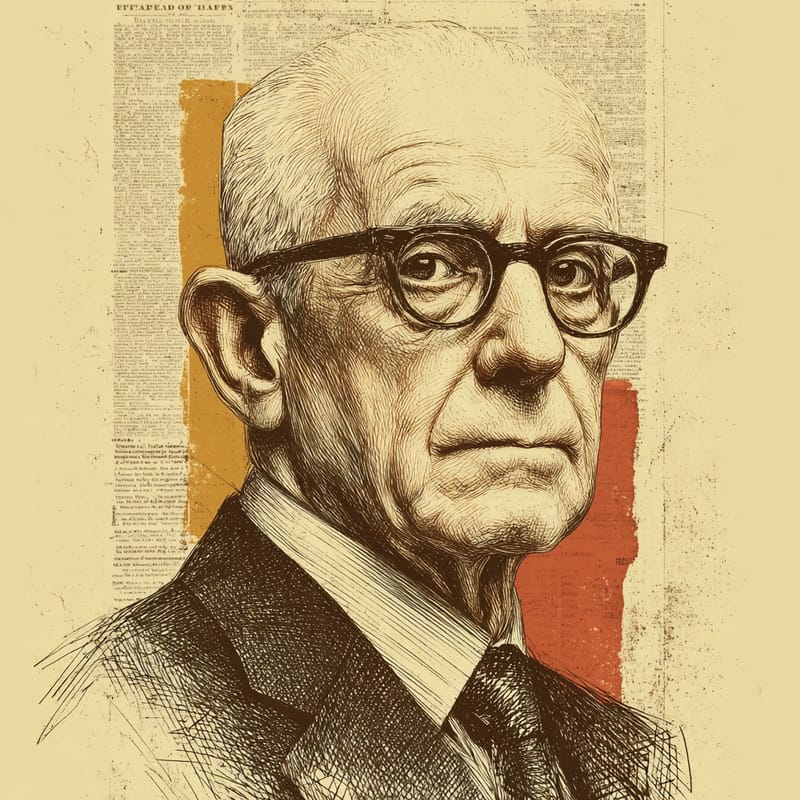
Mario Monti
The professor premier
An unelected cabinet of experts.
TechnocratOne of 729 ideologies · enter the Technocrat hall →- Role
- Prime Minister
- Era
- b. 1943
- Region
- Italy
- Social band
- Centre (no modifier)
- Placement
- +68 · +22 · +5
§ Where Mario Monti stands
3 axesMonti is a market liberal and fiscal hawk shaped by European competition policy. As commissioner he fined Microsoft €497 million in 2004, and as prime minister his December 2011 'Save Italy' decree raised the pension age, reintroduced a property tax on first homes and tightened the budget, followed by liberalisation of the professions and a 2012 labour reform. He nonetheless accepts a sizeable welfare state on the European model.
Monti embodies government by experts in an emergency. Appointed rather than elected in 2011, he led a cabinet of unelected specialists that depended on the parliamentary votes of rival parties, and in 2012 Italy wrote a balanced-budget rule into Article 81 of its constitution. He acted within constitutional procedures, however, and sought a popular mandate at the 2013 election.
On social questions Monti is a moderate with little interest in culture wars. His government concentrated on public finances rather than civil rights or family law, and his 2013 coalition joined his Civic Choice list with the Catholic-centrist UDC and Gianfranco Fini's Future and Freedom, a blend of secular liberals and Christian democrats that sat near the political centre.
How close are you to Mario Monti?
Three statements, one per axis. Answer them and we’ll drop you on the compass next to them.
§ The story
HistoricalMario Monti (born 1943) is an Italian economist who served as prime minister from November 2011 to April 2013. Educated at Milan's Bocconi University and at Yale, he taught economics and later led Bocconi as rector and president. He spent ten years in Brussels as a European commissioner, first for the internal market from 1995 and then for competition from 1999 to 2004, where his veto of the General Electric–Honeywell merger and his antitrust ruling against Microsoft earned him an international reputation.
When Italy's borrowing costs soared during the euro crisis and Silvio Berlusconi resigned in November 2011, President Giorgio Napolitano made Monti a senator for life and asked him to form a government of non-party experts. His cabinet raised taxes, reformed pensions and pushed through labour and market liberalisation, calming bond markets as the economy contracted and public resentment grew. His centrist coalition, built around his new Civic Choice list, finished a distant fourth in the 2013 election, and his tenure remains the textbook case of technocratic government and its political costs.
Notable for
- 01Led a technocratic government
- 02EU Competition Commissioner
- 03Euro-crisis austerity
Key works & moments
- 1995Becomes European commissioner for the internal market, nominated by Silvio Berlusconi's government.
- 2001As competition commissioner, blocks General Electric's takeover of Honeywell.
- 2004Fines Microsoft €497 million for abusing its dominant market position.
- 2011Appointed senator for life and prime minister; his 'Save Italy' decree raises the pension age.
- 2012Resigns in December after Berlusconi's party withdraws its parliamentary support.
- 2013Leads his new Civic Choice coalition to fourth place in the general election.
§ Minds closest to Mario Monti
All minds →

§ Also in the Technocrat hall
Enter the hall →§ Common questions
4 answersWhat is Mario Monti's political ideology?
Mario Monti is a liberal, pro-European technocrat: on the 99ideologies three-axis compass, a Technocrat. Economically he sits clearly on the market side (+68), favouring competition, liberalisation and balanced budgets within a European social model. On governance he leans towards expert authority (+22), having led an appointed cabinet of non-politicians, and socially he sits close to the centre (+5), avoiding cultural battles in favour of economic repair.
Is Mario Monti left-wing or right-wing?
Centre-right on economics but hard to place by party. Monti's austerity, pension reform and market liberalisation pleased business and the European Commission, and his own electoral support came largely from the centre and moderate right. Yet his government was backed in parliament by the centre-left Democratic Party as well as Berlusconi's People of Freedom, and he presented himself as above the left–right contest. He is best described as a liberal centrist technocrat.
Why was Mario Monti appointed prime minister?
Because Italy faced a debt crisis that its elected government could no longer manage. In autumn 2011 the gap between Italian and German bond yields widened sharply, raising fears that Italy might lose access to markets and threaten the euro. Silvio Berlusconi resigned on 12 November, and President Giorgio Napolitano, who had made Monti a senator for life days earlier, asked him to form a government of experts able to pass austerity measures that the main parties would support but not own.
Which minds are closest to Mario Monti?
On the 99ideologies three-axis compass, the minds closest to Mario Monti are Jean Monnet (97% alike), Robert McNamara (97% alike) and Hari Seldon (96% alike). The furthest is Emma Goldman (15% alike).