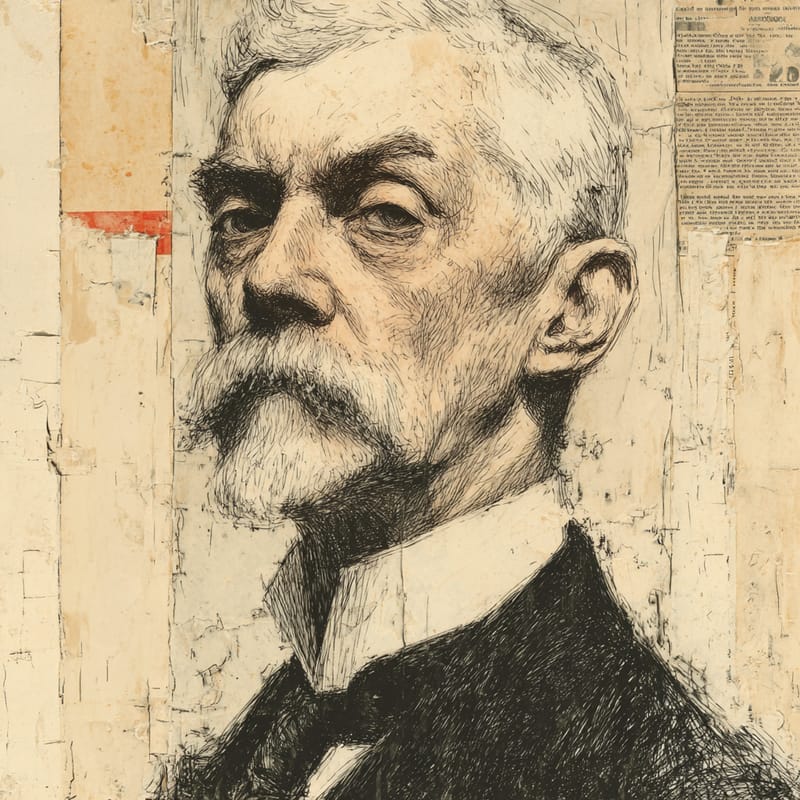
Andrew Mellon
The Mellon Plan
Cut taxes, cut debt, free the market.
Traditional Fiscal ConservativeOne of 729 ideologies · enter the Fiscal Conservative hall →- Role
- Treasury Secretary
- Era
- 1855–1937
- Region
- United States
- Social band
- Traditional
- Placement
- +78 · +6 · −46
§ Where Andrew Mellon stands
3 axesMellon's Taxation: The People's Business (1924) argued that lower rates would raise revenue by drawing capital out of tax-exempt bonds into productive enterprise, and the Revenue Acts of 1921, 1924 and 1926 cut the top income-tax rate to 25 per cent while budget surpluses paid down the war debt. Yet he kept the income tax graduated and argued that earned income should be taxed more lightly than income from investments.
Mellon was a pragmatic steward of federal finance rather than a crusader against the state: he served three presidents and ran the Treasury as a professional institution, which housed the new Bureau of the Budget created in 1921 to centralise federal spending plans. But his extensive business holdings while in office prompted an impeachment resolution in 1932, which Hoover defused by sending him to London as ambassador.
Mellon was a reserved patrician whose social values were family, property and inherited order. In the mid-1920s he pressed Congress to cut, and ideally abolish, the federal estate tax that fell on great family fortunes, and his department enforced Prohibition until 1930. His gift of European old masters to found the National Gallery of Art in 1937 reflected a conservator's reverence for tradition.
How close are you to Andrew Mellon?
Three statements, one per axis. Answer them and we’ll drop you on the compass next to them.
§ The story
HistoricalAndrew William Mellon (1855–1937) was an American banker, industrialist and art collector who served as Secretary of the Treasury from 1921 to 1932. The son of Thomas Mellon, a Pittsburgh judge turned banker, he took control of the family bank in 1882 and used it to finance young industrial companies, among them the aluminium maker that became Alcoa and Gulf Oil, becoming one of the richest men in the United States. Warren Harding appointed him to the Treasury in 1921, and he stayed on under Calvin Coolidge and Herbert Hoover.
Mellon's policies lowered the top income-tax rate from 73 to 25 per cent and cut the national debt by roughly a third, and admirers called him the greatest Treasury secretary since Alexander Hamilton. The 1929 crash and the Depression destroyed that reputation, and Hoover's memoirs cast him as the chief advocate of letting the slump run its course. Facing an impeachment resolution over conflicts of interest, he became ambassador to Britain in 1932. A grand jury declined to indict him for tax evasion in 1934, and his art collection founded the National Gallery of Art.
Notable for
- 01The 'Mellon Plan' tax cuts
- 02Cut the national debt in the 1920s
- 03Treasury Secretary 1921–1932
Key works & moments
- 1882Takes control of his father's Pittsburgh bank, T. Mellon & Sons.
- 1921Appointed Treasury secretary by Warren Harding; stays on under Coolidge and Hoover.
- 1924Publishes Taxation: The People's Business, setting out the case for lower tax rates.
- 1926The Revenue Act of 1926 cuts the top income-tax rate to 25 per cent.
- 1932Faces an impeachment resolution and leaves the Treasury to become ambassador to Britain.
- 1937Congress establishes the National Gallery of Art with his collection; he dies that August.
In their own words
“The history of taxation shows that taxes which are inherently excessive are not paid.”
§ Minds closest to Andrew Mellon
All minds →



§ Also in the Fiscal Conservative hall
Enter the hall →§ Common questions
4 answersWhat was Andrew Mellon's political ideology?
Andrew Mellon was a Republican banker and fiscal conservative of the 1920s: on the 99ideologies three-axis compass, a Traditional Fiscal Conservative. Economically he sat firmly on the market side (+78), cutting the top income-tax rate from 73 to 25 per cent and paying down the war debt. On governance he was close to the centre (+6), a professional steward of the Treasury rather than an enemy of the state, and socially he was traditional (−46), a patrician devoted to family wealth, property and inherited order.
Was Andrew Mellon left-wing or right-wing?
Right-wing. Mellon was the leading economic voice of the Republican administrations of the 1920s, cutting taxes on high incomes and estates and defending business against government interference. Critics then and since have seen his policies as favouring the rich, himself included. Yet his tax laws also raised exemptions so that most low earners paid no income tax, he argued for taxing earned income more lightly than investment income, and he believed in balanced budgets rather than unfunded tax cuts.
What was the Mellon Plan?
The Mellon Plan was Andrew Mellon's programme of tax reduction as Treasury secretary in the 1920s. He argued, notably in his 1924 book Taxation: The People's Business, that high wartime top rates drove wealthy investors into tax-exempt bonds, so cutting rates would revive enterprise and could even raise revenue. Through the Revenue Acts of 1921, 1924 and 1926 Congress cut the top rate to 25 per cent while raising exemptions for ordinary earners. Supply-side economists later cited it as a precedent for the Reagan tax cuts.
Which minds are closest to Andrew Mellon?
On the 99ideologies three-axis compass, the minds closest to Andrew Mellon are Ebenezer Scrooge (counting-house archetype) (98% alike), Phil Gramm (97% alike) and Paul Ryan (96% alike). The furthest is Emma Goldman (5% alike).