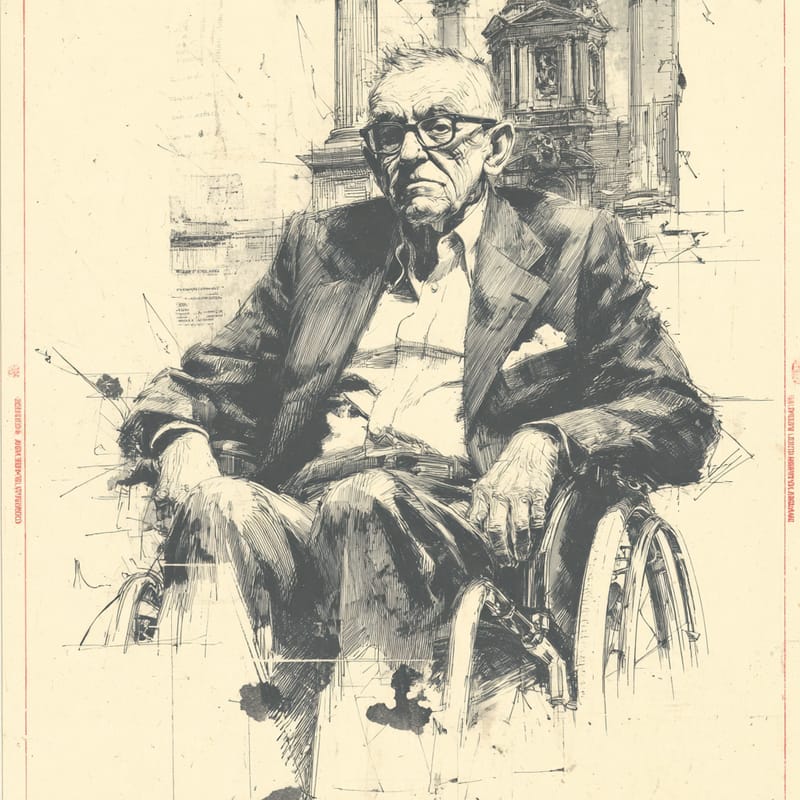
Wolfgang Schäuble
The black zero
Europe's apostle of austerity.
Rooted Fiscal ConservativeOne of 729 ideologies · enter the Fiscal Conservative hall →- Role
- Finance Minister
- Era
- 1942–2023
- Region
- Germany
- Social band
- Rooted
- Placement
- +66 · +10 · −30
§ Where Wolfgang Schäuble stands
3 axesAs finance minister Schäuble pursued the schwarze Null, a federal budget without new borrowing, and in 2014 the federal budget balanced for the first time since 1969 under the constitutional debt brake of 2009. In the euro crisis he tied rescue loans to austerity and in 2015 floated a temporary Greek exit from the euro, yet as a Christian Democrat he upheld the social market economy.
Schäuble was a parliamentarian for more than half a century and, as interior minister in 1990, took Germany to unity through a negotiated treaty under the Basic Law. In his second spell at the interior ministry from 2005 he pressed for stronger security powers, including covert online searches of suspects' computers, authorised for the Federal Criminal Police Office in 2008, and argued for using the army at home against terrorism.
A Protestant Christian Democrat, Schäuble stood for family, faith and national cohesion, and as interior minister introduced a nationwide citizenship test in 2008 and a 2007 rule requiring many spouses joining immigrants to show basic German first. He also launched the German Islam Conference in 2006, a standing dialogue between the state and Muslim organisations, which tempered his conservatism with an integrationist streak.
How close are you to Wolfgang Schäuble?
Three statements, one per axis. Answer them and we’ll drop you on the compass next to them.
§ The story
HistoricalWolfgang Schäuble (1942–2023) was a German Christian Democrat who sat in the Bundestag from 1972 until his death, longer than anyone in German parliamentary history. A lawyer and former tax official from Baden, he became Helmut Kohl's chief of staff in 1984 and, as interior minister, negotiated the 1990 Unification Treaty with East Germany. Nine days after unification a gunman shot him at a campaign event, leaving him paralysed, and he used a wheelchair for the rest of his life.
Schäuble led the CDU/CSU parliamentary group through the 1990s and was long seen as Kohl's heir, but in 2000 he resigned as party leader after admitting he had accepted a cash donation from the arms dealer Karlheinz Schreiber that was not properly recorded, opening the way for Angela Merkel. He returned as Merkel's interior minister and, from 2009 to 2017, finance minister, when his insistence on balanced budgets and austerity for bailed-out countries made him the face of German policy in the euro crisis. He ended his career as president of the Bundestag.
Notable for
- 01'Schwarze Null' balanced budgets
- 02Euro-crisis austerity
- 03Longest-serving Bundestag member
Key works & moments
- 1972Elected to the Bundestag, where he sits for the rest of his life.
- 1990Negotiates the Unification Treaty with East Germany; shot and paralysed at a campaign event in October.
- 1991His Bundestag speech helps swing the vote to move the capital from Bonn to Berlin.
- 2000Resigns as CDU leader amid the party's illegal-donations scandal.
- 2014As finance minister, achieves the first federal budget without new borrowing since 1969.
- 2017–21Serves as president of the Bundestag.
§ Minds closest to Wolfgang Schäuble
All minds →

§ Also in the Fiscal Conservative hall
Enter the hall →§ Common questions
4 answersWhat was Wolfgang Schäuble's political ideology?
Wolfgang Schäuble was a Christian Democrat and Europe's best-known fiscal hawk: on the 99ideologies three-axis compass, a Rooted Fiscal Conservative. Economically he sat firmly on the market side (+66), insisting on balanced budgets and austerity while upholding Germany's social market economy. On governance he leaned slightly authoritarian (+10), pressing for stronger security powers as interior minister, and socially he was moderately traditional (−30), a Protestant conservative who nonetheless opened a formal dialogue with Germany's Muslims.
Was Wolfgang Schäuble left-wing or right-wing?
Centre-right. Schäuble spent his whole career in the Christian Democratic Union, Germany's main conservative party, and was best known for fiscal discipline and a hard line toward indebted euro countries, which made him a hate figure for much of the European left. But he was a committed European integrationist who co-wrote a 1994 paper proposing a core Europe moving ahead on union, accepted the welfare state and served in grand coalitions with the Social Democrats, placing him in the moderate mainstream rather than on the hard right.
What is the schwarze Null?
The schwarze Null, or black zero, is the German term for a federal budget balanced without new borrowing, the black alluding to accounts kept in the black, and it became his signature as finance minister from 2009 to 2017. Working within the debt brake added to the Basic Law in 2009, he achieved the first federal budget without new debt since 1969 in 2014. Supporters credited it with restoring confidence in German public finances; critics, including many economists, argued it starved Germany of public investment in infrastructure.
Which minds are closest to Wolfgang Schäuble?
On the 99ideologies three-axis compass, the minds closest to Wolfgang Schäuble are Paul Ryan (96% alike), Pete Peterson (95% alike) and José María Aznar (95% alike). The furthest is Emma Goldman (11% alike).