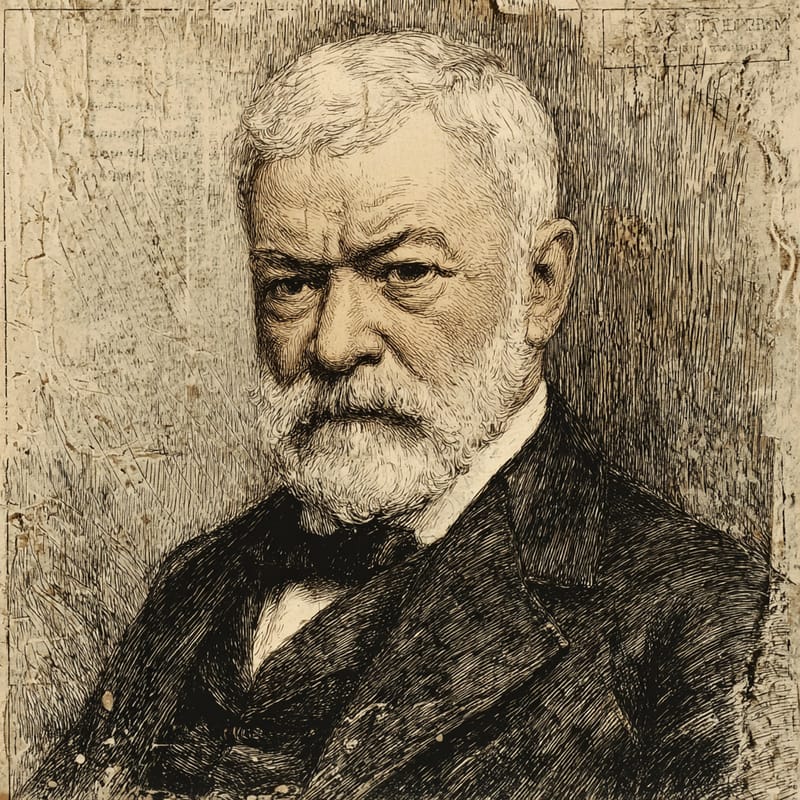
Andrew Carnegie
The gospel of wealth
Ruthless markets, then philanthropy.
CapitalistOne of 729 ideologies · enter the Capitalist hall →- Role
- Industrialist
- Era
- 1835–1919
- Region
- Scotland / US
- Social band
- Centre (no modifier)
- Placement
- +94 · +6 · −10
§ Where Andrew Carnegie stands
3 axesCarnegie built his empire on relentless cost-cutting, vertical integration and long hours at low pay, and his 1889 essay Wealth defended great fortunes as the reward of ability and the engine of progress. Yet he argued that the rich were trustees obliged to give their money away in their lifetimes and welcomed heavy taxes on large estates left at death, a concession that keeps him short of the market pole.
Carnegie sought power through industry rather than office and treated the state pragmatically: his steel prospered behind protective tariffs, and at Homestead in 1892 the Pennsylvania militia restored the plant to company control after the battle with the Pinkertons. He also campaigned against the annexation of the Philippines in 1898–99 and funded the Peace Palace in The Hague to promote international arbitration.
Carnegie mixed social Darwinism, learned from Herbert Spencer, with a radical's faith in self-improvement: his libraries were meant to let poor boys educate themselves as he had, and his 1886 book Triumphant Democracy celebrated American republicanism over British monarchy and aristocracy. He was sceptical of organised religion and opposed imperial conquest, a mix that leaves him close to the social centre.
How close are you to Andrew Carnegie?
Three statements, one per axis. Answer them and we’ll drop you on the compass next to them.
§ The story
HistoricalAndrew Carnegie (1835–1919) was a Scottish-born American industrialist whose steel company made him one of the richest men in history. Born in Dunfermline to a handloom weaver whose trade was being destroyed by mechanisation, he emigrated with his family to Allegheny, Pennsylvania, in 1848 and worked as a bobbin boy and telegraph messenger. As a protégé of Thomas A. Scott at the Pennsylvania Railroad he learned modern management and invested in bridges, sleeping cars and oil before opening his first steelworks in the 1870s.
Carnegie Steel dominated American steelmaking through relentless cost-cutting, vertical integration and the Bessemer process, and in 1901 he sold it to J. P. Morgan for about $480 million, creating U.S. Steel. His reputation was stained by the 1892 Homestead strike, when his partner Henry Clay Frick brought in Pinkerton guards and a gun battle left workers and guards dead. Carnegie then gave away about 90 per cent of his fortune, funding more than 2,500 public libraries, Carnegie Hall, research institutions and the Carnegie Endowment for International Peace.
Notable for
- 01Built Carnegie Steel
- 02'The Gospel of Wealth'
- 03Funded thousands of libraries
Key works & moments
- 1848Emigrates from Dunfermline to Pennsylvania and starts work as a bobbin boy in a cotton mill.
- 1875Opens the Edgar Thomson Steel Works near Pittsburgh, using the Bessemer process.
- 1889Publishes Wealth, later known as The Gospel of Wealth, urging the rich to give their fortunes away.
- 1892Strikers and Pinkerton guards fight at his Homestead works; the union is broken.
- 1901Sells Carnegie Steel to J. P. Morgan for about $480 million, creating U.S. Steel.
- 1911Endows the Carnegie Corporation of New York to carry on his philanthropy.
In their own words
“The man who dies thus rich dies disgraced.”
§ Minds closest to Andrew Carnegie
All minds →



§ Also in the Capitalist hall
Enter the hall →§ Common questions
4 answersWhat was Andrew Carnegie's political ideology?
Andrew Carnegie was a self-made industrial capitalist with a philanthropic creed: on the 99ideologies three-axis compass, a Capitalist. Economically he sat near the market pole (+94), defending great fortunes as the reward of enterprise while urging the rich to give them away and backing heavy taxes on large estates. On governance he was close to the centre (+6), pragmatic about tariffs and the state, and socially he sat near the centre (−10), a social Darwinist who also championed self-education, republicanism and peace.
Was Andrew Carnegie left-wing or right-wing?
Mostly right-wing in economics, but hard to label. Carnegie built his fortune by crushing competitors and unions and defended inequality as the price of progress, positions associated with the right. Yet he called for steep estate taxes, declared that a man who dies rich dies disgraced, praised republican democracy over aristocracy and backed the Anti-Imperialist League against the annexation of the Philippines. He is best seen as a classical liberal of the Gilded Age with an unusually demanding sense of the duties of wealth.
What is The Gospel of Wealth?
It is the popular name for Andrew Carnegie's essay Wealth, published in the North American Review in June 1889. Carnegie argued that competition and the concentration of wealth were beneficial, but that rich men were only trustees of their fortunes, obliged to spend them during their lifetimes on institutions that helped others help themselves, such as libraries, universities and parks. He condemned leaving huge fortunes to heirs and praised heavy taxes on large estates. Carnegie followed his own advice, giving away most of his fortune before his death in 1919.
Which minds are closest to Andrew Carnegie?
On the 99ideologies three-axis compass, the minds closest to Andrew Carnegie are Cornelius Vanderbilt (96% alike), George Washington (95% alike) and John Adams (95% alike). The furthest is Emma Goldman (7% alike).