
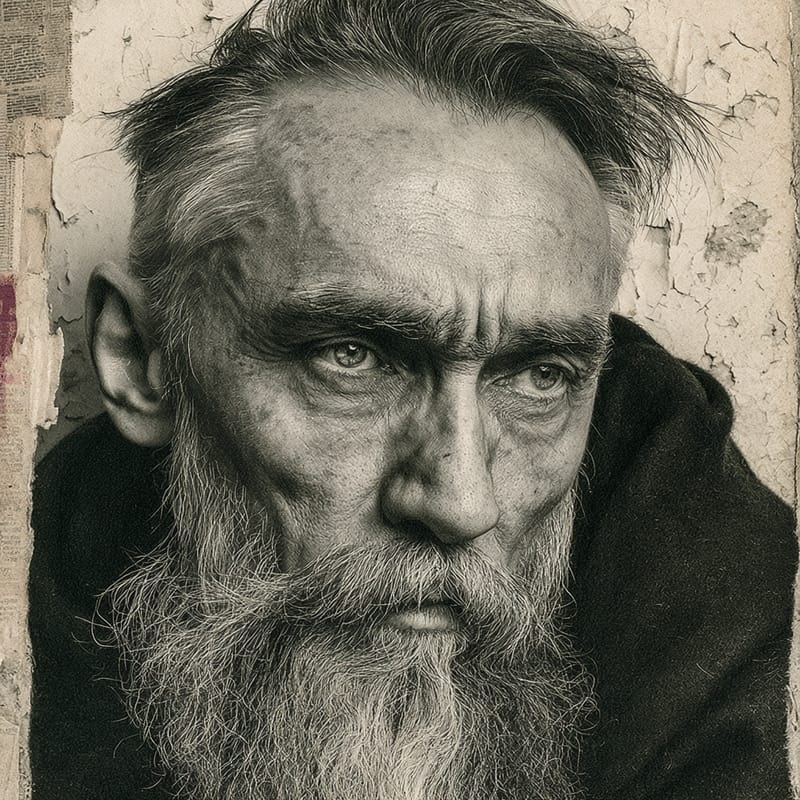
O'Brien
The boot stamping forever
Power as its own absolute end.
Leninist-MarxistOne of 729 ideologies · enter the Leninist-Marxist hall →- Role
- Inner Party official (fiction)
- From
- Nineteen Eighty-Four
- Region
- Oceania
- Social band
- Centre (no modifier)
- Placement
- −90 · +85 · 0
§ Where O'Brien stands
3 axesUnder Ingsoc the Party collectively owns everything. O'Brien's world has no private property, and Goldstein's book, which O'Brien admits he helped to write, explains that the Inner Party rules as a collective oligarchy rather than as individual owners. Scarcity is engineered through permanent war so that the masses stay poor and dependent, making the economy an instrument of power rather than welfare.
O'Brien is totalitarianism stated without pretence. In Part Three he tells Winston that the Party is not interested in the good of others, only in power, and that a revolution is made in order to establish a dictatorship. He uses torture, starvation and the terror of Room 101 not to extract information but to remake Winston's mind until he loves Big Brother.
O'Brien's Party destroys inherited loyalties: he boasts that it has cut the links between child and parent and between man and woman, and that in future there will be no loyalty except to the Party. Yet it also enforces sexual puritanism through the Junior Anti-Sex League and demands total conformity, so its war on tradition liberates no one.
How close are you to O'Brien?
Three statements, one per axis. Answer them and we’ll drop you on the compass next to them.
§ The story
FictionO'Brien is a member of the Inner Party in George Orwell's novel Nineteen Eighty-Four, published in 1949. A large, urbane man with a habit of resettling his spectacles on his nose, he wins Winston Smith's trust by hinting that he belongs to the Brotherhood, a secret resistance, and invites Winston and Julia to his flat to join it. The invitation is a trap: O'Brien has watched Winston for seven years, and after the lovers' arrest he becomes Winston's interrogator and torturer in the Ministry of Love.
O'Brien is Orwell's portrait of the totalitarian intellectual. Where Big Brother is only a face on a poster, O'Brien explains the system: the Party seeks power entirely for its own sake, reality is whatever the Party says it is, and the future is endless domination. Critics have read him as a distillation of the Stalinist interrogator and the show trial, and his name has become shorthand for cold, ideological cruelty. Richard Burton played him in the 1984 film adaptation, his last screen role.
Notable for
- 01Embodies the totalitarian state (in-story)
- 02'A boot stamping on a human face — forever'
- 03Reeducates Winston Smith
Key works & moments
- 1949George Orwell publishes Nineteen Eighty-Four, with O'Brien as the Inner Party member Winston trusts.
- Part OneWinston dreams of O'Brien promising they will meet in the place where there is no darkness.
- Part TwoPosing as a Brotherhood member, O'Brien arranges for Winston to receive Goldstein's forbidden book.
- Part ThreeIn the Ministry of Love, O'Brien tortures Winston until he sees five fingers when four are shown.
- Part ThreeIn Room 101, facing caged rats, Winston betrays Julia, completing O'Brien's work.
- 1984Richard Burton plays O'Brien opposite John Hurt in Michael Radford's film, his final screen role.
In O'Brien's words
“If you want a picture of the future, imagine a boot stamping on a human face – for ever.”
“Power is not a means; it is an end.”
§ Minds closest to O'Brien
All minds →



§ Also in the Leninist-Marxist hall
Enter the hall →§ Common questions
4 answersWhat is O'Brien's political ideology?
O'Brien is a true believer in Ingsoc, the ruling creed of Oceania in Orwell's Nineteen Eighty-Four: on the 99ideologies three-axis compass, a Leninist-Marxist. Economically his Party sits at the collectivist extreme (−90), owning everything and everyone. On governance it is near-total dictatorship (+85), sustained by surveillance and torture. Socially it lands at the centre (0), because its destruction of family and tradition is matched by rigid puritanism and enforced conformity.
Is O'Brien left-wing or right-wing?
Neither, in any meaningful sense. The Party's ideology is officially English Socialism and its economy is wholly collectivised, which places it on the left economically, but O'Brien openly dismisses equality and human welfare as goals: the Party wants power and nothing else. Orwell, a democratic socialist, designed him to show that totalitarianism of left or right ends in the same place, a ruling caste that worships power for its own sake.
What does O'Brien mean by a boot stamping on a human face?
It is his summary of the Party's goal. In Part Three of Nineteen Eighty-Four, after explaining that the Party seeks power purely for its own sake, O'Brien tells Winston that power lies in inflicting pain and humiliation, and that the future will be endless domination with no victory for the oppressed. The image is Orwell's warning that power, once freed from any ideal, becomes an end in itself, and it is among the most quoted lines in political fiction.
Which minds are closest to O'Brien?
On the 99ideologies three-axis compass, the minds closest to O'Brien are Enver Hoxha (97% alike), Leonid Brezhnev (95% alike) and Karl Radek (94% alike). The furthest is Hans-Hermann Hoppe (0% alike).